
A five step plan for fixing the Nashville Predators
There's being stuck between a rock and a hard place… and then there's being stuck where the Nashville Predators are right now. Stuck with an under performing team full of too many immovable contracts. Stuck with a general manager who has a lifetime contract. Stuck in the muddy middle of the NHL standings, unwilling to […]

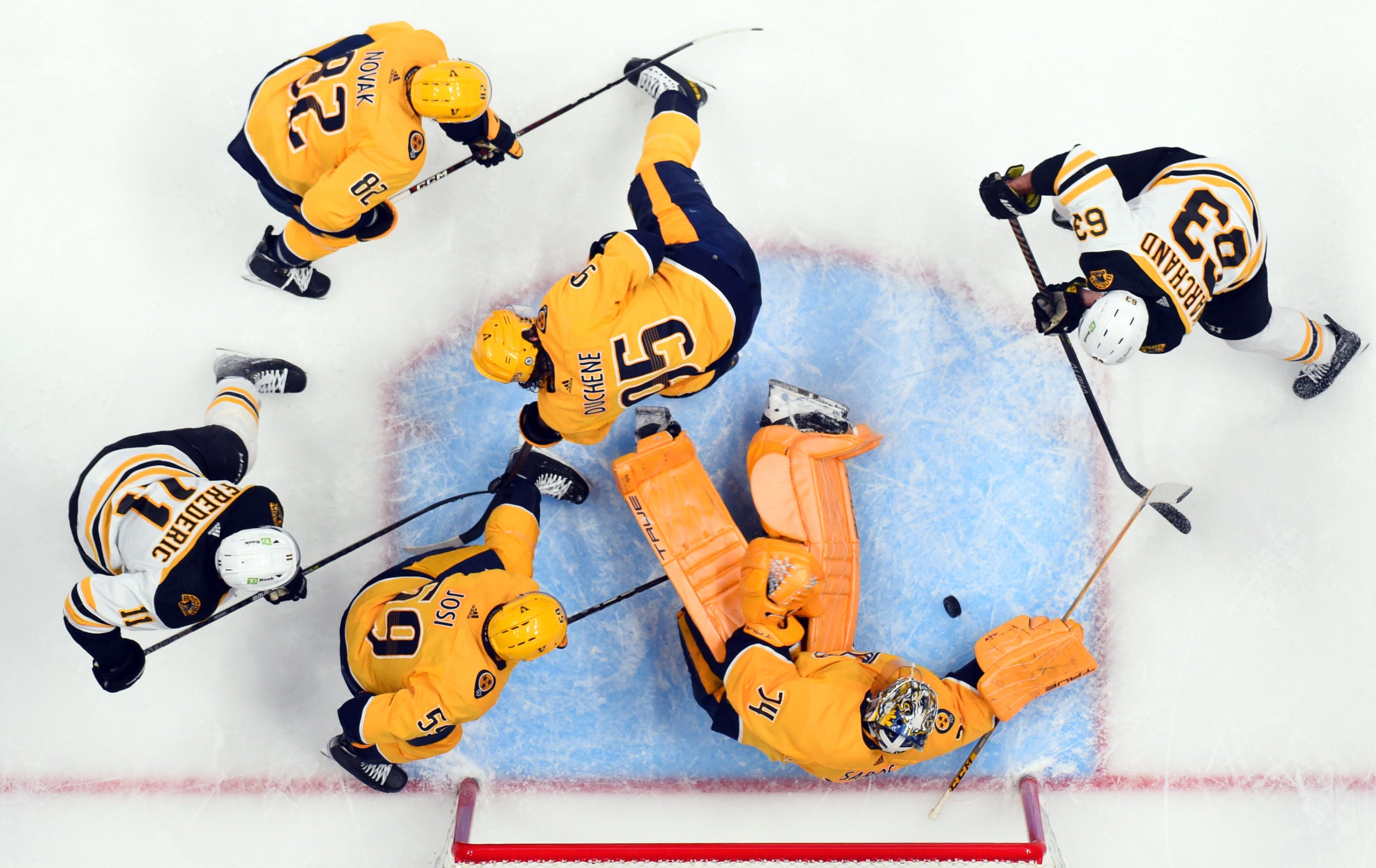
There's being stuck between a rock and a hard place… and then there's being stuck where the Nashville Predators are right now.
Stuck with an under performing team full of too many immovable contracts. Stuck with a general manager who has a lifetime contract. Stuck in the muddy middle of the NHL standings, unwilling to sink to the bottom for a chance at a generational player to change the course of the franchise. Stuck with a fanbase that is increasingly apathetic and more unwilling every day to commit to rising season ticket prices.
How did they find themselves in such an uncomfortable position?
It seems like only yesterday hundreds of thousands of gold jerseys swarmed Broadway to watch the Preds advance to the Stanley Cup Final for the first time in franchise history. Wasn't it just the other day that David Poile accepted the GM of the Year Award for his efforts that year? And then 12 months later, accepted the team's first ever Presidents' Trophy?
Has it really been six years since this franchise peaked?
Hard to believe.
Though in other ways, the last six years have seemed endless. Plotting a labyrinthine path of free agency signings, trade deadline deals, staff changes, and contract negotiations, David Poile has been chasing that 2017 high for years now, dragging the rest of the fanbase along with him.
And it's led to the current state of the franchise: on the verge of a complete re-haul.
But how do they get out of this mess? How do you fix the Nashville Predators? How do they get back to being a competitive team again?
Here's a five step plan that I think could work.
Step one: Part ways with David Poile
In some ways, this is the easiest of the five steps. All it requires is not renewing Poile's annually renewable contract at the end of the season. A quick meeting with the owners and it's "sorry, but we are going in a different direction, thank you for a wonderful 25 years" and it's done.
But in other ways, this will be the hardest of the five steps.
Not renewing David Poile's contract would be a complete personality change, not only for the ownership group, but for the franchise overall. Nashville's professional hockey team has only ever had one man in charge of the roster. Poile was here in the beginning and he's been here for the entire run.
A 25-year old marriage ending in divorce? That doesn't happen often in professional sports.
But Poile's skills at building a competitive roster have waned. The sport has changed considerably since he began his career in 1972, and for nearly all of it, Poile has been at the forefront of roster trends, scouting, drafting, trades, and more. He has mastered all of the tools a GM needs to master to make a roster competitive, save the mysterious one he still needs to make an actual Stanley Cup winner.
But the last six years have shown us that it's time he step aside. The current mess the team is in is almost entirely his doing.
Who takes his place? Assistant GM and Milwaukee Admirals GM Scott Nichol would be an excellent option. His work has been important in keeping the Admirals competitive in the AHL despite many players graduating to the NHL. His partnership with Karl Taylor has been crucial in the team's development of young players.
Step two: Assess coaching staff; make changes as necessary
I realize many people place most of the blame for this year's disappointing team at the feet of John Hynes. There's a lot of reasons for that. His decisions to bench players like Cody Glass and Tommy Novak, his lack of trust in Seattle Kraken Hall of Famer Eeli Tolvanen, and his overall inability to extract quality seasons out of key veterans like Mikael Granlund, Ryan Johansen, and Matt Duchene are all key pieces of evidence against him.
But the story on John Hynes as coach of the Preds doesn't only take place in the 2022-23 season.
What about Hynes' work to re-tool Mikael Granlund, who was a lost cause under Peter Laviolette, into a 60-point playmaking forward again? What about the overwhelming offensive seasons for Filip Forsberg and Matt Duchene in 2022? What about the development of young players like Alex Carrier, Tanner Jeannot, and Yakov Trenin?
The case against Hynes is not as simple as "he's a bad coach" or "he hasn't won anything yet". We all remember that Barry Trotz was seen as an average coach years before leaving Nashville in 2014. Then suddenly, when he got a generational Hall of Famer on his roster in Alex Ovechkin, his team won the Stanley Cup.
NHL head coaches can be tough to assess.
Jared Bednar, Mike Sullivan, Jon Cooper. All coaches who "hadn't won anything" until finally, when they got Hall of Fame rosters, they did win something. In fact, they won several somethings.
Lindy Ruff, Pete DeBoer, Rick Bowness. All coaches who have never won anything, yet continue to still get head coaching jobs.
Peter Laviolette, John Tortorella, Darryl Suter. All coaches who won Stanley Cups early in their careers, but have not won anything since. If "winning something" is the key to making a good hire, why haven't these coaches found success with their subsequent teams?
Because, again, NHL head coaches are tough to assess. A GM has to evaluate if the coach is a net positive for the roster and if he's maximizing the roster provided.
Is John Hynes getting the most out of all of his players? No.
Is John Hynes getting the most of out some of his players? Yes.
Is that enough? I don't know.
Let the new GM make that call after a strict assessment of the current coaching staff. If he feels like a new staff is needed, let him make the call. If he wants to keep Hynes around, thats fine too.
Step three: Package sweeteners with bad contracts
This is very important step. A new GM (and possibly a new coach) cannot be the only changes ahead of the 2023-24 season.
Going into next year with this same group of player would be verifiably insane.
The problem is, many of the contracts you'd like to move are not going to be easy to move. The Preds will have to bite the bullet and package a top prospect with one of their big contracts. It's going to hurt, but they have to do it.
Package one of these contracts:
- Ryan Johansen
- Mikael Granlund
- Matt Duchene
With one of these prospects:
- Luke Evangelista
- Egor Afanasyev
- Zach L'Heureux
Doing this would reduce the likelihood of retaining any salary, helping resolve your most immediate cap needs, while also freeing up the future of the roster.
Of those options above, I would suggest packaging Ryan Johansen with Luke Evangelista. A team like Ottawa, Detroit, or Anaheim (all of which have cap room) might be willing to take on the rest of Johansen's contract (two more years at $8 million per year) if he came with a young skilled forward like Evangelista.
Parting with any of these three forwards will hurt forward prospect outlook. However, I am not including Joakim Kemell on the list. He might end up being the best forward prospect in the system anyway, so you'd still have him.
Step four: Acquire draft capital
A lot of folks want the Nashville Predators to tank their way to the top. I am here to tell you 1) that will never happen and 2) most of the time it doesn't work.
I won't go off on a tangent on why tanking doesn't guarantee anything, except to say that for every Chicago, Colorado, and Los Angeles, there is an Ottawa, Buffalo, and Arizona. It's risky and it's just as likely to end up hurting your franchise in the long run as it is to earn you a Stanley Cup.
But one thing Nashville must do is stock up on draft capital.
While most people focus on quality when it comes to draft picks (over emphasizing picks in the top five), quantity is just as important. Having multiple first round picks, multiple second round picks, and multiple picks picks in the top 100 is what can dig your franchise out of a hole.
For many reasons, the Preds cannot target their rebuild into drafting one top three prospect, hoping that he's good enough to turn the franchise around. They need a multiple top 100 picks to pan out over a number of years in order to make it work.
The Preds have had no more than three picks in the top 100 in seven of the last eight draft classes. In 2003 and 2009, two of their best draft classes ever, the Preds had eight and six picks in the top 100, respectively. Those classes saw them land key pieces like Ryan Suter, Shea Weber, Kevin Klein, Ryan Ellis, and Craig Smith. There were other draft picks that didn't pan out, but the point is they had enough volume to account for the fact that not all of them will work out.
The Preds should focus on drafting at least four to six players in the top 100 over the next three draft classes, starting with 2023 (they currently have four picks in the top 100). This should net them a nice handful of NHL caliber talent to rebuild around.
This will be especially important because of step number five…
Step five: No big contracts for at least three years
Between 1998 and 2015, David Poile negotiated eight contracts with a total contract value higher than $20 million.
Since 2016? He's signed 14 contracts worth more than $20 million.
Of course, the average NHL contract value, not to mention the salary cap, has gone up considerably over that time. But it still reveals a trend for David Poile: he's throwing money at the problem, with little success.
He's also signing players off the market to multi-year deals, something he didn't use to do in the past. In 2014, fresh off hiring Peter Laviolette, David Poile went bargain hunting. He signed Mike Ribeiro, Derek Roy, and Olli Jokinen to one year, $1 million deals, hoping to hit on one. Ribeiro had a great year that year; Roy and Jokinen did not. In the end, it was a net positive for the Preds, as they got 62 points for just $1 million. Risking $3 million over one year is a classic David Poile maneuver and why he's considered an upper echelon general manager.
But since then, he's been less frugal. Throwing money at players like Kyle Turris and Nick Bonino, and signing home grown players to over blown contracts that sour quickly.
Credit the owners for opening up the pocketbook a little more in the last few years, but it doesn't appear David Poile has spent that money effectively.
The only solution is to stop the bleeding. The Preds cannot keep handing out big contracts. They probably can't even afford mid-range contracts. As a general rule, they probably need to stay away from players on the free agent market who might get more than $4 million per season or who want longer term.
In the meantime, the Preds can use some of their young players to fill roster spots while their draft capital works its magic, replacing older, overpaid veterans with younger, hungry skill players. Use the RFA system to your advantage as long as you can, building a solid core of young players. After three years of that, hopefully the NHL salary cap expands a little and you can start hunting big game free agents again.
If not this, the Preds need to try something
Over the next three years, with high price free agency off limits, and with an emphasis on drafting and trading new young players, the Preds will need to build around a young core they already have on the books. Cody Glass, Juuso Parssinen, Tommy Novak, and Yaroslav Askarov are all players you know can play in the NHL. Joakim Kemell and at least one of Evangelista, L'Heureux, Afanasyev will probably make it as well. Defensive prospects Ryan Ufko, Jack Matier, and Luke Prokop look very promising. With any luck, half of the NHL roster can come from within, with the rest of it filled with value finds on the market.
The Nashville Predators are up against it. They have to make significant changes to get out of the situation they are in. This five step plan isn't flawless and it comes with some risks. But they need to try something. As the old saying goes, "if you always do what you've always done, you'll always get what you've always gotten."
— Featured image via Christopher Hanewinckel/USA TODAY Sports —


