
Important moments from 'The Dynasty: New England Patriots' Episode 6: At All Costs
The New England Patriots took a chance when drafting Aaron Hernandez in the fourth round of the 2010 NFL Draft. And it was clearly not the right decision. The tight end went on to ruin many lives and cast a horrible light over an organization that had put so much faith in him. “When we […]

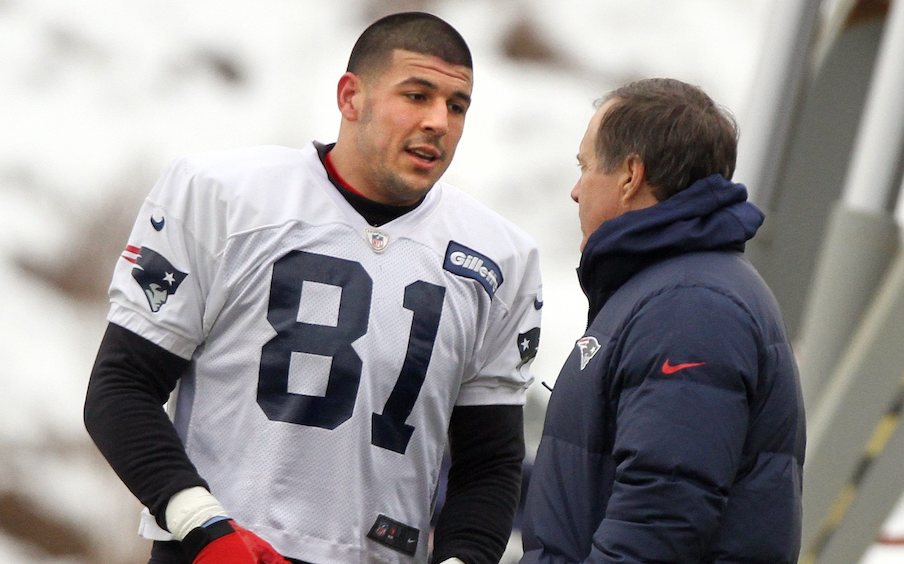
The New England Patriots took a chance when drafting Aaron Hernandez in the fourth round of the 2010 NFL Draft. And it was clearly not the right decision.
The tight end went on to ruin many lives and cast a horrible light over an organization that had put so much faith in him.
“When we bought the team, I said that we could make a difference in our community and make things better. We didn’t in this case. There are parents who wake up every day without their sons and a young daughter without her father," Kraft said. "We messed up in this one and for those of you who feel pain, I apologize.”
Here are the important moments from "The Dynasty: New England Patriots" Episode 6: At All Costs.
The 2010 NFL Draft
Having lost so many of their veteran players, the Patriots knew that this draft was going to be one of their most important.
And they got off to a strong start, selecting Devin McCourty in the first round, with the 27th overall pick in the draft.
"For me, it was an honor to be a part of that class and it was time for the new regime, the new guard to come in here and let go of some of the older guys,” McCourty said. "The top four to five rounds of that draft really end up being that kind of second wave of the Patriots Dynasty and I think we take a lot of pride in that."
In the second round, the Patriots selected Rob Gronkowski, and then two rounds later, they took Aaron Hernandez. There were now two rookie tight ends on the team, but one came with a very questionable past.
“We knew that there were issues," Ernie Adams said. "But you make a calculation on draft day, look we’re getting first round talent for fourth round price. And if it doesn’t work out right, we can always cut him.”
Hernandez's Past
The tight end had a troubled childhood, but found football as an outlet in High School.
"When he was 16 years old, his father, who kept him on the straight and narrow, dies. And Aaron started to unravel," Boston Globe Investigative Reporter Bob Hohler said. "He fell in with a rowdy crowd and he learned a whole new life. And so he has all these different issues that this kid is confronting when the big time colleges come looking for him.”
It was Florida Gators head coach Urban Meyer who saw potential in Hernandez and went to the principal of his high school, saying that they wanted him to move to Florida.
From there, he packed up from Bristol, Connecticut and moved, trying to truly begin his football career.
A Bad Start in Florida
While in Florida, Hernandez was at a bar and there was reportedly a dispute over the tab. It ended with him getting in a fight with the bar manager, punching him so hard that his eardrum burst.
But it was all swept under the rug.
“At Florida, they had a fixer for the players when they get in trouble, and that lawyer was there for Aaron. And everything went away," Hohler said. "So he comes away from the bar incident and he learns very early in his career about what Football INC. is, and that it is that you can get in trouble and not get in trouble.”
2010 Training Camp
Hernandez went into his first training camp with the Patriots knowing he was a talented football player. And because the team was in need of an offensive spark, the tight end went in thinking he could be the person to help with that.
“Aaron was a really big part of what the Patriots were trying to do. To grow and build offensively, he had so much confidence that he thought every play should be drawn up for him," Former offensive coordinator Josh McDaniels said. "And he knew he was a really good player, and he was.”
Plus with Gronkowski on the team too, they had a clear plan to utilize both his and Hernandez's strengths.
“The Patriots actually introduced this new type of offense that featured two tight ends. And together, those dudes were uncoverable," wide receiver Donté Stallworth said. "You couldn’t put a corner on those guys because they were too big. You couldn’t put a safety on them because they were too fast and too quick.”
Super Bowl XLVI
Once again, the Patriots were going up against the New York Giants in the Super Bowl.
And once again, they were forced to go home with a loss.
“That game was tough. We lost, but I’m like, ‘We’ll be back,' McCourty said. "We went 14-2 the year before, Super Bowl the next year. We’re going to keep doing this. Next time we’ll win it.'"
Robert Kraft and Hernandez
Robert Kraft felt that he had a genuine connection with Hernandez. And was consistently impressed with him, specifically throughout the 2012 preseason.
"Every time he’d see me, he’d kiss me on the cheek. I mean this is something I do with my sons," Kraft recalled. "I think he viewed me sort of as a loving paternal figure.”"
And Hernandez also proved to be there for Kraft.
"I remember when my sweet wife Myra passed away of Ovarian cancer. Aaron handed me a check for $50,000 to the fund that we had set up in memory of Myra. I said, ‘Aaron this is very sweet. You don’t have to do this. You’ve already got your contract,’ Kraft said. "And he started getting tears in his eyes. ‘No,’ he said. ‘This is very important to me. I want to do it for you.’ It really touched me. I felt he was what we wanted as the perfect Patriot player.”
Another new face
Along with all these new rookies, the Patriots brought in a veteran who was hungry to win.
“The Patriots were always a team that I wanted to be on because they were always winning. When I joined the team, I’m in my 10th NFL season and I had yet to play in a playoff game. I’ve been a part of a lot of mediocre teams," wide receiver Brandon Lloyd said. "Watching practice was exciting. I had a lot of admiration for Aaron’s athletic ability. I mean it was impressive. So I’m like, alright, my odds are pretty good to get to the Super Bowl.
“But I quickly realized that something was going on. There was this troubling undercurrent."
Lloyd's locker was right in between Hernandez and Gronkowski. So, he had heard some troubling things from Wes Welker who also had a locker next to Hernandez.
“In the locker room, we get away with saying a lot of offensive and disturbing things. But what Aaron was saying, it deviated far off the norm of just locker room bullsh**ing around," Lloyd explained. "He would rage out on players… Saying he’s going to beat their a**, saying, ‘I’ll kill you,’ which is something I don’t take lightly."
Troubling Behavior
Some of the things Hernandez would do during practice would annoy his other teammates.
"I remember there was one particular time we were out there doing a walkthrough with Tom. Aaron’s out there in flip flops going through the drills laughing, flipping the ball around, calling Bill Belichick, ‘Daddy,’ Lloyd said. "Tom’s like, ‘Get the f*** out of here. What the f*** are you doing? Get the f*** off the field.’ That got a rise out of Aaron… Stormed off the field. And oftentimes that didn’t elicit any response out of Bill."
And it also made them wonder why he was able to get away with this in a system run by someone as strict as Belichick.
"I remember one time in practice, we’re doing punt return, we’re catching balls, and Aaron’s sitting there, ‘I’m the best returner on this team. Bill, why aren’t I back there?” Like literally a rookie sitting there talking like this. And Bill’s like laughing," Wes Welker added. "And I’m like, ‘why does he love this guy?’ I don’t get it. I don’t get it. But when you’re that talented, a lot of people put up with a lot of stuff.”
Lloyd summed it all up perfectly.
"It reminded me of being on the teams where they let the star players do what they want to do," he said. "Doesn’t matter how you win, as long as you win.”
The Beginning of the End
Having been drafted by a team that was so close to his hometown, Hernandez began hanging out with people from Bristol, Connecticut. And many did not think it was good for him.
“I saw the group he was around. I had plenty of conversations with him about removing himself from certain individuals," Deion Branch said. "Like you’re in a different world now. You don’t need to do all that. You know, outside altercations and all this other craziness, like Aaron that’s stupid. But he still somehow couldn’t separate himself from that dark side.”
On June 17, 2013, Odin Lloyd's body was found about a mile away from Hernandez's house.
The police went to Hernandez's house and questioned him, yet he wasn't taken in.
But as Branch said, "It’s so wild how fast everything just changed.”
Despite all this going on in his personal life, Hernandez still was going to Gillette Stadium. And at one point, he was there at the same time as Robert Kraft.
“I found out he was working out in the weight room. I went down immediately and I said, ‘Aaron tell me, did you do this? Because if you did, I know you must have had some good reason. I’m going to get you the best defense lawyer we can get. And I’m going to do it at my cost,’ Kraft recalled. "And he looked me right in the eye, not blinking, anything, and said, ‘Mr. Kraft, I didn’t do that. I was in Rhode Island,’ or something. And when he said it, I believed him.
"He actually changed my life and how I look at people because it just, I to this day, I can’t believe I got snookered like that.”
Hernandez's Arrest
On June 26, 2013, Hernandez was officially arrested after being charged with first-degree murder. And almost immediately after, the Patriots released him.
“Aaron was being led out of his house in handcuffs and it was on television everywhere," Jonathan Kraft explained. "And I just remember, whatever warm feelings we might have towards Aaron, it looks like he’s done the ultimate bad things and we can’t have him on our team any longer.
“At that time, my dad and Bill were both out of the country, but I felt strongly that we couldn’t wait. So I called my dad and he very much agreed and we called Bill, and as was his wont, was always more measured. In the beginning he said, ‘he’s not guilty yet,’ and there were competitive issues too. He didn’t want to have to lose an amazing football player, so Bill’s instinct would be play this f****** thing out until the end. And I just knew we couldn’t play it out until the end, not because of how it look on us, but because we had to set a f****** example. This guy’s murderer.’"
After the Patriots severed ties with the tight end, they stopped talking about him completely.
“Aaron Hernandez basically became dead to the Patriots. Bill Belichick told his players he’s not to be spoken of anymore. He’s not a part of this team. We’re moving on," Hohler said. "But there were still so many questions that were unanswered. So the Globe spotlight team spent a year diving into every aspect of Aaron’s life. We found that long before the murder of Odin Lloyd, Aaron was sinking into a turbulent, troubled, really volatile and violent world.”
Hernandez tried to leave the Patriots
In July 2012, Hernandez was tied to another incident that occurred in a club in Downtown Boston.
"He’s out with his drug dealing buddy from Bristol, Connecticut. Hernandez and his friend leave that club and come up next to this car with two guys in it, who Hernandez believes disrespected him inside the club," Hohler explained. "And Hernandez opened fire.
“They escaped law enforcement, but Aaron’s paranoia is increasing. His drug use is increasing."
Because of that, he reportedly went to Bill Belichick and said that his girlfriend and her daughter were not safe. The Patriots head coach offered help from the security department for the Patriots, but he turned it down. Instead, he asked for a trade to the West Coast, but this came right after the Patriots had given the tight end a huge contract, so Belichick said no.
Looking back, this decision could have changed everything. So during an interview for this documentary, Belichick was asked about it. But he kept his answer short.
“Yeah, it’s an unfortunate situation about Aaron," Belichick said. "And I don’t have anything to add to it.”
Guilty Verdict
On April 15, 2015, Hernandez was found guilty and was sentenced to life in prison without parole.
“We knew he wasn’t the ideal citizen, but did we ever suspect this was a guy that’s going to be running around with guns, shooting people? No. Aaron was obviously a very talented player. I mean he got a big contract, which in retrospect, no we shouldn’t have done that," Ernie Adams said. "Probably the best thing for Aaron Hernandez pro football would have been to go to the Seattle Seahawks. Not be within a two hour drive of the people he grew up with from his hometown of Bristol. Someone got killed. A young person lost his life because of Aaron Hernandez.
