
Making a case for the Bengals signing Ezekiel Elliott
There are clear and obvious reasons why the Dallas Cowboys cut Ezekiel Elliott this offseason. At 27 years old, Elliott is nowhere near the same player he was when the Cowboys signed him to one of the most extravagant contracts a running back has ever signed. After seven years in Arlington, Zeke had outlived his […]


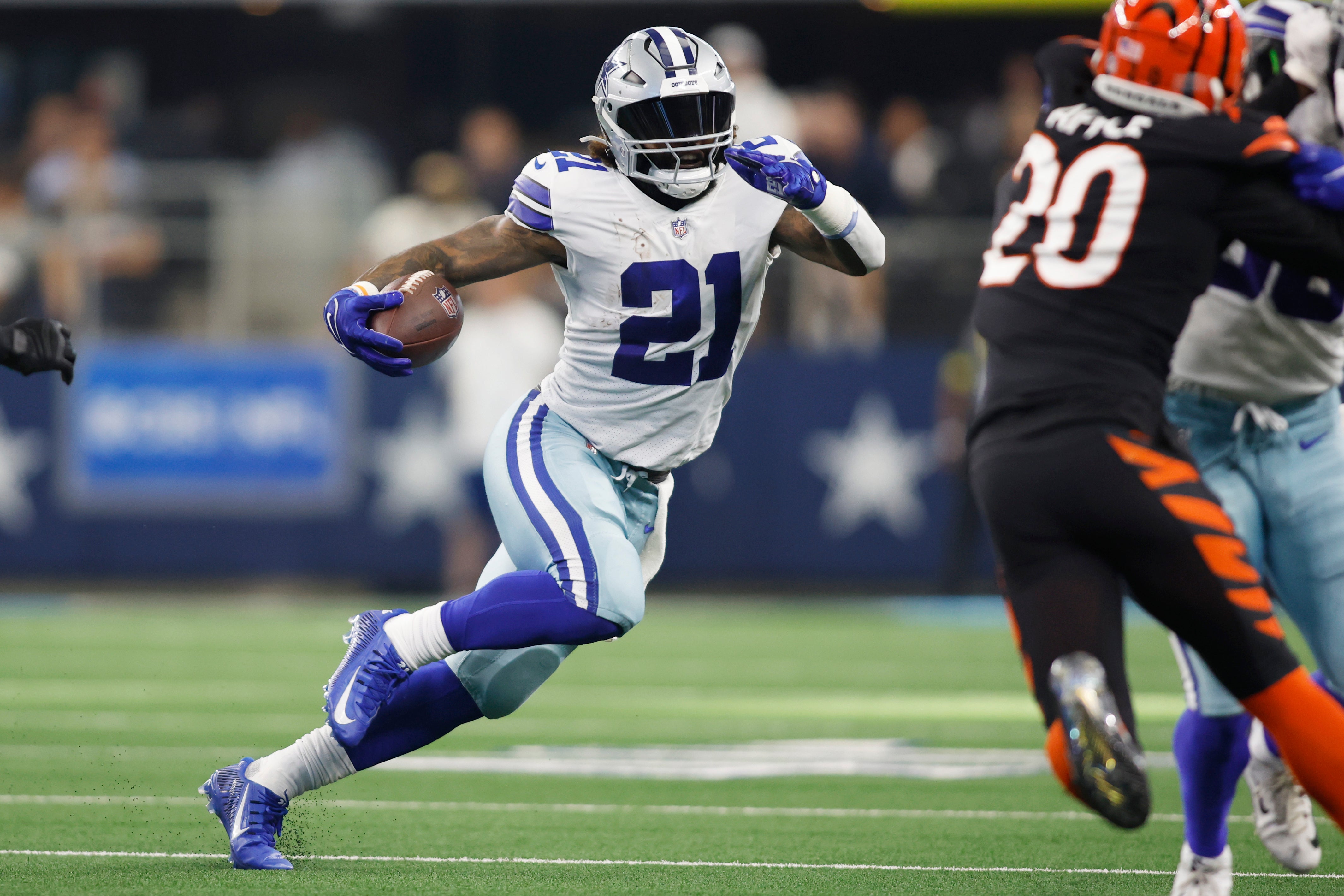
There are clear and obvious reasons why the Dallas Cowboys cut Ezekiel Elliott this offseason.
At 27 years old, Elliott is nowhere near the same player he was when the Cowboys signed him to one of the most extravagant contracts a running back has ever signed. After seven years in Arlington, Zeke had outlived his usefulness under an inordinate salary figure.
But Elliott still has a place in the NFL, and Cincinnati might just be the town.
We have to think about this not as a big name playing an overvalued position joining a contending team, but as specific type of player who would serve a very specific role.
The Cincinnati Bengals didn't just lose a running back when Samaje Perine took the Denver Broncos' offer of two years, $7.5 million last week. Perine runs hard and makes the most of the blocking he's provided, but his true value to the Bengals came from his reliability to pass protect.
In 2022, Perine was graded out at 73.8 for pass blocking from Pro Football Focus. He graded higher than 70 in 13 games. In 66 total pass blocking snaps, he allowed just two pressures and zero sacks.
That's what the "spreadsheets" tell us. Our eyes tell us something plain and simple: Cincinnati can't trust Mixon in those situations.
In fairness, Mixon was given just as many pass blocking snaps (64) last year, but he didn't come close to Perine's effectiveness. He graded out at 34.9 for the year, and the tape matches the grade.
Things all came to a head in the AFC Championship game. Perine out-snapped Mixon 37 to 15 on passing downs. In the most important game of the year when running the ball was a doomed plan, the team turned to their second-string back instead of the one with an $11.4 million cap hit attached to his name.
Why? That's up to the coaches to answer.
In critical situations, Mixon just doesn't see the field much, and part of that is the inconsistency he's proven to have on passing downs. For a team whose identity has evolved into a star quarterback with an elite trio of receivers, that's not great.
Enter Elliott, who's gradually been relegated to those duties in recent years.
Over the last three years, the former Ohio State star has hovered right around 250 carries a season while averaging about four yards a pop. The efficiency doesn't justify the volume in the slightest. Dallas likely felt obliged to feed their $90 million halfback.
Breaking off explosive runs isn't his game anymore, but finding two tough yards on a third-and-two? That is still in the cards. It's in the job description of being a third down back.
So is pass protection, and Elliott has that on his resume as well.
In three years of backing up Mixon, Perine averaged about 22 snaps per game with nearly 60% of them on passing downs. That workload fits Elliott's skillset perfectly at this point.
This was the Bengals plan when they envisioned re-signing Perine; pairing their veteran third down back with a more explosive runner in the Draft and saving the cash from Mixon's deal. Adding Elliott to the offense would all but confirm Mixon's fate.
But it's not just the money that matters, it's the dynamic of skillsets. Mixon and Perine worked because the former could just focus on running the ball in obvious situations while the latter did the dirty work. It's hard to find that complement for Mixon in a rookie.
While Elliott is no longer the running back he was when he took the league by storm all those years ago, he does have the blocking ability and just enough power left to gain tough yardage. You can rely on him right out the gate like you couldn't with a wide-eyed first-year player.
All of this won't matter if the Bengals aren't actually interested in Elliott. The team was included in ESPN insider Adam Schefter's report because it was the eight-year veteran's wishlist of teams to play for, not a finalist list of offering clubs. But we shouldn't rule out a return to Ohio precisely because of what happened last week.
When Orlando Brown Jr. realized he wasn't going to get the deal he wanted as a left tackle, his camp reached out to the Bengals. A deal quickly came together when the Bengals realized they had a reasonable shot to land a player who wasn't even on their radar.
Elliott's deal won't be anywhere close to the magnitude of Brown's, but a similar situation could develop.
The Bengals wouldn't be signing the old Elliott, and that's fine. They can turn to the draft to locate their own Tony Pollard. For the offense they want to run, a third down back like Elliott is now would keep the offense moving forward.


