
Has the Bengals' run game been that good? Breaking down the stats that matter
The inability to pass the ball effectively will hinder any NFL team, including the Cincinnati Bengals. Joe Burrow's calf injury is the biggest reason why the Bengals' passing game has not been up to snuff to start the season, and it will likely prohibit him from feeling 100% for a while. How can the Bengals […]


The inability to pass the ball effectively will hinder any NFL team, including the Cincinnati Bengals. Joe Burrow's calf injury is the biggest reason why the Bengals' passing game has not been up to snuff to start the season, and it will likely prohibit him from feeling 100% for a while.
How can the Bengals work around this? Many have pointed to the obvious: Run the ball more often. Not just because it's only other phase of the offense, but because the Bengals have had success doing so the times Burrow has handed the ball off.
But I think folks are getting a little ahead of themselves, because the Bengals' run game has not been as great as it's been advertised.
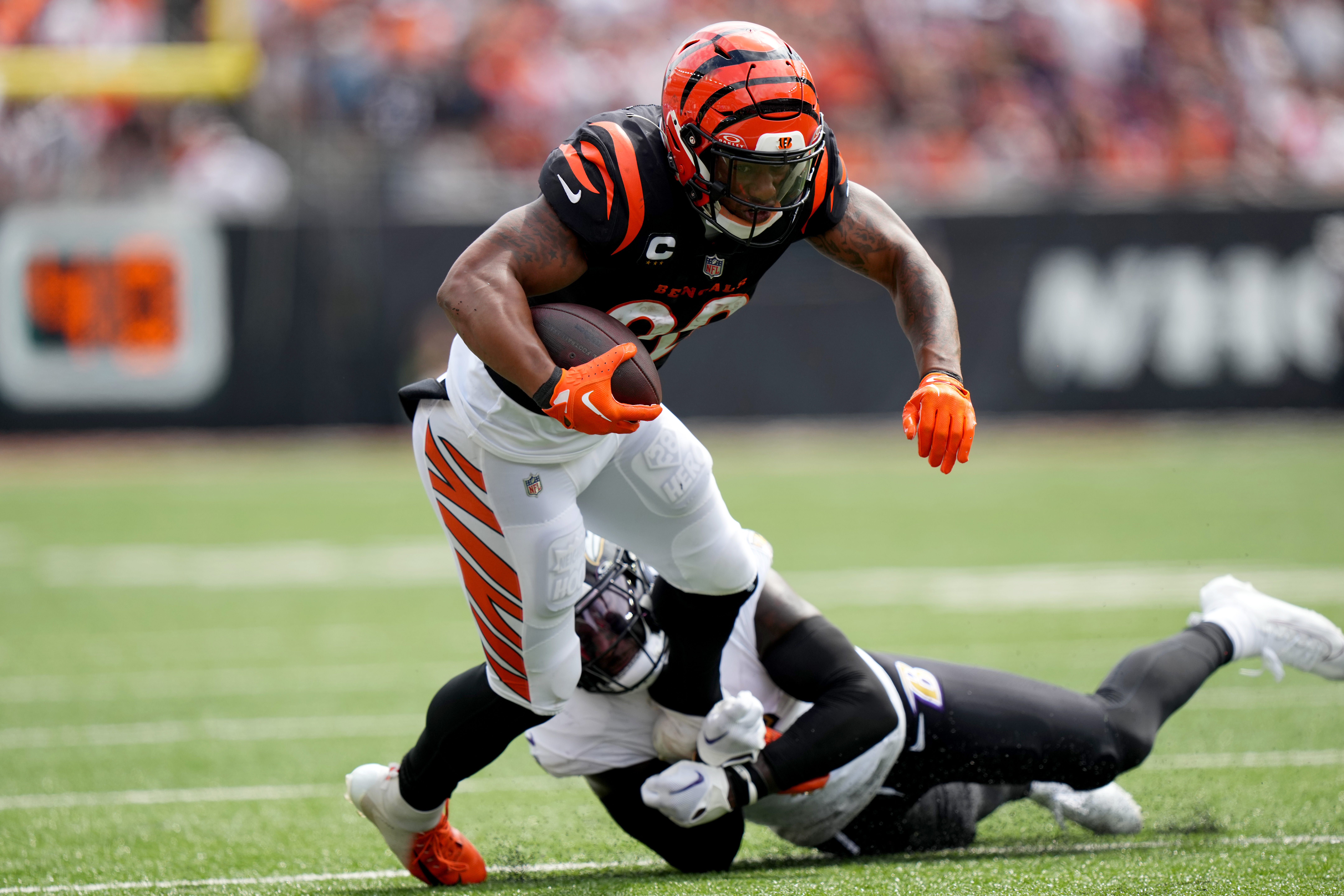
Let's focus on the positives first. The leader of the run game, Joe Mixon, has looked pretty good through two games. He's averaging 4.42 yards per carry, which looks relatively large compared to his career average of 4.1. This is aided by his 26 yards over expected, which brings his per carry average in that stat to 10th in the league as of now.
Mixon is also off to a good start in terms of generating yards after contact. His average of 3.31 per carry would be a career high for him, and significantly higher than his 2022 average of 2.61. The seventh-year back is also on pace for forcing 43 missed tackles in the regular season, which would be his second-highest total of his career.
These metrics show that Mixon is performing above his standard independently from blocking or even scheme, which has been an issue for most of his career. The tragedy with running backs lies in needing everything to click on all cylinders, and the Bengals are not quite there yet.
Despite the evidence that supports Mixon's solid start, the Bengals as a whole rank 18th in Expected Points Added per rush, and 27th in rush success rate. Mixon has 26 of the team's 32 designed carries, by the way.
18th in EPA is not terrible, 27th in success rate is verging on the border. Both can be explained.
When the Bengals' run game has been successful, the success has been relatively noticeable. Mixon's 4.42 per carry average has been aided by three runs of 10 yards or more, including a high of 22 yards he scampered for back in Week 1. In most cases, these runs greatly boost EPA for obvious reasons. The more yards you generate, the more likely you're increasing your chances of scoring compared to where you started. His three runs of 10+ yards are in his top five in terms of EPA.
But did you know Mixon's second-biggest run from an EPA perspective was a three-yard gain? This is where context comes into play. Mixon converted a third-and-1 from the Ravens' seven-yard line with four minutes remaining last Sunday. The Bengals' expected points value was 4.85 at the start of the play, and increased to 6.28 by the time Mixon gained three yards and created a new set of downs.
Getting closer to the end zone, adding four more downs to get in, and increasing expectation of a touchdown. Of all the ways I can best explain EPA, this feels like the simplest.
The sample size for Mixon getting the ball in short yardage situations has been small thus far, but four of his six carries with five or fewer yards to go on second or third down have resulted in positive EPA outcomes. This has pulled plenty of weight in the argument for the Bengals to run the ball more often without people even realizing it. But it's not the entire story, and the rest of greatly impacts the argument of taking pressure off of the passing game.
Here's the short of it: The Bengals still can't run the ball very well on early downs.
Remember their success rate ranking of 27th? That means that 26 teams have produced a greater percentage of positive EPA runs. A lot of this comes from underwhelming on first and second down. The Bengals rank 26th in early down success rate, with the percentage coming in at exactly 31%.
Everyone knows the verbiage "staying ahead of the chains," well, this is pretty much what it doesn't mean. Running the ball when needing 10 yards to create a new set of downs means avoiding second-and-long and third-and-medium in order to be deemed successful. That's the trade-off from passing the ball, which can achieve those results empirically easier.
What makes this more damning is the fact that defenses are still urging the Bengals to run the ball. Mixon has faced 8+ defenders in the box just 3.85% of his carries. If you need a calculator, that equals one of his 26 carries. It certainly didn't happen on first-and-10, and yet 53% of Mixon's carries to start a new series has resulted in negative EPA. That simply needs to be better if the Bengals want a run game to bring aid to their struggling passing game.
Most analysis regarding the run game is inherently unfair. New information makes what most of us learned growing up outdated. Hell, every time a running back carries the ball three yards on first-and-10, most of that stadium is clapping. Positive yardage is better than nothing, right?
The Bengals simply need more if they have to support a struggling passing game.
Bengals Week 2 PFF Recap: 3 stats to know
Cincinnati fixed an easy problem on offense, but needs to do much better rushing the passer.
Featured image via © Albert Cesare/The Enquirer / USA TODAY NETWORK


