
Predicting Alabama’s full running back committee as the run game faces pivotal season on the ground
Alabama’s run game is facing a pivotal season with Kalen DeBoer and Ryan Grubb back together again.

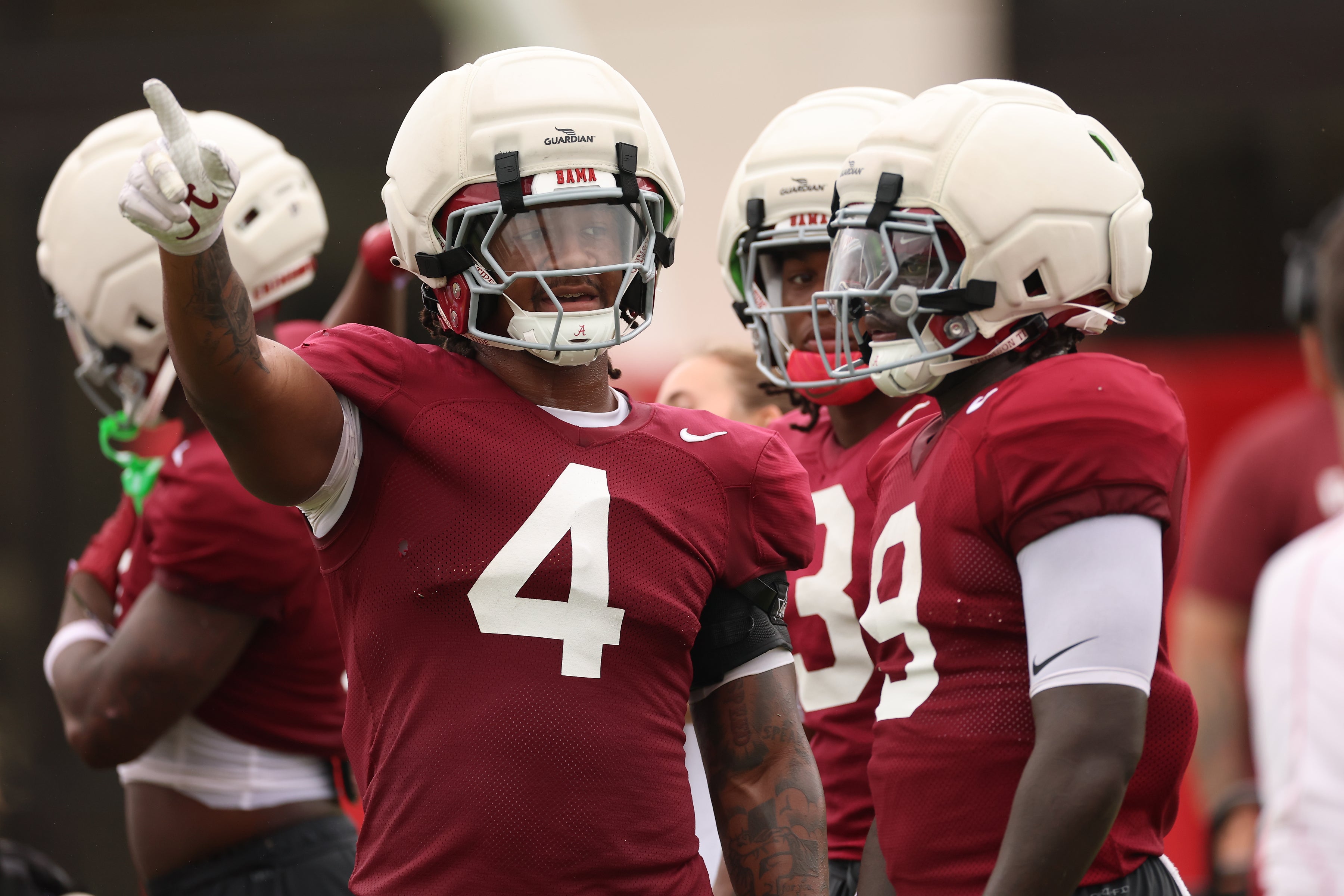
Heading into the 2025 season, Alabama is having to replace two of its top three rushers in Jalen Milroe and Justice Haynes. While that does sound like a monumental task, it’s possible — likely, even — that the Crimson Tide field a more effective and consistent rushing attack despite those losses.
Alabama won’t rely nearly as much on the quarterback run as it did with Milroe at the helm, but Ty Simpson is likely to remain a small part of a ground attack, even if it comes from more unscripted runs. The Crimson Tide’s traditional run game is expected to return though with starter Jam Miller leading a group that also consists of Daniel Hill, Richard Young, Dre Washington, Kevin Riley and AK Dear.
What will the snap and carry distribution look like amongst those running backs though? How many guys will be a consistent part of the rotation, and what opportunities will each of them get? It’s tough to definitively answer either of those questions, but we decided to at least look back on previous Kalen DeBoer (and even a Ryan Grubb) offenses to try and get an idea.
So here’s what we did. I went back to each of the 11 years DeBoer has either been an offensive coordinator or head coach on the FBS level. I included his team’s top three running backs, plus the quarterback while diving into their carry percentages. And between his time at Fresno State, Indiana, Washington and Alabama, I discussed how many runners were consistently involved. I also included Grubb’s time as the Fresno State play-caller in 2019 after DeBoer had left for Indiana.
Check it out below.
2024 (Alabama HC) – DeBoer
- Jalen Milroe (QB): 168/488 carries (34.4%)
- Jam Miller: 145/488 (29.7%)
- Justice Haynes: 79/488 (16.2%)
- Richard Young: 27/488 (5.5%)
-Milroe is the only quarterback who has exceeded a 30% share. He’s one of just two quarterbacks to have led his team in carries with the other being Reginald Bell at Eastern Michigan in 2014. Jake Haener topped a 25% share in 2020, but that was a strange season with limited games played, so teams didn’t have to worry about overusing their top playmakers. Overall, this was a two-back offense that was headlined by the quarterback run.
2023 (Washington HC) – Both
- Dillon Johnson: 233/411 carries (56.7%)
- Tybo Rogers: 44/411 (10.7%)
- Michael Penix Jr. (QB): 35/411 (8.5%)
- Will Nixon: 33/411 (8%)
-Johnson is the only DeBoer running back who has received over a 50% workload, which happened in 2023. Rogers technically got the second-most carries on the team, but Nixon was the team’s second back. He played 204 snaps compared to Rogers getting 103. Nixon was more relied on in the passing game too, almost doubling Rogers in targets (20 vs. 11). Four running backs played over 100 snaps, but this felt like a one-back offense when Johnson was healthy and able to go. Penix was good for a little under two carries per game, but they were rarely — if ever — designed runs.
2022 (Washington HC) – Both
- Wayne Taulapapa: 140/400 carries (35%)
- Cam Davis: 107/400 (26.8%)
- Richard Newton: 45/400 (11.3%)
- Michael Penix Jr. (QB): 35/400 (8.8%)
-This was a true two-back offense. Of Newton’s 45 carries, over a third of them (16) came in the two games Davis missed, Stanford and Texas. Penix averaged 2.3 carries in 2022 compared to 1.7 in 2023. Taulapapa was extremely efficient with his touches. He totaled 1,112 yards (887 rushing, 225 receiving) on 164 touches while scoring 12 total touchdowns (11 rushing) and averaging 6.3 yards per carry. Davis went for over 650 total yards (522 rushing, 137 receiving) while scoring 13 times.
2021 (Fresno State HC) – Both
- Ronnie Rivers: 161/439 carries (36.7%)
- Jordan Mims: 127/439 (28.9%)
- Jake Haener (QB): 71/439 (16.2%)
- Jordan Wilmore: 14/439 (3.2%)
-This was clearly a two-back offense with Jake Haener averaging close to four carries a game. Both Rivers and Mims got over 700 rushing yards to go with five and six rushing touchdowns, respectively. But they were also both super effective in the passing game. Each of them received 30 or more targets (Rivers got 44) while posting at least 320 receiving yards apiece. That means they were both 1,000-yard producers in DeBoer’s offense.
2020 (Fresno State HC) – Both
- Ronnie Rivers: 100/216 carries (46.3%)
- Jake Haener (QB): 57/216 (26.4%)
- Jordan Mims: 28/216 (13%)
- Jevon Bigelow: 11/216 (5.1%)
-This was an interesting year. Rivers got the third-highest carry share under DeBoer with Dillon Johnson (56.7%) and Eastern Michigan’s Darius Jackson (49.4%) being the only two to exceed him. That was the result of Mims missing the entire 2019 season due to an ankle injury. If you look at 2017 and 2018, Mims was right there in the mix with Rivers, same as it was in 2021. In other words, this was supposed to be a two-back system. Haener picked up some of the slack (getting over a 25% carry share), but DeBoer didn’t have to worry about overusing Rivers because there were only six games played that season. Rivers averaged close to 20 carries in the five games he was healthy. And he still came within striking distance, somehow, of topping 800 total yards of offense (507 rushing, 265 receiving) and double-digit touchdowns (9). Was a one-back offense, but should’ve been a two.
2019 (Indiana OC) – DeBoer
- Stevie Scott III: 178/467 carries (38.1%)
- Peyton Ramsey (QB): 97/467 (20.8%)
- Sampson James: 81/467 (17.3%)
- Ronnie Walker: 27/467 (5.8%)
-This felt like more of a one-back offense, as 33 of the 81 attempts for James came in the two final games that Scott was forced to missed. This means Sampson averaged a little over four carries per game in the 11 contests Scott participated in. Meanwhile, Scott averaged a healthy 16.2 carries while going over 1,000 total yards (845 rushing, 211 receiving) and scoring 11 total touchdowns (10 rushing). Both were big backs too. Scott was 6-foot-2, 231 pounds, and James was 6-1, 220. Ramsey was also a heavily relied on runner. He came close to 100 carries while averaging a respectable 6.6 true carries per game (true carries take out sack numbers).
2019 (Fresno State OC) – Grubb
- Ronnie Rivers: 177/394 carries (44.9%)
- Jorge Reyna (QB): 98/394 (24.9%)
- Josh Hokit: 75/394 (19%)
- Saevion Johnson: 4/394 (1%)
-This was Grubb’s one season as big-time college coordinator without DeBoer being his head coach. Rivers handled by far the largest portion of the carries to running backs, but Hokit at least did enough to call this a two-back offense, as he averaged 7.7 touches per game (6.3 carries, 1.4 receptions). That said, Rivers still managed to get over 200 touches (177 carries, 43 catches) while totaling 1,247 yards (899 rushing, 348 receiving) and 16 touchdowns. Reyna and Hokit got the same amount of true carries per game (6.3).
2018 (Fresno State OC) – DeBoer
- Ronnie Rivers: 132/501 carries (26.3%)
- Jordan Mims: 113/501 (22.6%)
- Josh Hokit: 73/501 (14.6%)
- Marcus McMaryion (QB): 71/501 (14.2%)
-DeBoer’s first two seasons at Fresno State included a true three-headed monster at running back. Between the 2017-18 seasons, Rivers (233 total carries), Mims (264) and Hokit (201) were all heavily utilized. They were all in a respectable rushing range in 2017, as each of them posted between 480-627 yards rushing, 5-7 scores on the ground and averaged between 4.15 and 4.75 yards. But in 2018, Hokit fell off compared to the other two, averaging just 3.56 yards and only scoring one touchdown. He did manage to average a respectable 5.6 carries in 13 games though, so we still include him as a constant in the rushing attack.
2017 (Fresno State OC) – DeBoer
- Jordan Mims: 151/515 carries (29.3%)
- Josh Hokit: 128/515 (24.9%)
- Ronnie Rivers: 101/515 (19.6%)
- Marcus McMaryion (QB): 57/515 (11.1%)
-This is as balanced as it gets amongst a trio of running backs. Mims played the most snaps with 341, but Rivers (299) and Hokit (287) weren’t far behind. That also goes for touches, production and everywhere in between. Over these two years, McMaryion averaged around four true carries per game. DeBoer and Grubb managed to get three different running backs at least 100 carries while also seeing the quarterback get somewhat involved in the run game, but it came at the expense of the passing game, as Fresno State averaged 31.2 pass attempts per game (tied for No. 73 nationally). 2018 was slightly better (31.4 attempts, tied for No. 65), but you also saw the three-headed monster get fewer carry opportunities (down to 318 from 380).
2016 (Eastern Michigan OC) – DeBoer
- Ian Eriksen: 184/480 carries (38.3%)
- Breck Turner: 77/480 (16%)
- Brogan Roback (QB): 63/480 (13.1%)
- Shaq Vann: 21/480 (4.4%)
2015 (Eastern Michigan OC) – DeBoer
- Darius Jackson: 208/421 carries (49.4%)
- Shaq Vann: 100/421 (23.8%)
- Brogan Roback (QB): 51/421 (12.1%)
- Juwan Lewis: 4/421 (1%)
2014 (Eastern Michigan OC) – DeBoer
- Reginald Bell (QB): 133/459 carries (29%)
- Ryan Brumfield: 95/459 (20.7%)
- Bronson Hill: 85/459 (18.5%)
- Darius Jackson: 61/459 (13.3%)
Final Thoughts
We’ve seen DeBoer do a little bit of everything. Workhorse running backs have been a thing (Washington in 2023, Indiana in 2019), and we’ve also seen three-back committees (Fresno State in 2017 and 2018). But here’s the thing, there’s only been one year where Grubb had anything other than a two-back offense — Washington in 2023. And even then, we still saw Nixon and Rogers play.
I can see Ty Simpson getting somewhere between 3-4 true carries per game, which would be significantly less than the 11.2 that Milroe averaged in 2024. So really, it’s about determining whether we’re going to predict two or three running backs to get meaningful action while also seeing fairly consistent touches.
Right now, there are four guys who feel very much in that conversation. Miller is a shoe-in at this point with Hill, Young and Washington all vying for either one or two spots. And really, it’s a toss-up between which of them it’ll be. I can see Young being RB2 behind Miller, but I can also see him falling to RB4, which could lead to sporadic, inconsistent usage for anyone in that role. The same can be said for the other two guys.
I’ve been on the Hill bandwagon for quite a while though. At 6-foot-1, 244 pounds, his power helps generate consistent yardage, which only helps as far as keeping Alabama’s offense on schedule. He’s more than a power back too, as he’s also a true receiving threat out of the backfield. For those reasons, I have him as a part of the rotation. If there is a third option included, I’m going with Washington. Young’s biggest asset (power) is too similar to Hill while Washington brings more juice and another quality receiving option.


