
What will new Oklahoma Sooners OC Seth Littrell's rushing scheme look like in 2024?
The Oklahoma Sooners enter 2024 with new coordinators on all three phases of the ball. Offensive coordinator Jeff Lebby, a former Sooners player, was hired by fellow SEC school Mississippi State to serve as their head coach. Oklahoma turned to another former player to fill in as offensive coordinator for 2024, hiring former North Texas […]

The Oklahoma Sooners enter 2024 with new coordinators on all three phases of the ball. Offensive coordinator Jeff Lebby, a former Sooners player, was hired by fellow SEC school Mississippi State to serve as their head coach.
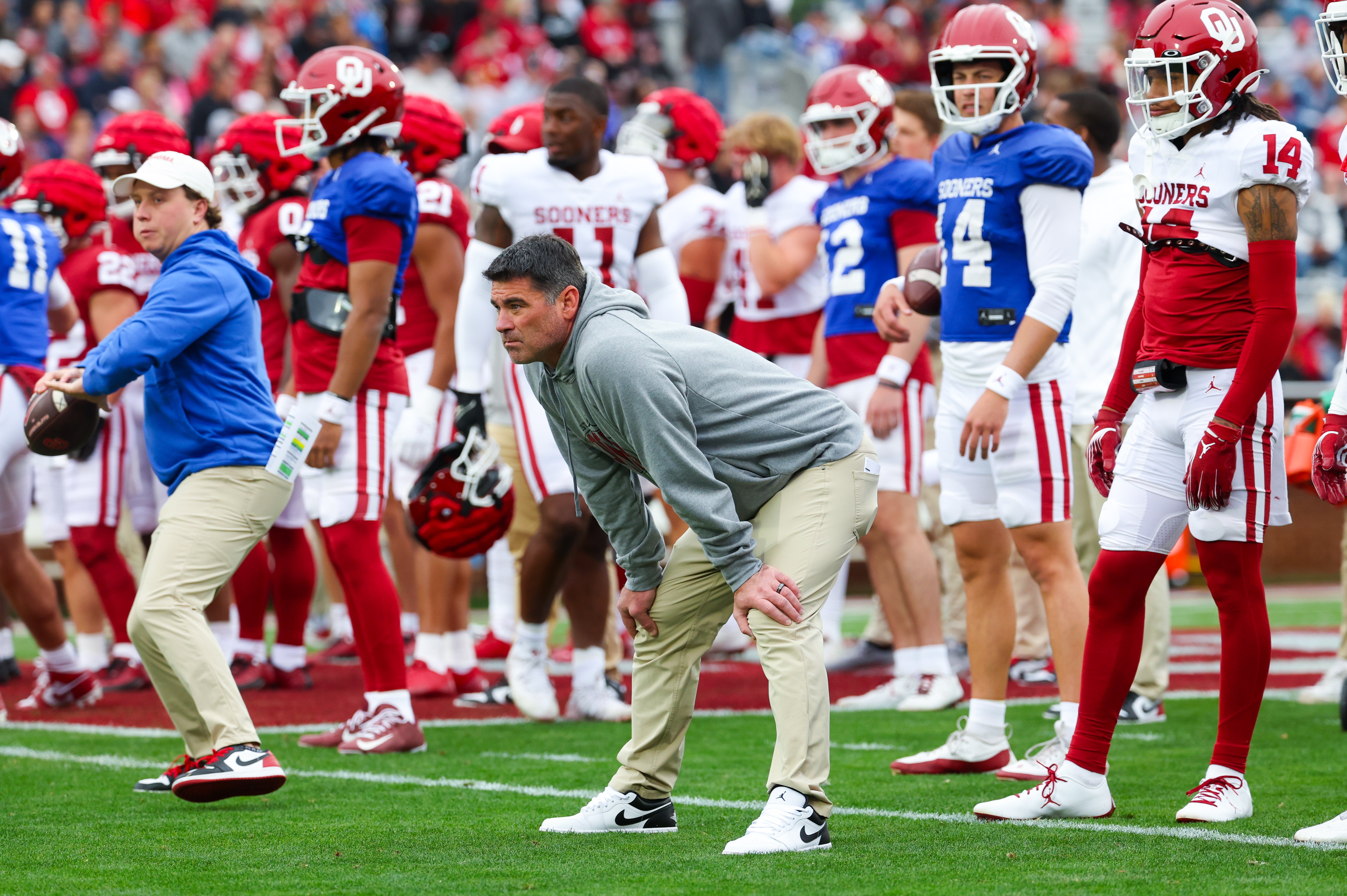
Oklahoma turned to another former player to fill in as offensive coordinator for 2024, hiring former North Texas head coach Seth Littrell. Littrell served as an analyst for the Sooners in 2023, so he's already well-familiar with the talent on the roster.
The main question on the minds of many Oklahoma fans is just what Littrell's offense will look like. After some frustrations with Lebby's situational play-calling and inconsistent run game, fans are hopeful Littrell can turn that around.
So just what will Seth Littrell's rushing attack look like? What types of runs does he prefer to call? What will OU favor in 2024?
I'll mainly be looking at Littrell's tenure at North Texas here, as that's where the data is most reliable.
Littrell's Mean Green Ground Game
It was a tale of two different offenses for Littrell at North Texas. When Littrell was hired to coach the Mean Green in 2016, he brought on former Texas Tech gunslinger Graham Harrell to serve as his offensive coordinator. Under Harrell, North Texas relied on a pretty steady dose of zone runs with very few power concepts, favoring inside and outside zone as their main runs.
Harrell was hired away in 2019 to serve as the offensive coordinator for the USC Trojans. There, Littrell and the Mean Green shifted drastically away from zone runs towards a power-run game. In fact, North Texas called outside zone just once in 2020, and called it a grand total of 66 times from 2019-2022.
| 2016-2018 | 2019-2022 |
|---|---|
36%-Inside Zone | 32%-Inside Zone |
27%-Outside Zone | 19%-Man |
16%-Counter | 18%-Counter |
8%-Power | 17%-Power |
1%-Man | 4%-Outside Zone |
Expectations for Oklahoma in 2024
So which will it be for the Sooners? Will they be more of an outside zone team like Littrell ran early on at North Texas or more of a power run like his later years?
For comparison's sake, let's look at Oklahoma's run game in 2023 under Jeff Lebby.
| 2023 Oklahoma Sooners Rushing Attack |
|---|
34%-Inside Zone |
15%-Counter |
14%-Man |
13%-Outside Zone |
12%-Power |
As you can see, the Sooners ran more outside zone this past season than Littrell had in his last three seasons with the Mean Green. Yet, that doesn't mean they should continue doing so.
From a schematic perspective, Oklahoma will likely be in shotgun well over 90% of the time, if not even closer to 100% of the time. They'll likely mix in some pistol looks here and there, but shotgun will be the name of the game once more.
Outside zone out of shotgun is extremely difficult to run well, even in the NFL. While it's easier to pass and create easy yards off of RPO's in shotgun due to the lateral stress it puts on defenders, outside zone runs become harder for the running back to execute. The back has to turn his hips to the sideline, making cutbacks difficult to hit without losing momentum. This is why even in the NFL, only the most talented athletes at the position are successful at this run and why most outside zone teams predominantly run it from under-center.
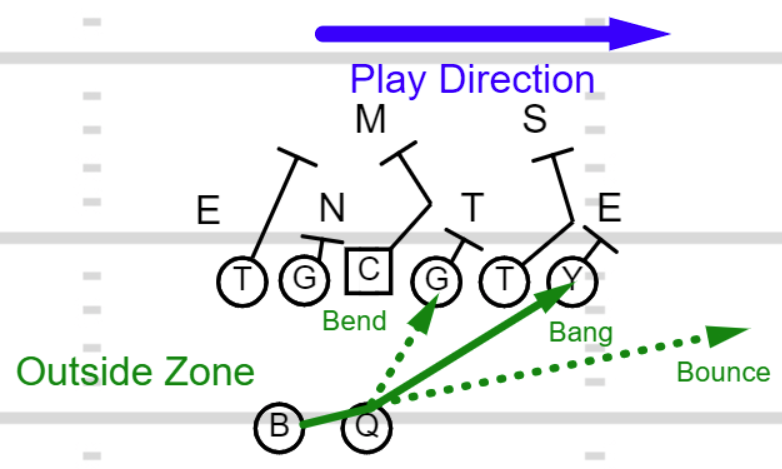
There's also more of a tell in 'gun running, as the back declares where he's running based on which side of the QB he aligns to. Stout defenses can check to a more aggressive front to that side, bottle up the run and force the back to cut, his momentum drops, and the run becomes that much easier to stop.
While this isn't an intended slight against any of the athletes in Oklahoma's running back room, as it's a concept even NFL players struggle with, outside zone just shouldn't be their calling card with this degree of difficulty.
Even Lebby realized this. Oklahoma in 2021 (Lincoln Riley's last season) ran outside zone 27% of the time. In 2022 and 2023, that number dropped to 16% and 13% respectively.
Oklahoma's offensive line personnel
What Oklahoma's offensive line looks like can also show us some signs. Teams that are traditionally zone-heavy prefer lighter, more athletic linemen. You seldom see an outside zone tackle heavier than ~315 pounds outside of the elite NFL talents. These players are working laterally and out in space more, so they need to be lighter.
Power-oriented teams, conversely, favor heavier linemen. This is where you see the 320-330-pound maulers kick in.
- Oklahoma's freshman class looks like this:
- Eddy Pierre-Louis: 330 pounds
- Eugene Brooks: 336 pounds
- Josh Aisosa: 323 pounds
- Isaiah Autry-Dent: 310 pounds
- Daniel Akunkunmi: 321 pounds
That is not a typical outside zone offensive line class. If the freshmen class didn't provide enough clues, look at the transfers the Sooners brought in.
- Febechi Nwaiwu (UNT): 339 pounds
- Branson Hickman (SMU): 301 pounds
- Geirean Hatchett (Washington): 312 pounds
- Michael Tarquin (USC): 317 pounds
- Spencer Brown (Michigan State): 321 pounds
All of these players outside of Hickman are well into the typical size profile of a power-run scheme. Hickman is a center, which explains the slighter size. Additionally, all of these transfers, sans Hickman, transferred from power-run offenses.
Oklahoma's transfers and recruits along the offensive line average 321 pounds. If that doesn't say power-run, I don't know what else would.
It's clear to me that Oklahoma is leaning more into the power run game under Seth Littrell. Littrell moved away from it at North Texas, likely for the reasons I mentioned above about the difficulty of executing it at the collegiate level. I'd expect outside zone usage to drop even below Lebby's 13% last season into single-digits like it was in Littrell's final years, while these snaps transition into plays like counter, duo, and traditional power runs.
In my opinion, this is a good thing for the Sooners' rushing attack. Power runs require less reading and vision than zone runs do, as the linemen create their own set lanes for backs to follow. In a zone-based offense, particularly outside zone, backs have to constantly read and adjust to the flow of their blockers. Runners, especially ones with poor vision, can often struggle with these reads and either bounce runs outside or hesitate, killing the play before it starts.
In a power-run game, backs have to be a little more patient and follow their blocks, but typically these runs are easier for many backs to handle, hence why they are becoming increasingly popular at the NFL level. Additionally, it's easier to make linebackers second-guess assignments with pulling blockers than it is with zone rushers, as they can't just fire into gaps to stop the run. The whole goal of power runs is to create lanes for the running back to immediately work vertically and use their speed to create plays.
Robert Spears-Jennings among five Oklahoma Sooners poised for breakout 2024 seasons
We are exactly ten days away from the Oklahoma Sooners taking the field for their 2024 season opener against the Temple Owls. The Sooners' first season in the SEC brings plenty of change to the team but is filled with potential as Oklahoma takes that first step into their new conference home. What Sooners are ready […]
Oklahoma's running back room is riddled with speedsters like Gavin Sawchuck and Kalib Hicks as well as newcomers Sam Franklin and Taylor Tatum. A power-run game like what Littrell likely will run is built for backs like these players, as it gets their speed downhill right away and into the open field.
All in all, it seems fairly likely that the new Oklahoma Sooners offensive coordinator is going to Run Power Often in Norman in 2024. Hopefully, this shift can get more out of their rushing game than their last few seasons. A steady run game would go a long way in helping ease Jackson Arnold's transition into becoming the new starter at quarterback.


