
Arch Manning’s NFL Draft stock surges, but how high can it rise?
After a season of hype, doubt and resurgence, Arch Manning’s November breakout has vaulted him back into the 2026 NFL Draft conversation.


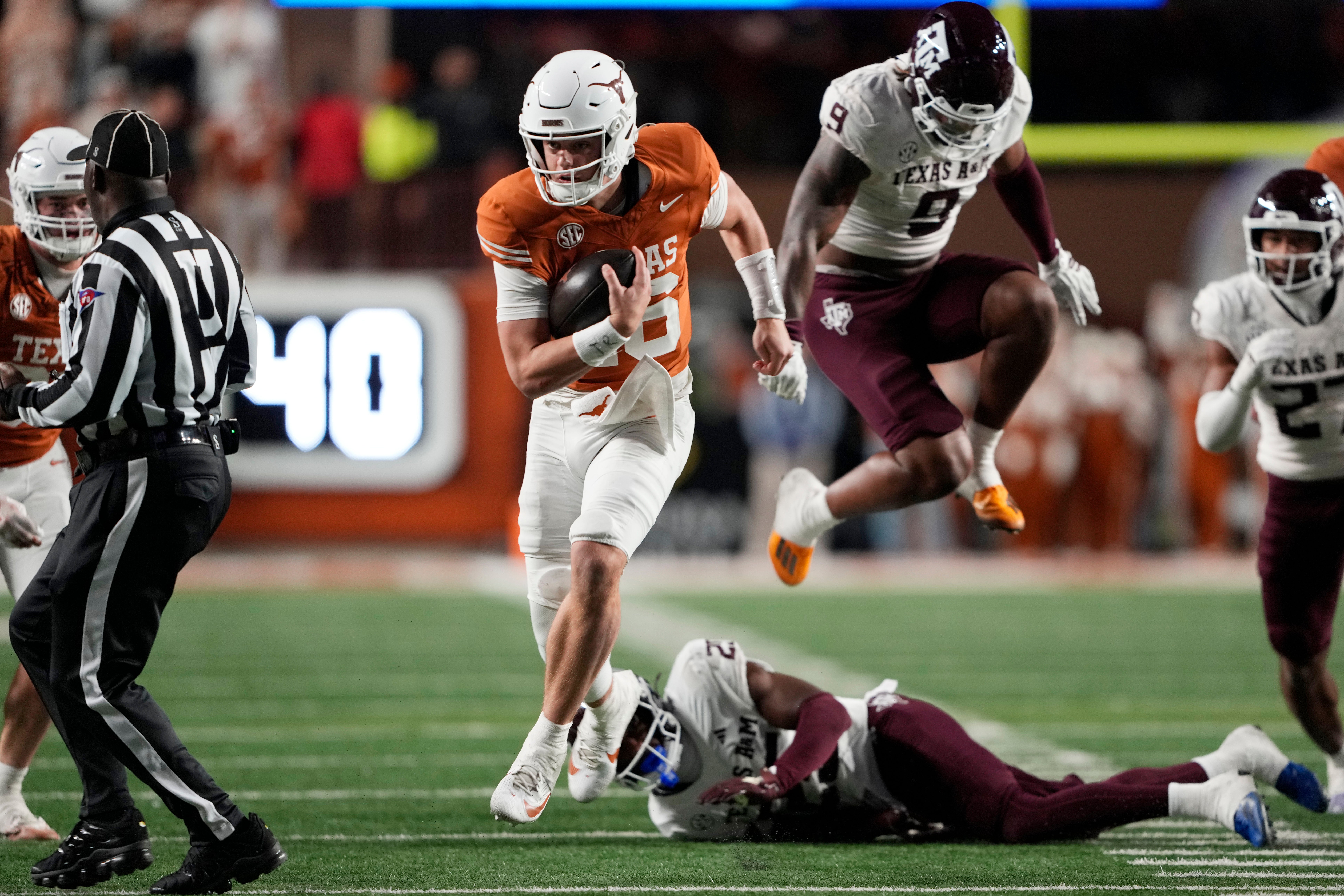
This season has put Arch Manning through the full cycle—from sky-high expectations to harsh criticism to serious questions about his readiness. Now, following a strong November capped by a major win over No. 3 Texas A&M, he’s entered December as one of the most debated quarterback prospects for the 2026 NFL Draft.
No quarterback entered the year with more pressure. Manning arrived at Texas as a high-profile starter, carrying both a legendary surname and the weight of a system designed around his success. But once games began, reality didn’t match the hype. His early statistics were underwhelming. The Florida loss became a focal point for critics. His throwing mechanics regressed. His choices under pressure seemed hurried. Eventually, he found himself tagged as one of college football’s most overhyped players.
The second half of Manning’s season flipped the script
Over his last five games, Manning threw 12 touchdown passes with just two interceptions. He added three rushing scores. He tore apart No. 9 Vanderbilt for 328 yards and three touchdowns, then detonated Arkansas with 389 yards and four touchdowns, becoming the first player in Texas history to throw, rush and catch a touchdown in the same game. And against No. 3 Texas A&M, facing the best defense remaining on the schedule, Manning delivered a poised, mistake-free second half: 6 for 9, 163 total yards, two touchdowns, zero turnovers.
That period is significant because NFL evaluators came into the season with one crucial question: could Manning perform against top-tier competition? He faltered against Ohio State and Georgia early on. Saturday night provided his final opportunity to prove himself. While he didn’t put up spectacular numbers, he kept the offense on track, made the decisive rushing play that clinched the victory, and outperformed A&M’s defense over the game’s final half-hour.
The draft landscape has also changed considerably. Clemson’s Cade Klubnik dropped out of contention. Penn State’s Drew Allar collapsed. LSU’s Garrett Nussmeier took a step backward. New contenders have surfaced—Indiana’s Fernando Mendoza, Alabama’s Ty Simpson, Oregon’s Dante Moore—but none has pulled far enough ahead to eliminate Manning’s potential as a top prospect. His physical attributes remain intact: height, arm strength, athleticism, resilience.
That potential explains why NFL teams will stay interested even though he hasn’t fully developed yet. Manning appears more composed, precise, and confident now compared to September. Still, he’s only completed one year as a starter, and there’s no replacement for actual game experience.
Should he declare, a team could legitimately select him first overall. Should he stay, he could enter 2026 as college football’s premier quarterback—and a much more reliable, well-rounded franchise option.
Both possibilities exist now. Manning’s November performances ensured that.
Texas Longhorns News
Texas lands four major recruits as Longhorns build momentum for future rosters
Texas’s recruiting surge continues with four major commitments — including five-star talent Easton Royal — signaling a new wave of star power and long-term depth for the Longhorns following their upset win over No. 3 Texas A&M.


