
Why Texas will dominate the Citrus Bowl regardless of Michigan’s coaching turmoil
Texas enters the Citrus Bowl with momentum and clarity after closing the season strong. Michigan arrives with talent but uncertainty. Here’s why the Longhorns have the edge in Orlando.


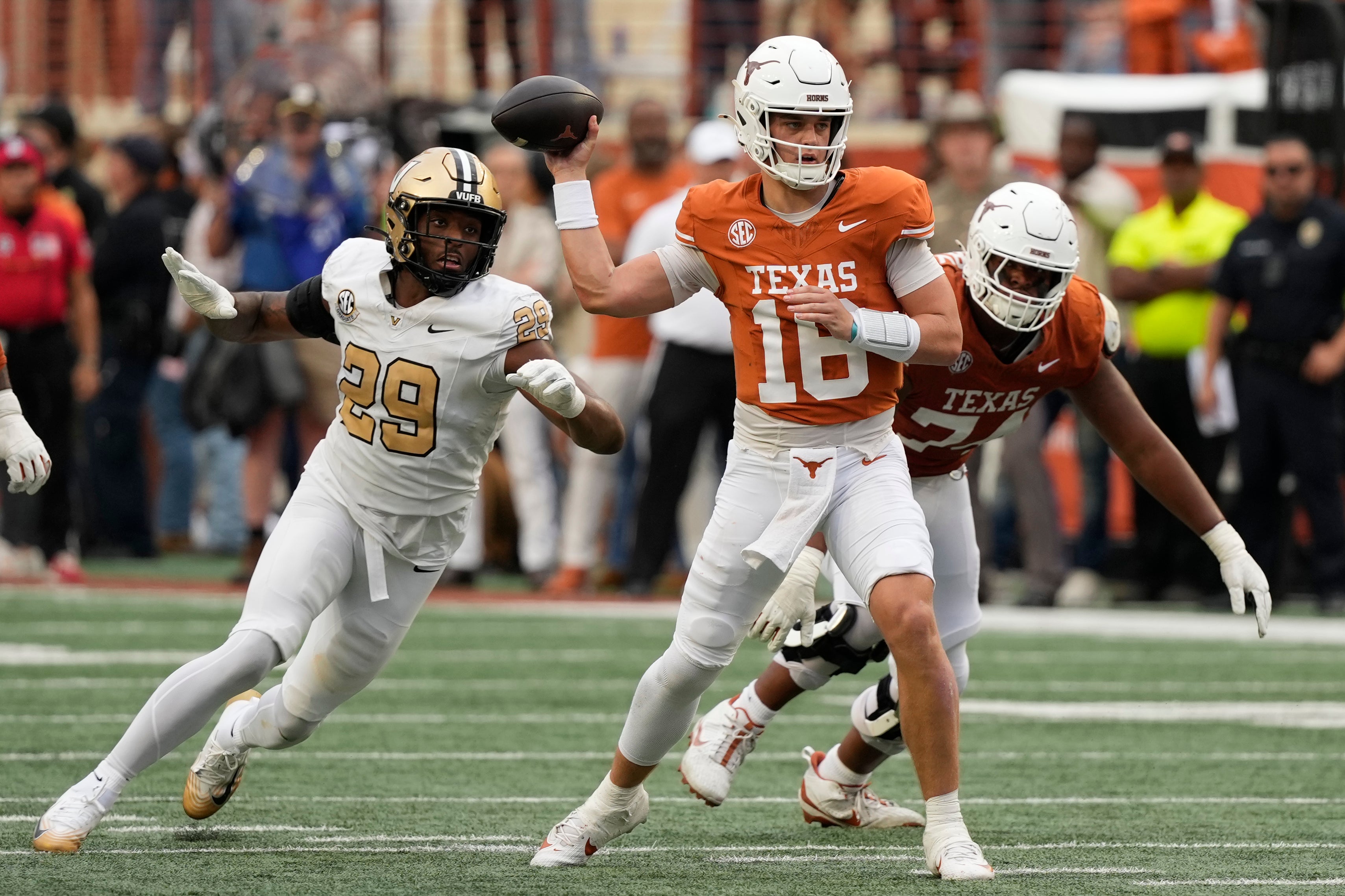
Texas and Michigan roll into Orlando carrying championship caliber rosters, and championship-sized disappointments. This wasn’t the bowl either program had planned for when the season started.
Texas came into the year with Arch Manning under center and College Football Playoff expectations baked into every preseason projection. Michigan opened the season banking on continuity to carry them to the Playoffs. Both programs spent the fall discovering just how quickly momentum can evaporate.
That shared reality is what makes this matchup son compelling. But it’s also why Texas—not Michigan—has the blueprint to walk out of Florida with the win.
Michigan’s résumé looks solid. The structure underneath it does not.
Michigan shows up with the same identity it’s leaned on all season. Power running game. Disciplined defense that doesn’t give up explosive plays. Running backs Jordan Marshall and Justice Haynes combined for nearly 1,800 yards and 20 touchdowns, enough production to keep the Wolverines competitive even when nothing else clicked.
That formula works—until it doesn’t. And bowl season has a way of exposing overly simplified offensive strategies.
Michigan never found its footing this year, and the wheels came off late. Freshman quarterback Bryce Underwood’s stat line tells you everything: 2,229 passing yards, nine touchdowns, six interceptions. The talent is there. The consistency isn’t. When the structure breaks down, the offense stalls out.
Then there’s the coaching situation. Michigan enters this game dealing with late-season staff turnover as HC Sherrone Moore was let go amidst scandal. That trauma is impossible to smooth over with clichés about staying focused. Preparation timelines shift. Evaluation processes change. Uncertainty creeps into a program. Bowl games don’t hide those cracks—they highlight them.
Michigan can win this game if it controls the clock, stays ahead of the chains, and forces Texas into predictable third downs. But that requires execution from an offense that’s been inconsistent all year and stability from a coaching staff that’s dealing with anything but consistency.
The blueprint is there. The question is whether Michigan can actually execute it when the margin for error is this thin.
Texas didn’t just survive November. It answered major questions.
Texas’ season didn’t collapse. It recalibrated.
The turning point wasn’t about avoiding losses—it was about how the Longhorns responded after playoff hopes slipped away. The win over Texas A&M wasn’t just rivalry week emotion. It was a statement about physicality, execution, and composure that Texas had been chasing all season. That performance didn’t just close out the year. It reset the program’s identity heading into bowl prep.
Arch Manning’s trajectory tells the same story. He finished with 2,942 passing yards, 33 total touchdowns, and seven interceptions—solid numbers across the board. But the real development showed up in November. Three straight games over 300 yards. Sharper command at the line of scrimmage. Better instincts when the pocket collapsed and plays broke down.
Manning stopped forcing the moment and started controlling it. That shift is what separates a talented freshman from a quarterback who can actually win you games when the structure isn’t perfect.
Against Michigan, that maturity becomes the difference. This isn’t a game that needs fireworks. It needs discipline, spacing, and a quarterback who understands when to take what the defense gives him instead of chasing the highlight reel.
Texas has that now. Michigan is still trying to figure out if it does.
The matchup that tilts the bowl
Michigan wants to grind this game out between the tackles. Texas wants to stretch it into open space and make Michigan chase.
The matchup that decides which vision wins starts up front. Texas’ run defense has been one of the SEC’s most consistent units all season, ranking near the top in yards allowed per carry. That’s a problem for Michigan, because controlling the line of scrimmage is the foundation of everything the Wolverines do offensively. If Texas holds up early and forces Bryce Underwood into predictable passing downs, the entire structure of Michigan’s game plan falls apart.
Michigan’s receivers—Andrew Marsh and Donaven McCulley—can make plays when the ball is on time and the coverage is clean. But they’re not built to win consistently against a defense that can disguise pre-snap looks and disrupt timing. Texas doesn’t need to generate constant pressure. It just needs to win first down and force Michigan into second-and-long situations where Underwood has to carry the offense himself.
On the flip side, Texas’ receiver depth creates mismatches Michigan doesn’t have an answer for. Ryan Wingo’s breakout season, combined with DeAndre Moore and Parker Livingstone, gives Steve Sarkisian the ability to attack coverage both horizontally and vertically. Michigan can handle one matchup problem. It struggles when forced to account for multiple threats at once.
That’s the edge Texas brings into this game—not just talent, but options. And in a bowl matchup where execution matters more than emotion, options win.
Texas’ bowl prep has purpose.
Steve Sarkisian has been clear about what this bowl game represents for Texas—it’s not a playoff audition, it’s a live evaluation with high stakes attached. The running back rotation, offensive line combinations, and defensive snap distribution aren’t just game-day adjustments. They’re auditions for 2026. Texas already knows who its core is. The Citrus Bowl is about sharpening the edges and identifying who steps up when the depth chart opens up.
Michigan, meanwhile, is caught between development and survival mode. Coaching turnover shifts priorities. Playcalling gets conservative. Young quarterbacks feel the weight of that uncertainty, and it shows up in execution. Bowl games usually come down to which sideline knows exactly what it’s trying to accomplish—and right now, Texas has a much clearer answer than Michigan does.
Why Texas wins
Michigan is disciplined, physical, and absolutely capable of grinding this game into a slugfest. That said, Texas is building momentum. Michigan is still trying to find it.
The Longhorns have the quarterback whose development is accelerating, not stalling. They have the defensive front built to neutralize Michigan’s bread-and-butter run game. And they’re coming off a rivalry win that reinforced their identity instead of exposing their flaws. This doesn’t feel like a consolation prize for Texas—it feels like a checkpoint. A chance to close a messy season with something that looks like progress. Michigan is still searching for what that progress even looks like. Bowl games reward teams that know who they are and can execute that identity under pressure. Right now, Texas has a much clearer answer to that question than Michigan does.
Score prediction: Texas 28, Michigan 20
A win built on defensive discipline, quarterback growth, and a program that looks far more settled than it did a month ago.
Texas Longhorns News
Texas’ roster shakeup begins: what the first seven Portal entries reveal about Sarkisian’s vision for 2026
Here’s what each departure means and how Steve Sarkisian’s team is redefining its identity.


