The Dallas Mavericks' most glaring problem has an extremely clear fix
DALLAS – Midway through the third quarter, after the Dallas Mavericks and Orlando Magic traded scores are back-to-back possessions, Luka Doncic hunched over and put his hands on his knees. He looked tired. At that point, he had scored 32 of his eventual 44 points, and the Mavericks' lead hadn’t looked commanding in the slightest. […]

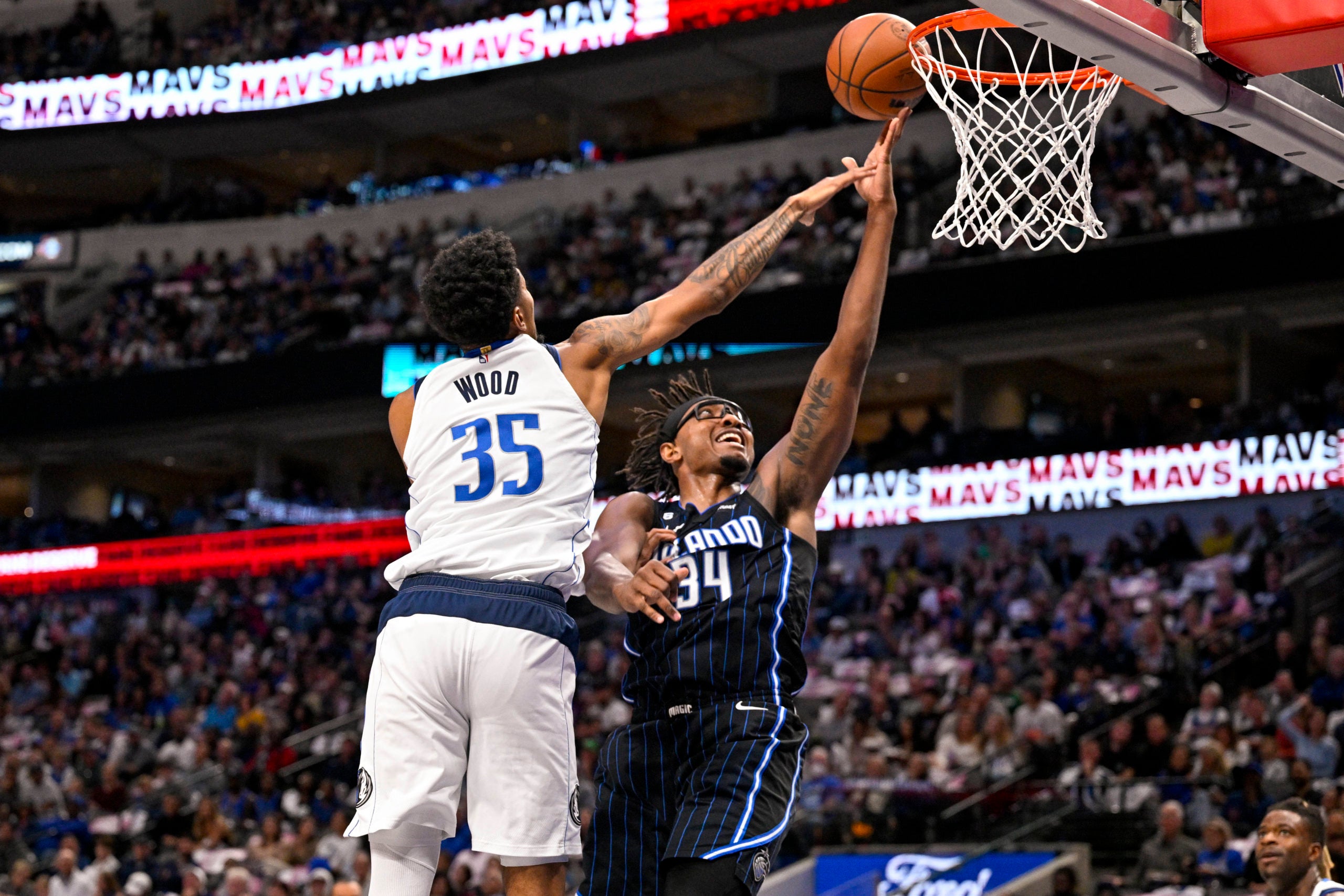
DALLAS – Midway through the third quarter, after the Dallas Mavericks and Orlando Magic traded scores are back-to-back possessions, Luka Doncic hunched over and put his hands on his knees.
He looked tired.
At that point, he had scored 32 of his eventual 44 points, and the Mavericks' lead hadn’t looked commanding in the slightest. Doncic went on to play the rest of the frame before taking his usual rest to start the final quarter of action.
Dallas still hadn’t pulled away.
It took a fourth-quarter surge from veteran Tim Hardaway Jr., who scored 12 of his final 21 points in the final stanza, to finally put away a pesky Magic team that seemingly hung around all Sunday night at American Airlines Center.
The final score: 114-105.
Yet, what the weekend, including a bizarre meltdown loss to the Oklahoma City Thunder on Saturday night, revealed about the Mavericks was this team has a two-pronged problem that can be fixed with one amicable solution.
The problems? Defending at the point of attack and closing out games. The solution? Jason Kidd settling on a rotation that doesn’t feel nearly as clunky as it does currently.
After blowing a double-digit cushion to Oklahoma City and becoming the second team ever to blow a 16-plus point lead with four minutes remaining, Dallas gave up a first quarter that saw Orlando shoot 62 percent from the floor and 67 percent from the 3-point line.
Some may call it a back-breaking loss hangover. Others may say Orlando was playing above its usual competency. But the truth is somewhere in the middle. Dallas isn’t as sound defensively as it was last season, and it appears to be hurting the team in critical moments – whether that comes at the start of a game or the end.
And the porous defensive effort has weighed on Kidd as a head coach.
After Sunday night’s game, when prompted to explain why Dallas let Orlando jump out to an early lead, Kidd detailed the glaring flaws within the team’s recent defensive trends.
“I think we’re starting to get into this trend of giving up a big first quarter that we have to address,” Kidd said. “Looking at the scorers around the league, there’s a lot of points being scored. So, if you’re not comfortable getting into the 115 or 120 [point range], you’re probably going to be in trouble.
“Until we can become connected on the defensive end, we’re just going to have to ride our offense. Our offense is playing at a high level. We’ll figure out the defensive side of the ball.”
When pressed as to why the team’s defense was struggling, Kidd answered with a non-answer.
“We haven’t worked on it enough,” he said while laughing.
Though that may be true, there is also another reason Dallas’ defense has struggled at the start of games and in critical moments – the rotation.
In short, it’s a mess.
Kidd is firm in starting JaVale McGee. The only issue evident in Kidd’s decision is that McGee hasn’t been a net-positive player for the Mavericks.
Further, McGee, coming into Sunday’s game, was a minus-23 when on the floor this season. On Sunday, in nine minutes of game action, McGee was a minus-12.
He hasn’t played well. And though Kidd gives him the benefit of the doubt, stating that McGee is still learning, it feels incongruent to want better first-quarter defense while also not starting the game with a better big man in the middle.
Dallas has depth at the center position. Between Christian Wood, Maxi Kleber, and Dwight Powell (who played well in both games), there are enough centers on the roster for Dallas to experiment. Kidd knows that.
But what Kidd likes about McGee is his tone setting and the idea of him being an establisher of the sorts with the first unit. In principle that idea makes sense. It also bodes the question, however, at what cost?
Penciling McGee in as a starter every night he is healthy only limits Kidd’s ability to tinker with the rotation. It is slowing down the process of finding the best five — and a closing five, an issue that reared its head against Oklahoma City.
It’s clear that Wood, at least for now, won’t get a starting nod — even with McGee struggling. When McGee rested against the Thunder, Powell was thrust into starting duties.
“When you look at the rotation today, we’ll give him [McGee] a chance,” Kidd said. “He’s going to get into the swing of things, and we believe in him. He’s going to start… We believe in JaVale, and he’ll be better.”
Powell will continue to play spot minutes. Kidd said he wants to find minutes for him in the rotation on a consistent basis. And it might be beneficial for Doncic to have a vertical floor stretcher and lob threat in him. Kleber is going to do what he does, barring any injury. Yet, what stands out is McGee and his play.
Through the first six games, it hasn’t looked great. Neither has Dallas’ defense or the team’s ability to close games. But fixing both issues isn’t necessarily quantum physics. It comes down to Kidd finding his best five, building trust with them, and letting them learn through trial. Yet, to get there, Dallas must be willing to explore more options rotations-wise. To be married to an idea — solely based on principle — would only prove to be a fool’s errand.
Related Dallas Mavericks reading
"Luka Doncic learns an extremely important lesson in an overtime win against Brooklyn."
"The cruel reality facing the Dallas Mavericks early in the season."
"How the Dallas Mavericks may have walked into the next Patrick Beverley."
Feature image via Jerome Miron-USA TODAY Sports