
Titans' old habits have created all kinds of new problems
Thanks to Mike Vrabel leading the Tennessee Titans to their most successful era of football in decades, there hasn't been much doubt regarding his process and the effects it has on the entirety of the football team. There's simply been too much winning to even think about questioning Vrabel and the way he's guiding the […]


Thanks to Mike Vrabel leading the Tennessee Titans to their most successful era of football in decades, there hasn't been much doubt regarding his process and the effects it has on the entirety of the football team.
There's simply been too much winning to even think about questioning Vrabel and the way he's guiding the franchise product on the field.
But if there's one Achilles heel of Vrabel's that has stuck out like a sore thumb — despite the success he's had so far — it's his stubborn ways of addressing key aspects within the team.
That same stubbornness hasn't exactly negatively impacted the Titans in a significant way just yet, mostly due to the fact that their winning has outweighed any potential sore spots Vrabel might have.
However, that soon might change, as Vrabel is now facing the difficult challenge of staring his stubbornness in the face and deciding if it's time for him to change or not.
This sudden shift in mindset comes after the Titans got flattened by the Buffalo Bills on national television by a score of 41-7.
"We got our asses kicked," Vrabel said. "Plain and simple."
The embarrassing display was littered with deficiencies, from lapses in coverage to poor attempts at showcasing a smidgen of what the modern NFL calls offense.
From start to finish the Titans truly looked helpless, and as a result, the franchise is off to its worst start in a decade.
"We have to get things fixed," Vrabel said after the game. "We have to figure out how to win a game."
Letting the outmatched rookie fight a losing battle
In terms of fixing things, the journey might have to start with Vrabel.
Throughout the game, the Titans elected to stick with their usual methods within the secondary by not choosing one of their corners to shadow Stefon Diggs.
Granted it's a tough ask of any corner on the Titans' roster to shadow Diggs, since he's constantly proven why his status as one of the league's best receivers is legit. But with how badly the Titans' initial plan blew up in their face, it's confusing as to why they didn't at least explore the possibility of engaging in a different thought process.
For years, the Titans have opted to stick to scheme instead of breaking it off and practicing new theories. That means keeping every corner within the defense at their schemed or predetermined spot, instead of using one to follow a receiver around in hopes of preventing any problems from developing.
This same line of thinking has worked out for the Titans before, but tonight, Diggs and the Bills completely exploited it and the Titans simply didn't respond.
Rookie corner Tre Avery was often matched up with Diggs due to his predetermined spot within the scheme. Normally, these red flags would be addressed with extreme swiftness and precision, but in the Titans' case, they simply decided to let events play out.
The results were expected, as Diggs torched Avery whenever he got the chance.
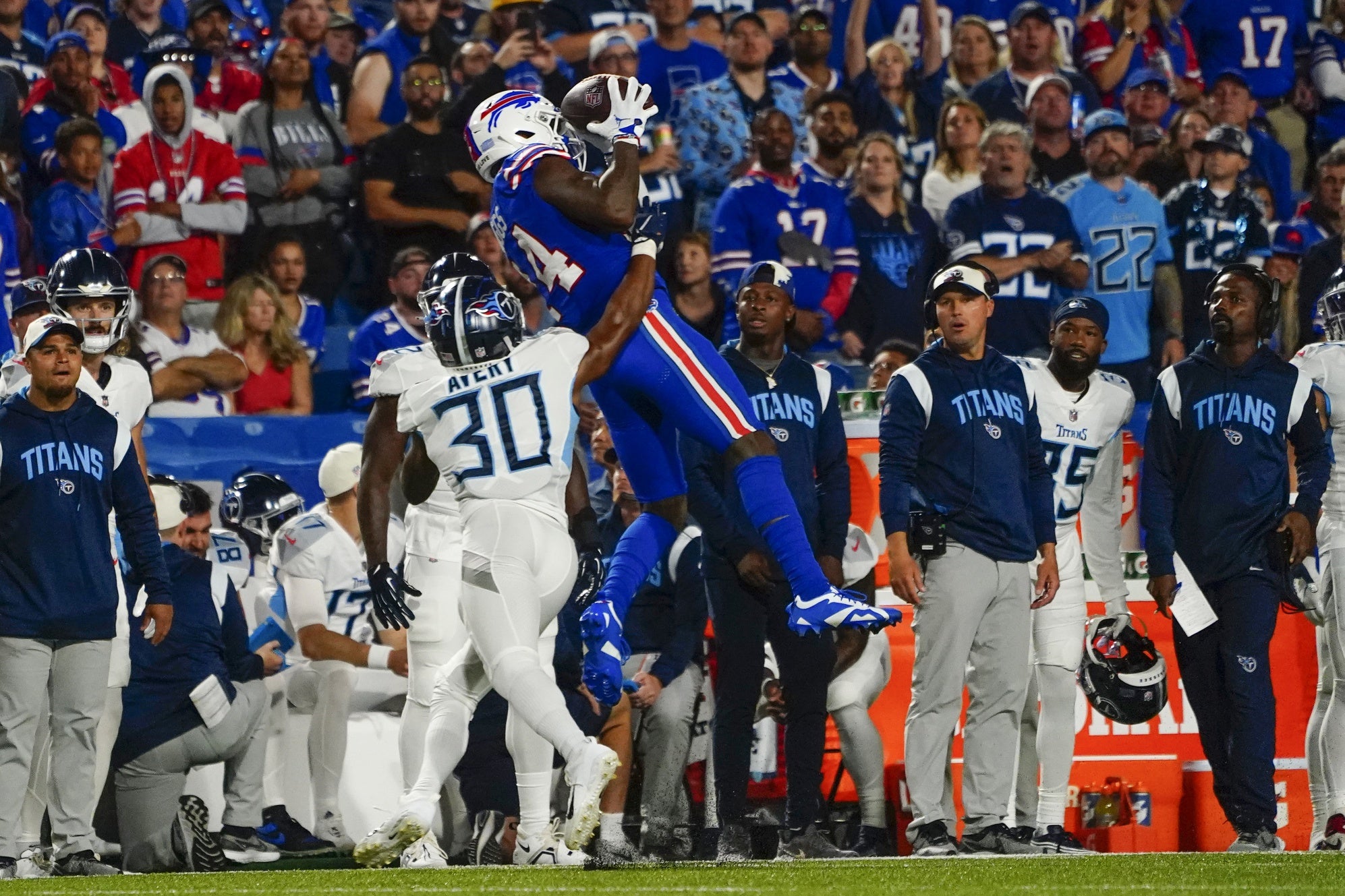
"We were certainly trying," Vrabel responded to a question asking if the Titans thought about switching up coverages that reflected Diggs' success.
As Diggs' performance unfolded, the Titans didn't look to stick another corner on him. They stayed true to their roots — which is to stay within their scheme — and they got burned for it.
There's obviously no guarantee that sticking another corner on Diggs would help minimize the impact he was making on the field.
But in a game where you need to minimize the impact of opposing playmakers, you have to at least put in an effort towards trying different things in hopes of meeting a dissimilar outcome.
Because if you don't, you're more than likely going to end up on the wrong side of the spectrum, no matter how hard you try to make your own personal way work.
However, that isn't solely connected to the on field side of things. It can also be tied to your preference of change and how quickly you want to engage with the process it brings.
The Todd Downing problem
Todd Downing's status as the Titans' play-caller falls in line with the idea of change.
His track record so far hasn't been pretty. His inability to avoid head-scratching play calls, as well as his lack of awareness when it comes to personnel fits stand out as the main reasons why his stronghold on the play-calling duties has come into question.
To make these concerns go away — and all the shouts for him to relinquish his duties — Downing has to exhibit a vast alteration in call frequency and alertness to detail when it comes to personnel frequency.
However, against the Bills, Downing didn't do much in the way of eliminating the very issues that are plaguing him in the first place.
"It's not going to be about one person," Vrabel said.
The offensive flow after the opening game script was mostly nonexistent, as Downing continued to familiarize himself with confusing run calls on long down and distance situations, and the practice of telegraphing plays due to confusing usage of personnel.
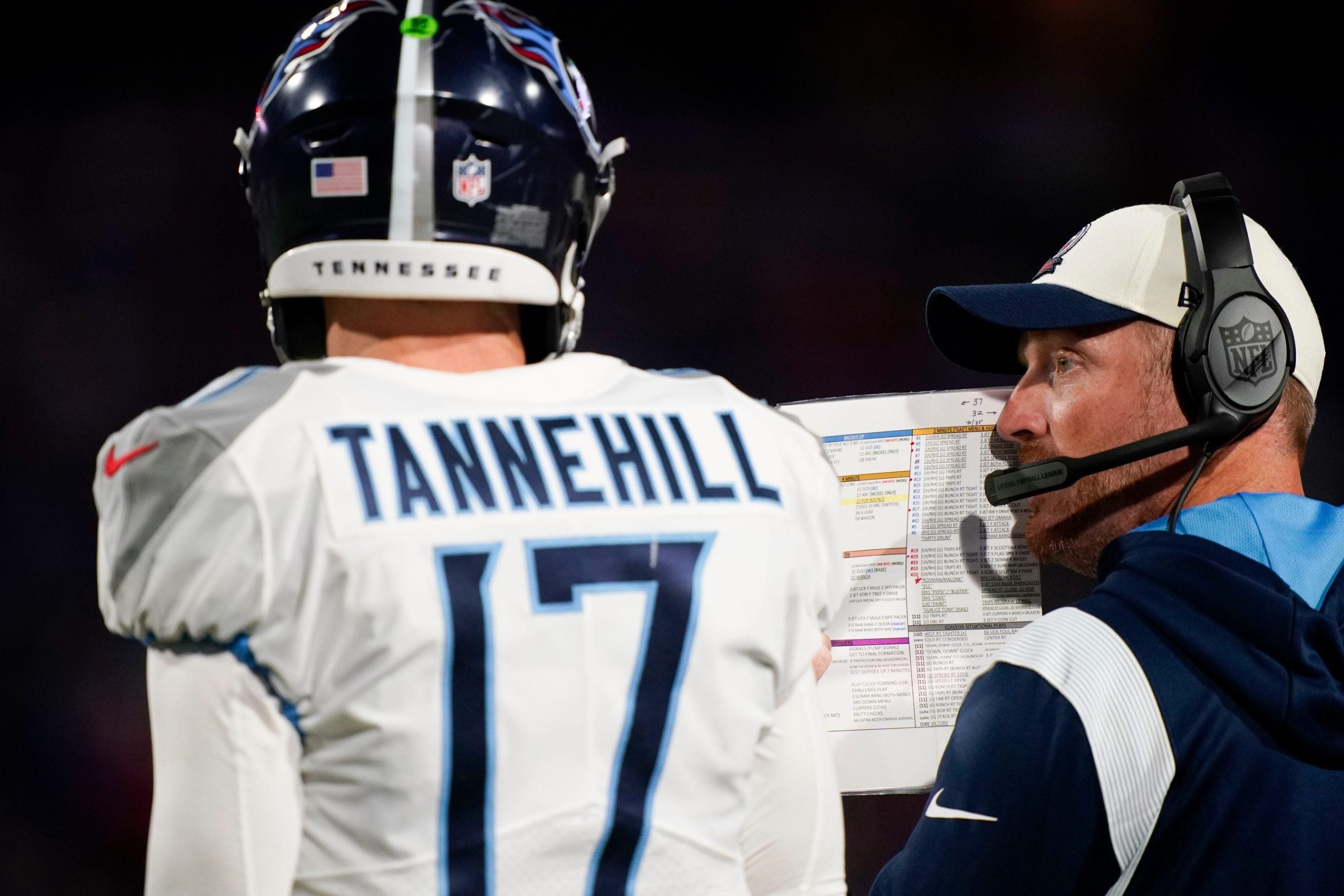
These two issues have been reoccurring problems for Downing as a play-caller dating back to last season. They've led to this offense becoming predictable and somewhat anemic more times than not, which has in part turned the unit into one big mess.
With such a drastic change in offensive output, the expectation for an organization that's rebranded itself as one of class and excellence, would be to examine any scenarios to right the ship and bring such a physical group back on track.
But with Vrabel, the idea of suddenly adjusting the current formula and moving away from what worked previously, isn't something that falls in line with the norm of how he operates.
That includes removing Downing from the post as lead play-caller or moving away from the habit of being scheme dependent and force feeding the football to your playmakers.
Vrabel was in a similar situation after the 2020 season, as Shane Bowen was fresh off a season coordinating one of the league's worst defenses. Vrabel had the option of removing Bowen from the post and slotting a new mind into Bowen's potential old role.
But he stuck with his guns and elected to trust Bowen's ability to rebound the following season.
The move fell in line with Vrabel's method of keeping continuity across his staff for as long as possible, regardless of the results that may arise. Downing's situation has many similarities, as Vrabel didn't want to jettison a coordinator because of a down year leading a unit.
The difference between the two though, is the fact that Bowen evolved and found ways to exploit his personnel in a good way during his second go-around as a coordinator. Unlike Downing, whose well known struggles have stepped into the spotlight once again.
And unless Downing finds a way to move past his struggles — which at this point in time seems unlikely — this offense will continue to sputter.
And Mike Vrabel will have to be the one to answer for it doing so.
Moving forward, there has to be a level of reform, as these blatant shortcomings can and will keep this unit from avoiding a tragic downfall.
Vrabel is the one who controls the keys to do so, whether he chooses to use the key to flip the switch though, remains to be seen.
"There's always going to be plays as a play-caller you wish you had back," Vrabel explained.
Featured image via Mark Konezny-USA TODAY Sports


