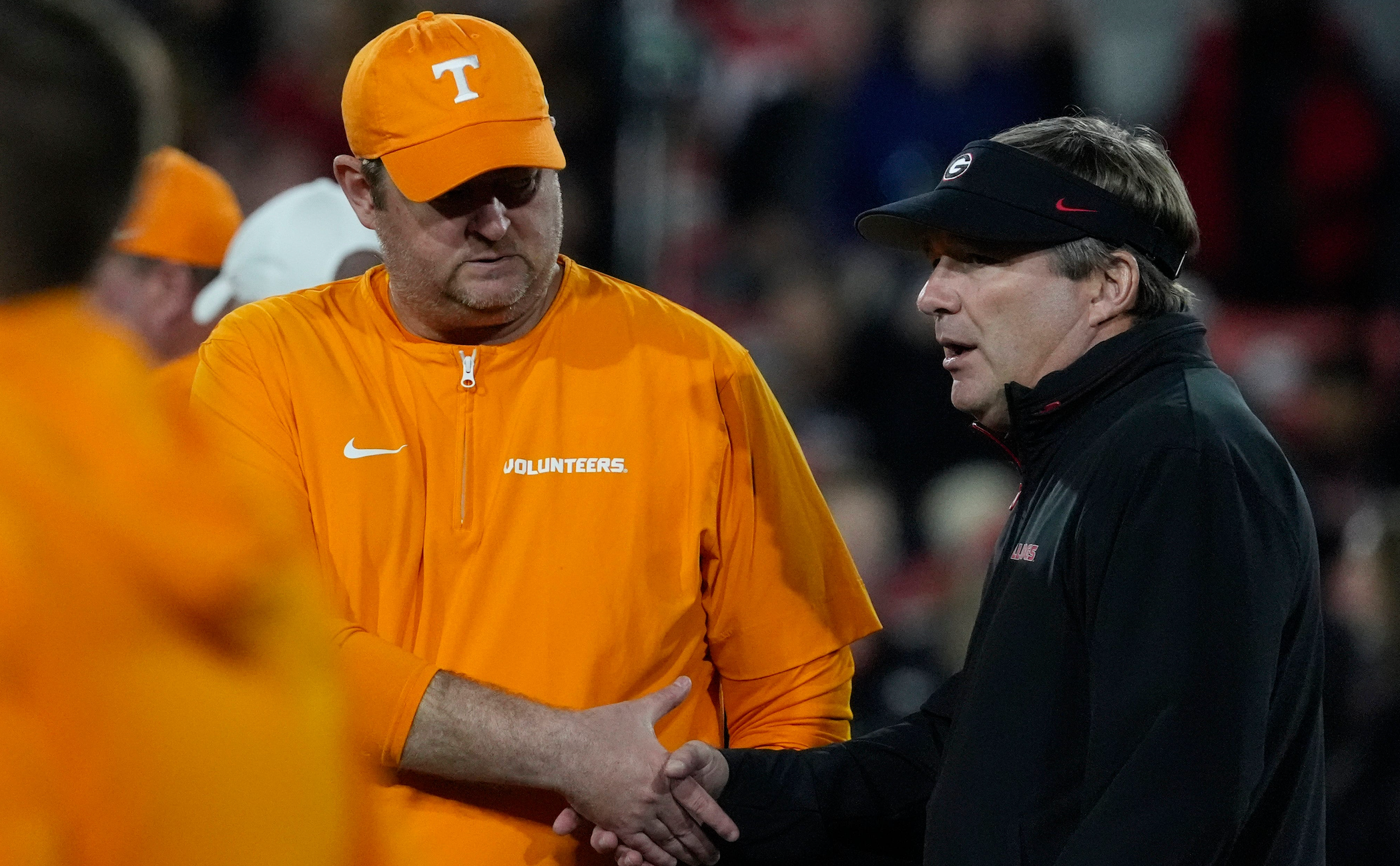
Georgia's Kirby Smart inadvertently makes great case for why Tennessee shouldn't have been penalized for 12 men on the field
One of the most controversial calls in the Tennessee Vols' loss to the Georgia Bulldogs this past weekend was a 12-men-on-the-field penalty that was called against UT after a late offensive substitution by UGA. The penalty turned a third-and-seven into a second-and-two for the Bulldogs with the game still tied at 17 in the third […]



One of the most controversial calls in the Tennessee Vols' loss to the Georgia Bulldogs this past weekend was a 12-men-on-the-field penalty that was called against UT after a late offensive substitution by UGA.
The penalty turned a third-and-seven into a second-and-two for the Bulldogs with the game still tied at 17 in the third quarter. It was a call that dramatically changed how the game was played.
Here's what went down.
Georgia made an offensive substitution and Tennessee countered by running two players onto the field. Those two players started running onto the field with 17 seconds left on the play clock (Georgia's substitutes got to the line with around 20 seconds left on the play clock). The official held the snap for around seven seconds (once UT started its substitution) even though Tennessee defensive lineman Jaxson Moi, who was jogging at a slow pace, wasn't off the field yet. Moi still had one foot on the field when the ball was snapped, which resulted in the penalty (the play was reviewed thanks to some politicking from college football darling Georgia head coach Kirby Smart).
Over the last two days, Georgia media and fans have pointed to a "three second" rule that they claim states that defensive players have three seconds to get off the field when matching an offensive substitution.
That's actually not the rule. And Smart confirmed that on Monday while speaking with reporters.
Smart, who admitted that Georgia will sometimes use the same strategy of trying to make the opponent burn a timeout in the that situation, also inadvertently made a strong case for why it shouldn't have been a penalty on Tennessee.
"The issue is every conference officiates it differently," said Smart of the substitution situation. "I've watched teams really late at night, so you can imagine where they're playing, what part of the country they're in, where that's completely accepted in terms of take as long as you want.
"They don't actually let you do that in our league, and that's really to benefit the teams that play with pace. Because if they allow you to sub and take all the time you want, then you really slow teams down. And there's not a game that I've played in that they don't come over there and tell you, you either gotta speed your guys up, or we're gonna set it on the ready for play, and we're gonna wind the clock. Because people have made it where if an offense makes a mistake and subs late, they're gonna make them burn the timeout. Everybody tries to do it, we even try to do it. But you can't do it at the expense of 24 seconds. There's 23 seconds on the clock, and we're gonna go sub a guy and take 20 seconds up, because that isn't what it takes.
"A lot of people say, well, they say you have to sub in three seconds," continued Smart. "No, you have to start the substitution process in three seconds. That's how long you have to start the process. But it doesn't say once you start the process, you can go at a snail's pace off. They give you a reasonable amount of time, and they give you an opportunity to snap the ball. So that's the rule. If somebody subs with ten seconds left on the shot clock, they're probably gonna get a delay of game if somebody tries to sub on defense. But if they do it with 20, there's reasonable time to sub."
So according to Smart, the opponent has three seconds to start a substitution. Georgia finished its substitution with 20 seconds left on the play clock and Tennessee started running players onto the field with 17 seconds left on the play clock which means the Vols were in compliance with that aspect of the rule.
From there, it gets subjective. According to Smart, once you start the process, you get a "reasonable" amount of time. We can argue all day what that amount of time is, but since it's not clearly stated in the rule book, there's no point in arguing it because no one will ever agree on an answer. That debate is a complete waste of everyone's time.
Smart, however, seemed to suggest that 10 seconds is a reasonable amount of time. The official in the Georgia/Tennessee game held the snap for around seven seconds. If he holds the snap for three more seconds, Moi is nearly off the field (even while jogging at a leisurely pace) when the official moves. And he's definitely off the field before Beck snaps the ball.
Based on Smart's comments, the Vols should've had a few more seconds to finish their substitution.
I think a couple of things are obvious here. If the official wants to call it a penalty, then it's a penalty. The rule is ambiguous enough that it's impossible to say that the call was 100 percent wrong.
But at the same time, I think everyone (if they're being reasonable) can agree that the official in this game didn't hold the ball as long as we usually see in these situations in college football (note: Kirby's comment about the SEC officiating it differently doesn't mean that there's a different rule…it means he thinks the SEC officials interpret the rule differently than other conferences).
(And by the way, Moi's one foot that was still on the field had absolutely zero impact on the play.)
Tennessee did something that we see teams do every Saturday in college football. And it's almost never a penalty on the defense. For whatever reason, the officials decided on Saturday night in Athens to officiate that situation differently than they have in the past.