
Why Nashville Predators fans and media were wrong about Kevin Lankinen
It was a signing that came with a lot of confusion for Nashville Predators fans and media alike. Kevin Lankinen came to the Predators when General Manager David Poile signed him to a one-year contract worth 1.5 million dollars on July 14, 2022. Not a bad price for a backup goaltender. But the confusion around […]

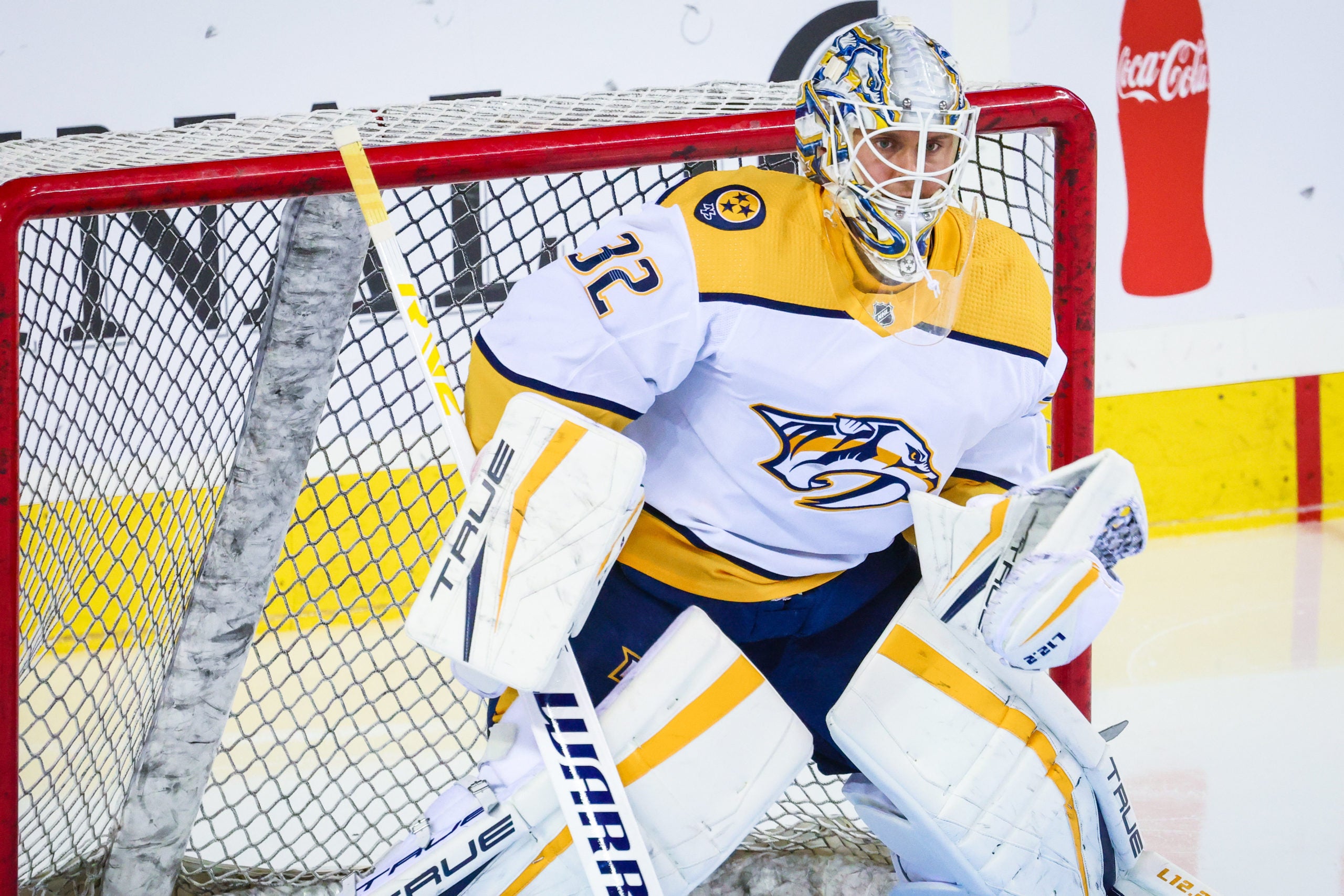
It was a signing that came with a lot of confusion for Nashville Predators fans and media alike.
Kevin Lankinen came to the Predators when General Manager David Poile signed him to a one-year contract worth 1.5 million dollars on July 14, 2022. Not a bad price for a backup goaltender.
But the confusion around signing him had more to do with the Preds' recent experience with the Finnish netminder, who had previously played two seasons with the division rival Chicago Blackhawks. The Predators had seen a lot of Kevin Lankinen over the past two seasons and they hadn't been kind to him.
Lankinen played six games against the Predators over those two seasons. The numbers were less than ideal. Lankinen had a record of 1-4-1 against the Preds, with 17 goals scored against him. His lone win came in overtime in the coaching debut of Derek King, who served as Interim Head Coach after the firing of Jeremy Colliton.
What's more is that after his first NHL season, when Lankinen had a record of 17-14-5 and a save percentage of .909, in his second season, things took a turn for the worse. He finished with a record of 8-15-6 and a save percentage of .891. After that season, with his contract expiring, Lankinen hit free agency.
This is where the Predators, and subsequent fan confusion, came into the picture.
Signing Kevin Lankinen didn't make much sense at the time
Nashville had just faced an early and uninspiring exit from the first round of the playoffs to the eventual Stanley Cup Champion Colorado Avalanche. One of the biggest contributing factors to this abrupt end to the postseason was the high-ankle sprain of Juuse Saros that forced less-than-reliable David Rittich into the spotlight for Game 1. Rittich lasted just over 15 minutes and allowed 5 goals before being pulled in favor of AHL call up Connor Ingram.
In the aftermath, Rittich was allowed to walk in free agency and the Predators went into the summer with a rehabilitating Saros and Connor Ingram. Most assumed Saros would be back at 100% by the start of the season and Connor Ingram, who had become a fan favorite, would be the probable backup. That's when free agency opened and Poile made the deal.
First, there was a rumor that Nashville was in talks with Lankinen. This drew a lot of attention, mainly because of the Nashville vs. Chicago (with Lankinen in net) results of the past two seasons. Then, Poile signed Lankinen. Alex's feeling mirrored what a lot of us were thinking:
Now, all speculation aside about reasons for signing him, whether it was confidence in Ingram, upgrading from Rittich, or something else, it did provide for a competition scenario in training camp. To make a long story short, John Hynes explicitly said that the backup goalie position was an open competition for everyone at training camp, which included Lankinen, Ingram, Yaroslav Askarov, and Devin Cooley.
Askarov, while impressive and exciting, was raw and needed refining in Milwaukee. Cooley, though solid, also went to the AHL. This left Ingram and Lankinen with the team as they headed to Europe for their NHL Global Series adventure. The trip allowed them to keep an expanded roster size, but Ingram saw no action on the trip. Lankinen, however, started the second game of the season and came away with a big win, looking cool, calm, collected, and in command of the game.
Soon after returning from Europe, Ingram was waived and claimed by the Arizona Coyotes. That left the Predators with their goaltending tandem of Vezina finalist Juuse Saros and Kevin Lankinen. The early returns were good, but expectations were still fairly low. However, after the season got going, Lankinen looked great in net. Basic stats tell a lot of the story. As of publication, Lankinen carries a save percentage of .924, 4th out of all NHL goalies with at least 300 minutes on the ice. And while the results are far better than his previous seasons, how much of his improved performance can be attributed to the team playing in front of him?
Most assumed that the difference was as simple as this–Lankinen was a good goalie on a bad team in Chicago and now he's playing with a much better team in front of him. However, a careful examination of a few other key statistics tells quite a different story.
Are the Predators playing better defensively in front of Kevin Lankinen than the Blackhawks did? Here's what I found when I looked at the stats.
Kevin Lankinen's underlying metrics
First, I looked at expected goals against (xGA) from Natural Stat Trick. This is a measure of how many quality chances the team is allowing against Lankinen. It has less to do with the goalie and more with the team. I broke it down to events per sixty minutes played. Since goalies typically play sixty minutes, this is a good way to look at these stats because it lets you know how often each event happens per game.
This season, the Predators are allowing 3.26 xGA/60
Last season, the Blackhawks allowed 2.68 xGA/60.
The season before, they allowed 2.75 xGA/60.
In this category, it's safe to say he's seeing expected goals more frequently with the Predators in front of him than he did in either season with the Blackhawks. Each Blackhawks team was able to keep those expected goals under three, while the Predators are allowing more than three.
Then, I took a look at high danger shots against (HDSA). Again, another reflection on how the team is defending and suppressing (or not suppressing) shots in front of Lankinen.
This season, the Predators are allowing 9.2 HDSA/60.
Last season, the Blackhawks allowed 7.9 HDSA/60.
The season before, they allowed 9.6 HDSA/60.
In this category, the Predators are only slightly better than 2021 Blackhawks, while allowing high danger shots more frequently than last season's Blackhawks.
Finally, I looked at rush attempts allowed. While not necessarily a defensive measure, this stat shows how the team plays in transition. Teams that allow a lot of rush attempts are playing a little looser down the ice, away from the goalie, that can often put the goaltender in a bad situation.
This season, the Predators are allowing 2.36 rush attempts/60.
Last season, the Blackhawks allowed 2 rush attempts/60.
The season before, they allowed 1.35 rush attempts/60.
Once more, in this category, the Predators are allowing more rush attempts than either of the Blackhawks teams that played in front of Lankinen in seasons prior. It's also worth noting that this season, Lankinen is facing rush attempts from the opposition at a much higher rate than he did in either of his previous NHL seasons. To be fair, these metrics all measure dangerous, goal-scoring situations. Looking at shots against (SA), each season, Lankinen has faced about 32 SA/60 with all teams. In other words, Lankinen is seeing the same amount of shots with the Predators as he did with Blackhawks.
Clearly, Lankinen's improvement has nothing to do with "a team playing better defense in front of him". In fact, it appears that the Predators aren't actually playing better defense in front of Lankinen at all; the Blackhawks of last season and the season before did a better job of preventing good chances for the opposition. And, to be fair, these are all metrics of dangerous goal-scoring situations. When compared with the number of shots Lankinen faces, that means the Predators are simply putting him in danger more often.
If better defense can't explain why Lankinen is so much better this season than he was in the previous two seasons, then what can?
What's been better about Lankinen?
One possible reason, based on statistics, is usage. Teams carry two goalies during the regular season. Net-minding responsibilities are usually broken down based on percentages. For example, last season, the Predators had Juuse Saros and David Rittich. Saros was the clear #1 goaltender. Rittich was clearly the backup goaltender. In years past, Preds fans had seen Rinne/Saros combination that was 1A/1B, but with Saros/Rittich, it was definitely 1/2. Last season, Saros started 67 of 82 games–81%. Rittich started 12 of 82–14.6%.
In his first year in Chicago, which happened to be the year of COVID, the Blackhawks played 56 games. Of those 56 games, Lankinen started 37–66%. Last season, a regular, 82-game season, Lankinen started 29–35%. Currently, the Predators have played 47 games. Lankinen has been the starter in 10–21%. What this says to me is that Lankinen does better with more time between starts. Lankinen may just be an absolutely rock solid backup goaltender that thrives when his usage stays low.
Of course there are other possibilities. It's entirely possible that Lankinen focused on improving his game over the summer. It's also reasonable to assume that Lankinen has benefitted from time with Predators goaltending coach Ben Vanderklok or even special advisor Pekka Rinne. But another likely possibility is that the overall change from one organization to another has helped Lankinen as well. All organizations are different and all teams have different dynamics. It's entirely possible that the Predators organization and the team itself are just a better fit for Lankinen. And, as a result, Lankinen feels better and plays better. Or, it's just a combination of all these things.
Regardless of the reasons, it seems fair to state: Nashville Predators fans and media were wrong about Kevin Lankinen.
-featured image via Sergei Belski/USA TODAY Sports-


