
Solving the puzzle of Harold Perkins’ fit in the NFL and why his 2026 NFL Draft stock is a challenge to figure out
Much has been made about LSU LB Harold Perkins fit in the NFL. Where should the intriguing NFL Draft prospect play at the next level?


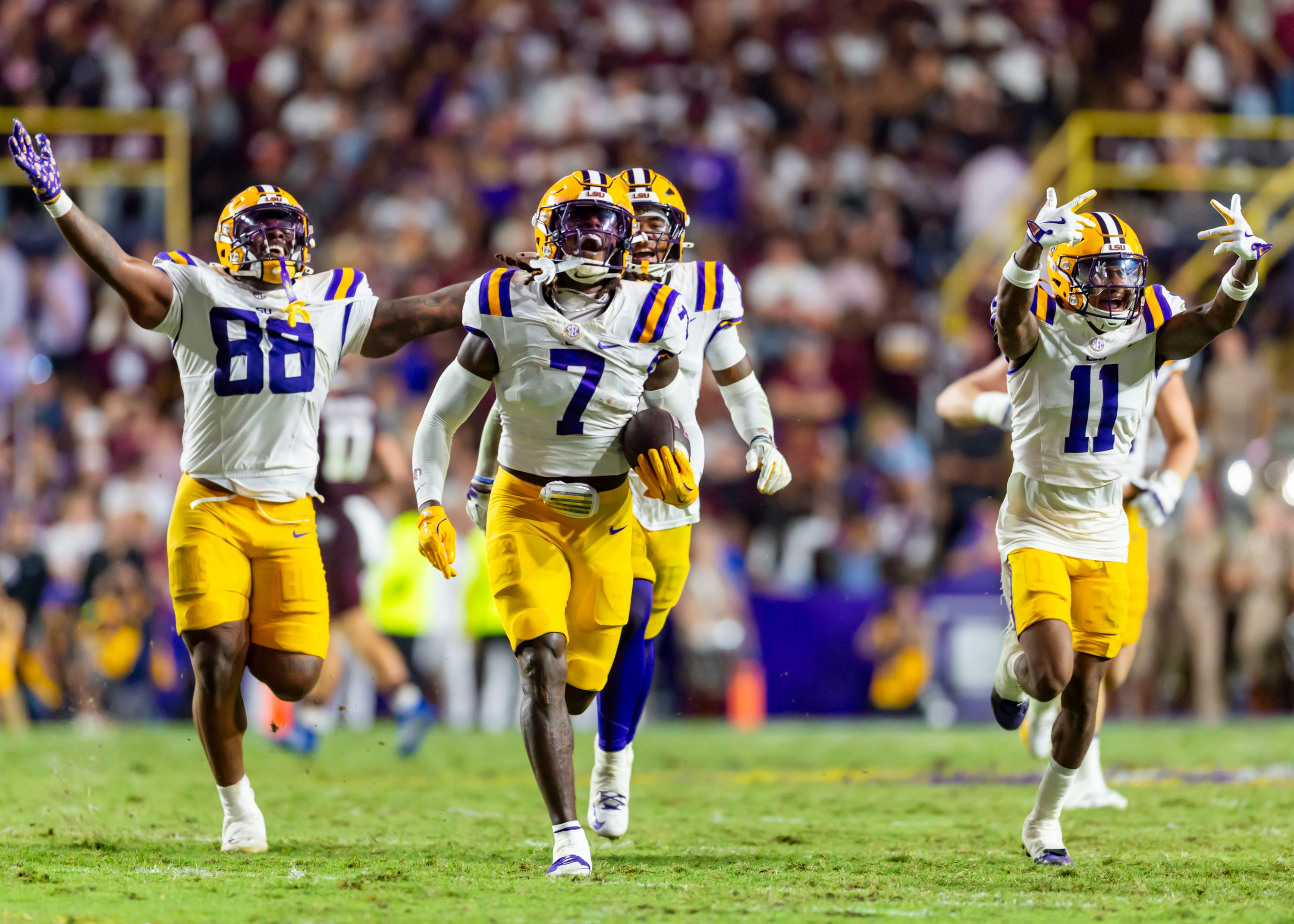
Ever since his freshman season with the LSU Tigers, former five-star do-it-all playmaker Harold Perkins Jr. has dominated discussions as one of the most intriguing defensive players in America. His elite athleticism jumped off the screen right away, and discussions about where to play him broke out early.
The Tigers even struggled to figure out where best to play Perkins, bouncing him from outside to inside linebacker, and a torn ACL in 2024 didn’t help matters. However, under new defensive coordinator Blake Baker, Perkins flourished while playing a fairly unique role for a “linebacker” in college football.
Recently, Perkins accepted an invite to the East-West Shrine Bowl, prompting a discussion about where “best” he fits at the next level. For my money, I have a bit of a different answer than what I’ve seen so far.
The trouble with Harold Perkins’ fit
The staff at LSU tried to move Perkins to an inside linebacker role, and in the words of Brian Kelly: “I can say we made a mistake with that.” Quite frankly, if he can’t play inside in college, he definitely can’t play inside linebacker in the NFL, where the hashmarks are tighter and discipline is much more critical.
Additionally, he can’t really play as an EDGE rusher, simply off of measurables alone. He’s 6’0, 215-pounds, which virtually disqualifies him as anything more than an occasional blitzer. Perkins also struggles to work off of blocks, and there are several reps where he gets completely washed out of the play in run defense.
This lack of measurables to play on the line of scrimmage (or in the box at all, quite frankly) and frustrating discipline puts him in a bit of a bind projection-wise. In the words of a scout I spoke to about this article, he said “*expletive* awesome athlete with nowhere to play in the league”. However, what if there’s a different role for Perkins in the NFL? We can look to his college days to find out where he might be at his best at the next level.
Harold Perkins: Defensive Back?
LSU moved Perkins to play the “STAR” position for their defense this season. A “STAR” is a hybrid safety/linebacker position, essentially acting as a “jumbo cornerback” with the coverage ability to handle tight ends and wide receivers while still bringing the physicality needed to fit the run. In the NFL, players like Kyle Hamilton, Quentin Lake, and Derwin James have popularized this role in modern defenses. However, those are defensive backs moving down to act as an additional linebacker, not a linebacker moving back to defensive back.
Based on his profile, though, I think we can say Perkins isn’t exactly a normal or traditional linebacker. We’re not asking Tuf Borland to move out into the slot and cover wide receivers here. Perkins is a rare athlete, with the fluidity and range to actually cover out of the slot and hang downfield, unlike all but perhaps one linebacker in the NFL.
LSU knew it too, deploying him all over the formation. They used him as a stack ‘backer, overhang, blitzer, nickel, and on occasion the pole-runner in their Tampa 2 looks, whatever they could come up with to maximize his unique athletic tools. It’s this role that I think Perkins would be best at in the NFL, not as a “linebacker”, but rather, more of a unique safety.
We often hear the term “chess piece” thrown around by scouts, and more often than not, that simply means “He’s cool but not really good at any one single position”. I’ve heard those concerns for Perkins already, and it’s not entirely without merit. After all, what I’m theorizing for him here is a complete projection in role. However, this isn’t the first time we’ve seen players like Perkins in the league before, and there’s precedence for his usage with several players currently in the NFL and in the past.
Currently, the Baltimore Ravens play Kyle Hamilton in this exact role. They don’t ask him to cover deep (they tried that and immediately realized that was a bad idea, prompting them to draft Malaki Starks and trade for Alohi Gilman to ensure they didn’t have to do that again). Instead, he’s deployed as a pseudo-linebacker/overhang, where he can match up with tight ends, and play the flats and underneath to keep most things in front of him, where he’s at his best.
Several other players in recent history have been utilized in similar fashion as well. The 49ers used Eric Reid under Robert Saleh all over as both a slot defender and dimebacker, blitzing, playing underneath, and lining up in man coverage. The Lions also used Glover Quin in this role towards the end of his career to maximize his gifts.
That’s the role I envision Perkins working best at. Quite simply, I think he’s too small to play a traditional ‘backer role at the next level. However, if a team has some creative vision to move him further back, I think the sky is the limit for Perkins. It’s all a projection based entirely on his traits and reportedly very high character and work ethic, but that’s what scouting is for.
2026 NFL Draft stock
With this being projection-based, his draft stock could vary wildly from team to team. Some teams with perhaps a more…traditional coaching staff might look at him and dismiss him entirely as a tweener. Others might be more intrigued by his do-it-all ability (hello, Brian Flores) and fight to add him to the team. It will likely just depend entirely on what position he might be viewed at.
If he’s a safety, it’s not a massive projection to make, considering his role this season, but he comes in with significantly less experience there than just about everyone else in the class. Additionally, it’s a stacked safety class at the top, and the position itself isn’t deemed “valuable”, which plays a part in evaluations.
If he’s a linebacker, it gets even trickier. I don’t think this is a role he’d be best suited for, but similar players have gone early based entirely off of traits, which Perkins has in spades. Another LSU linebacker, Devin White, had much the same issues as Perkins and went fifth overall. Another Devin, Devin Bush, went tenth overall. However, it’s a stacked linebacker class, and Perkins isn’t a traditional linebacker, which will also sway his evaluation.
This is why projecting Perkins’ draft stock is a difficult puzzle to crack. He no doubt has the tools, ability, and upside to be worth a top-100 selection in the 2026 NFL Draft. However, he’s a unique, untraditional prospect, and trying to figure those out is always a challenge. There’s a role and a pathway forward for Perkins to be an impact playmaker in the NFL if a team is willing to make that gamble and investment. Of that, I have no doubt.
NFL Draft
4-Round 2026 NFL Mock Draft: Raiders, Browns, Jets, and Cardinals grab quarterbacks and the wide receiver run starts early
Fernando Mendoza and Dante Moore solidifying themselves as QB1 and QB2 as Carnell Tate and Jordyn Tyson lock in the WR1 and WR2 spots


