
Bengals' ideology cost themselves millions in salary cap space when paying both Ja'Marr Chase and Tee Higgins
There should be zero criticism for the Bengals choosing to extend Ja'Marr Chase's contract and keeping Tee Higgins on a new deal. NFL teams should always be praised for paying its best players, especially when said players have proven to be incredibly valuable in winning games. Chase and Higgins are two critical reasons why the […]


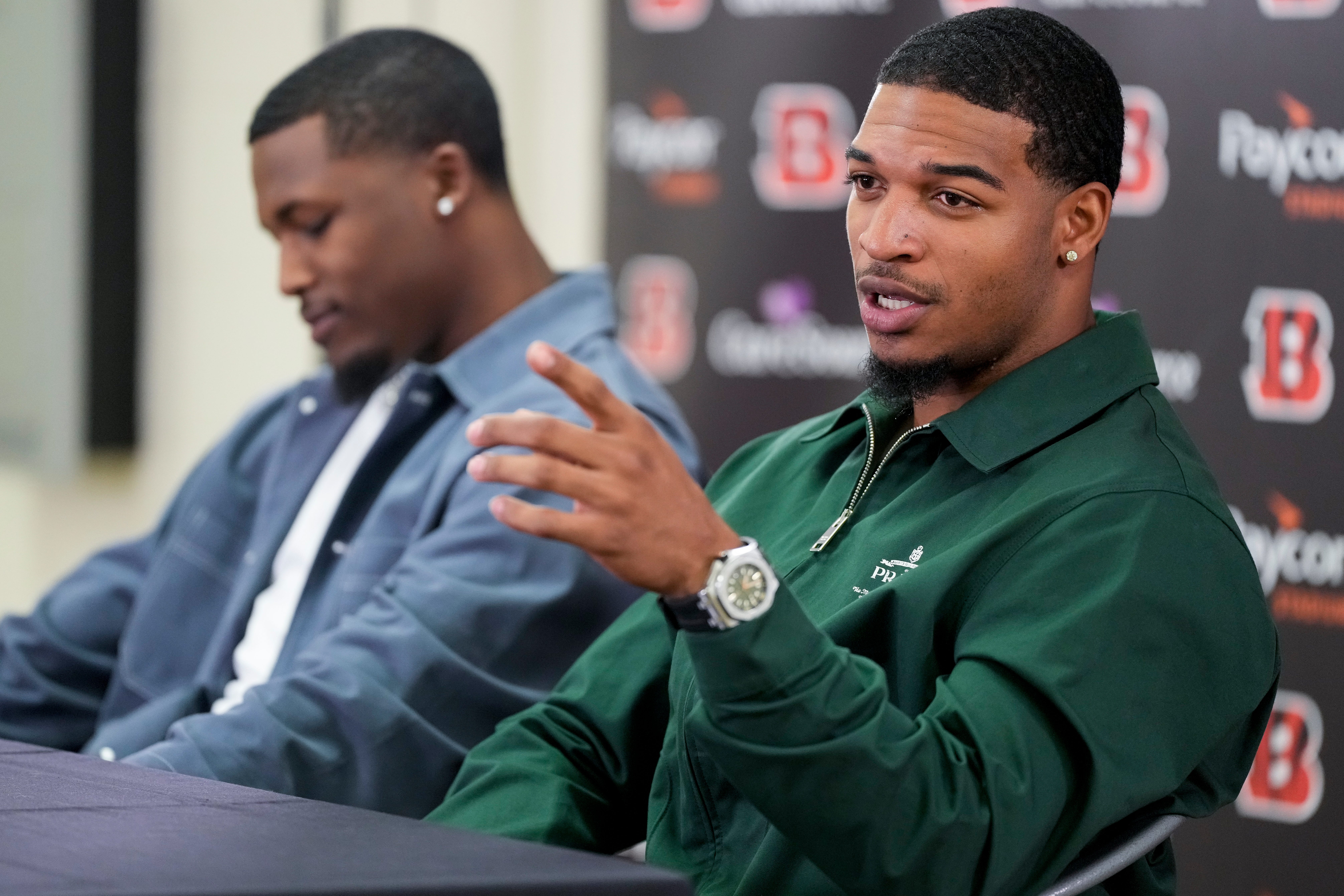
There should be zero criticism for the Bengals choosing to extend Ja'Marr Chase's contract and keeping Tee Higgins on a new deal. NFL teams should always be praised for paying its best players, especially when said players have proven to be incredibly valuable in winning games. Chase and Higgins are two critical reasons why the Bengals have put together four consecutive winning seasons and have five playoff victories this decade.
If there's anything to critique when it comes to paying these two players, it's how they did it, not why they did it.
This goes beyond just the timing aspect. Yes, contracts for Chase and Higgins would've likely been cheaper had Cincinnati gotten signatures from them last year, or in Higgins' case, two years ago. The final numbers are indeed large, but now that we know the true details of both contracts, the Bengals decided against helping themselves in the current day with the way both deals were structured.
In a nutshell, the Bengals aren't saving very much 2025 salary cap space with these deals.
Bengals realize minuscule salary cap savings by signing Chase, Higgins
Before they signed their respective deals, Chase and Higgins combined to count for exactly $47,995,200 against the salary cap for this year. Chase was scheduled to count for $21,816,000 against the cap, which was the fifth-year option the team activated to his rookie contract last offseason. Higgins originally had a second-straight franchise tag placed on him back in February, which was $26,179,200. Add them together and you get a number just shy of $48 million.
That's a hefty sum for two players, and the allure of getting both signed on long-term deals was to lower that sum in order to create more cap space for the addition of more investments.
Investments such as a Trey Hendrickson contract extension, or a veteran guard alongside Lucas Patrick. Investments the Bengas would be wise to make.
This was possible by agreeing to give both players hefty cash payments this year in the form of bonuses that get prorated over the life of the deals. The Bengals could've incentivized their star wideouts with immediate cash and cash in the future in the form of guaranteed future salaries without having to put a large chunk of cash on the books for just this year.
The Bengals did include proratable bonuses for each player, but there are non-proratable bonuses for each of them as well. In turn, their 2025 cap hits are very similar to what they were previously before putting pen to paper Tuesday.
| PLAYER | OLD 2025 CAP HIT | NEW 2025 CAP HIT |
|---|---|---|
JA’MARR CHASE | $21,816,000 | $23,570,000 |
TEE HIGGINS | $26,179,200 | $24,061,765 |
OLD COMBINED CAP HITS: $47,995,200
NEW COMBINED CAP HITS: $47,631,765
NET CAP SAVINGS: $363,435
In the grand scheme of the NFL, $363,435 is virtually nothing. It's less than half of what the minimum salary is. If the last player selected in the upcoming NFL Draft plays all 17 games this year, he will make $560,249 in cash this season than that figure according to Over The Cap.
How did this happen? Well, for Chase, they gave him a $10 million roster bonus for 2025 that is, again, not going to be prorated over the life of the deal. That $10 million is put onto the books for this year only, ballooning his 2025 cap hit by $8 million.
As for Higgins, He's getting a $5 million roster bonus this year in addition to a $15 million roster bonus that is being prorated. Instead of just putting all $20 million into a single proratable bonus, the Bengals split the two and cost themselves $3.75 million in savings.
Why the Bengals continue to operate this way
There are advantages to this. Obviously, both Chase and Higgins still earn plenty of cash this year and their overall cashflows are pretty strong compared to their peers. From the Bengals' perspective, they constructed both contracts to keep future cap hits relatively lower than what they could've been had more cash been prorated into future years. This will allow for more cap space in those years as well compared to what they could've been.
It also minimizes future dead cap the team would have to deal with, which is vital in the eyes of director of player personnel Duke Tobin.
"We've managed our cap well," Tobin said at the NFL Scouting Combine. "We've got low dead money. We want a high payroll and low dead money so the people that are in Cincinnati playing for us can get all the money."
But now we've reached something that borders ideology. Is there an advantage to the Bengals ensuring future cap space if they won't maximize it when the time comes? It doesn't look like it.
The Bengals could've signed both Chase and Higgins to strong deals and saved millions in cap space in order to comfortably add more players to their roster. Instead, their cap space looks almost identical to what it was previously, and there's not as much space to make helpful additions.
Those moves could still theoretically happen, but the Bengals don't spend up to the cap. As of right now, they're at $23,932,791 in top-51 space. They typically save nearly just under $20 million in space leading up to the draft to pay their incoming rookies and have space left over for emergency midseason signings. There will always be space to rollover into the next league year, starting the cycle all over again.
A cycle that could've evolved with these contracts, but is staying the same nonetheless. If any sort of criticism should be pointed in Cincinnati's direction right now, it should be centered around that cycle failing to evolve.
Bengals Free Agency Tracker: Signings, additions, releases, and everything else to know
All the latest updates for Bengals free agency.


