
Bengals have an easy first task of their offseason and they should honestly get it done before the season ends
Cincinnati should act fast with starting right guard Dalton Risner.


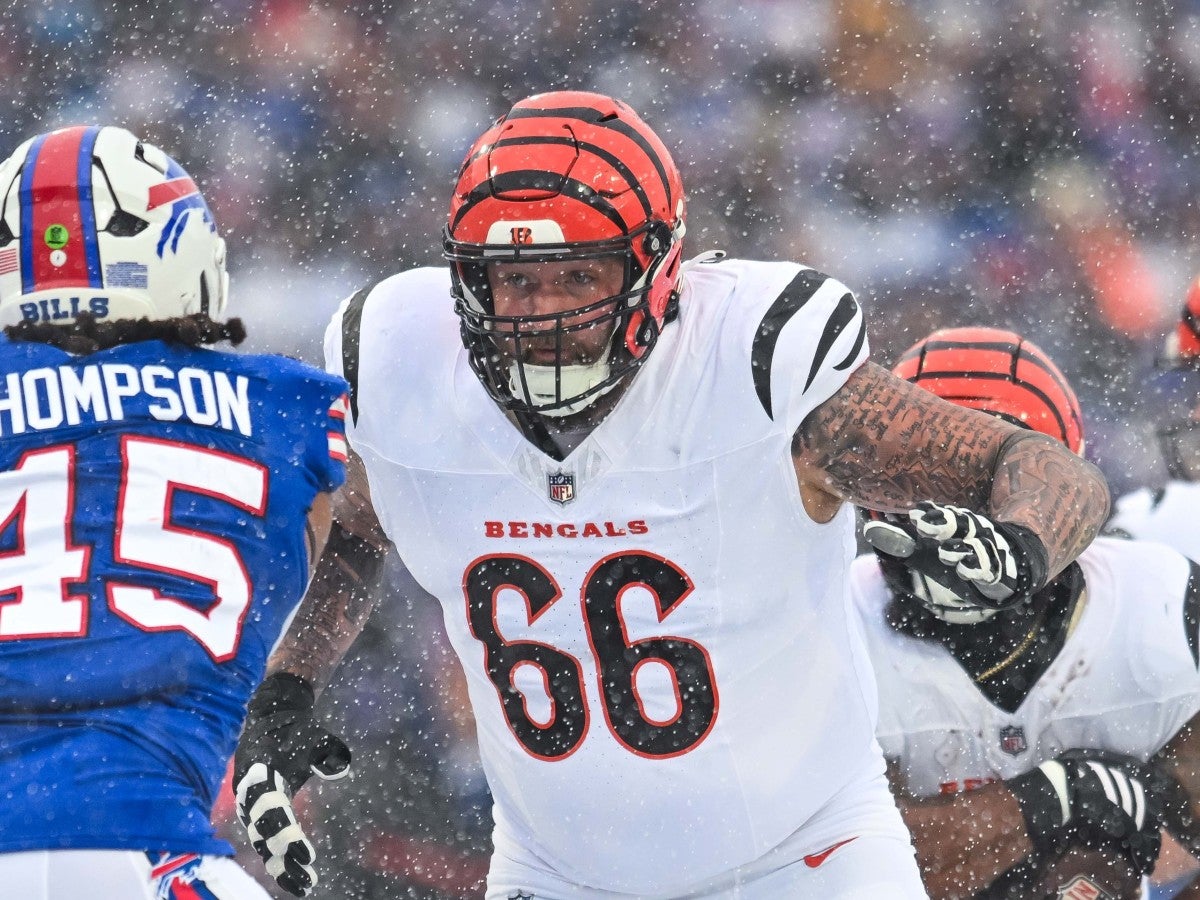
Signing and then starting Dalton Risner at right guard has been a success for the Cincinnati Bengals.
Risner joined the Bengals right before the regular season began as a final depth piece for their offensive line, but he ended up starting in four of their first seven games as well. When rookie Jalen Rivers went down with an ankle injury in Week 11, Risner took over RG duties and has yet to leave the starting lineup. There’s a clear reason why.
Risner has Pro Football Focus’ fifth-highest Pass Blocking Efficiency score since Week 12 despite playing the eighth-most pass-blocking snaps in that timeframe. He’s got the fifth-highest score when looking at True Pass Sets as well, and he ranks third in those snaps.
He’s been exceptional in pass protection. Not just for Bengals standards, for quality NFL starter standards.
Left guard Dylan Fairchild, Cincinnati’s third-round pick from the 2025 NFL Draft, has also scored high since Risner took over as the full-time starter on the other side of Ted Karras, but Fairchild is locked in for another three years on his rookie contract. Risner’s one-year contract expires in March.
The Bengals finally have two quality guards starting for their offensive line. They should make sure that does not change this offseason.
Bengals need to extend Dalton Risner’s contract before free agency
This is one of the easiest tasks Cincinnati will have in all of 2026. Risner has shown to be a perfect fit for what the offense needed at RG, and the rest of the rest of the line has felt his impact as well. Head coach Zac Taylor admitted the unit has never played this well in his seven seasons on the job.
“It’s just really, really impressive in terms of the overall connection of the communication,” Taylor said Monday. “I think that’s why our offensive line is playing the best since I’ve been here.”
Part of that is continuity and the lack of injuries from the group through 16 games, but the lack of weak points from left tackle to right tackle can’t be understated.
LT Orlando Brown Jr. remains the solid starter he’s been since arriving in 2023. Fairchild has exceeded rookie expectations at LG. Ted Karras is as consistent as they come at center. Amarius Mims has taken a jump at RT.
This was the hope for all four positions, but RG didn’t have as much optimism surrounding it entering the season. Even when Risner signed on Aug. 28, his arriving late to the party tempered expectations on his readiness to start and block at a high level. Since he’s re-entered the lineup, he’s been that fifth piece Cincy needed to go with Brown, Fairchild, Karras, and Mims.
Risner has become the final piece of the Bengals’ o-line puzzle, a puzzle that hasn’t looked truly complete in about a decade. The best part is it’s not too late to run it back. Risner is no spring chicken, but a 30-year old lineman easily has another handful of quality years left in his tank.
Extending Risner is the clear decision, and the Bengals have until the first week of March to get it done before his deal expires. It may take that long before something gets done, but a savvier path forward would be to expedite that process.
Risner’s extension should be signed before the regular season ends
Sunday’s regular season finale against the Cleveland Browns is not going to change the evaluation of Risner. Cincinnati should already know he needs to be in the plans for 2026 and perhaps beyond. Karras has gotten two one-year extensions since turning 31 in 2024 and the front office hasn’t looked back. The idea of starting Risner at 31 and 32 years of age is completely reasonable as his game has shown no signs of falling off.
The Bengals, of course, don’t offer lucrative contracts to players 30 and older. That shouldn’t be an issue for Risner, who’s last three contracts have all been one-year agreements worth under $3 million. A veteran used to going year-by-year shouldn’t be deterred from a multi-year offer without any guarantees beyond the year of signing.
So why do get it done before the regular season? To spread the signing bonus out longer. For example, a two-year deal with a $7.5 million signing bonus would be able to prorate that signing bonus over the course of both years on the salary cap, splitting it into two separate $3.75 million boosts to the respective cap hits. If the two-year deal with the same $7.5 million signing bonus is signed before the current season ends, then the signing bonus’ proration can begin in the current year and it would split into thirds of $2.5 million instead of halves of $3.75 million.
This would mean smaller overall cap hits for the next two years when the extension actually keeps Risner under contract, and if the Bengals decide to move on after the first year, it wouldn’t be as costly from a cap perspective.
Minimizing future dead money and saving cap space is music to Cincinnati’s ears, and a move like this would not be unprecedented. The Bengals extended former starting C Trey Hopkins to a three-year deal one day before the end of the 2019 regular season. Hopkins played two more years before being released in the 2022 offseason in a manageable roster move.
It makes all the sense in the world to replicate this strategy with Risner, who should remain as Cincinnati’s starting RG for the foreseeable future.
Cincinnati Bengals News
8 Bengals who could be playing their final game in Paycor Stadium this Sunday
This could be it for several key Bengals players.


