
How can the Packers improve their run defense during the season?
The Green Bay Packers are 32nd in EPA per rush since Brian Gutekunst became the team's general manager in 2018, 32nd since Matt LaFleur took over as the head coach in 2019, and also 32nd since Joe Barry was hired to be the defensive coordinator in 2021. So the fact that they've been 27th over […]


The Green Bay Packers are 32nd in EPA per rush since Brian Gutekunst became the team's general manager in 2018, 32nd since Matt LaFleur took over as the head coach in 2019, and also 32nd since Joe Barry was hired to be the defensive coordinator in 2021. So the fact that they've been 27th over the first month of this season isn't a surprise, nor should be viewed as a small sample size stat. It's a long-term, cultural problem. Now, though, LaFleur seems to be more concerned than even with the chronic problem.
"It's more the philosophy of some of the things we're trying to get done, different ways, especially when you know teams are going to run the ball," LaFleur said last week. "I know we'd like to keep a shell on our defense, but there may be times we have to break that."
Most of the problems are, indeed, philosophical. Former DC Mike Pettine and current DC Joe Barry have differences between their styles of defense, but both schemes are predicted to stop the pass. For Barry, there isn't one specific issue. It's a combination of factors.
"It's not one thing", Barry said on Monday. "It's one thing on this play, another thing on this play. So it's a number of things."
So, how can that change during a season? It probably won't, entirely. But there are ways to mitigate the issue. According to Cody Alexander, author of the book MatchQuarters and host of The Art of X Show, the Packers can extrapolate some of the things they are doing on third downs to earlier downs.
"They are already a heavy cover 3 team, but also heavy in the middle of the field disguise," he said. "So probably they could get a safety down there in the box on early downs".
The Packers have used a surprisingly high percentage of cover 3, 60%, which is second in the NFL — just below the Indianapolis Colts. They generally alternate safeties Darnell Savage and (more frequently) Rudy Ford to support the run game and create disguises. That's why they are the 3rd team with less cover 2 coverage in the league, despite being expected to be a heavy cover 2 unit going into the year.
At this point of the season, it's impossible to change the core concepts of a defense, but it's realistic to adjust the approach or other elements of the system.
"Philosophy over scheme changes," suggests Michael Wahle, a skill development specialist who played as a guard for the Packers between 1998 and 2004. "It's how the coaching staff implements individual tactics and techniques to highlight player or group strengths. If you slant and fill, you have to be violent and precise with lane discipline. If you play straight up, you have to be exact on how your defensive tackles handle double teams. If you want to play off coverage, you have to affect the quarterback throw with four. Right now, they don't match up identity with personnel."
During the offseason, Green Bay prioritized a different skill set. By letting Dean Lowry and especially Jarran Reed go, and then drafting Colby Wooden and Karl Brooks, the Packers moved into a direction of disrupting the opposing offense. Ideally, it would work for both the pass and the run. So far, the results haven't been great.
"I think as a staff, we're open-minded enough to make those adjustments," LaFleur added. "And we're going to do whatever we need to do to put our guys in a better position."
Next Monday, the Packers face the Las Vegas Raiders, who are 32nd in EPA per rush this season. It's a good first test to see if there is an adjusted approach. If there isn’t, it will be hard to believe in any significant improvement throughout 2023.
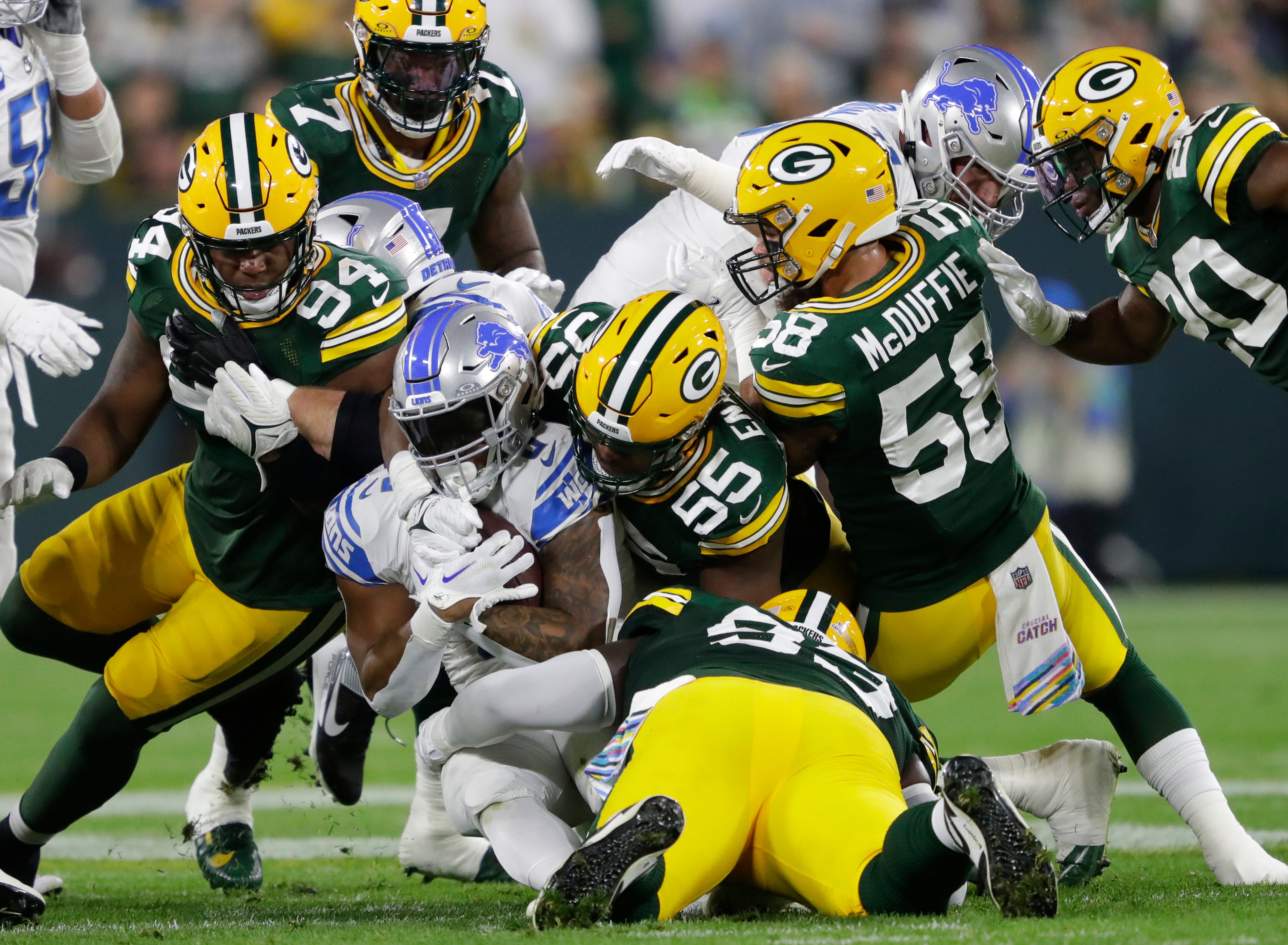
Packers’ Joe Barry says defense ‘will correct’ run game issues
We’ll see if it actually happens.


