
What a new Jordan Love contract extension could look like?
When people want to discuss the future of quarterback Jordan Love in Green Bay, financial considerations are always relevant. And there is a natural trend to compare Love's situation to Daniel Jones, the New York Giants quarterback who signed a four-year, $160 million extension last offseason. The comparison is fair because both players were first-round […]


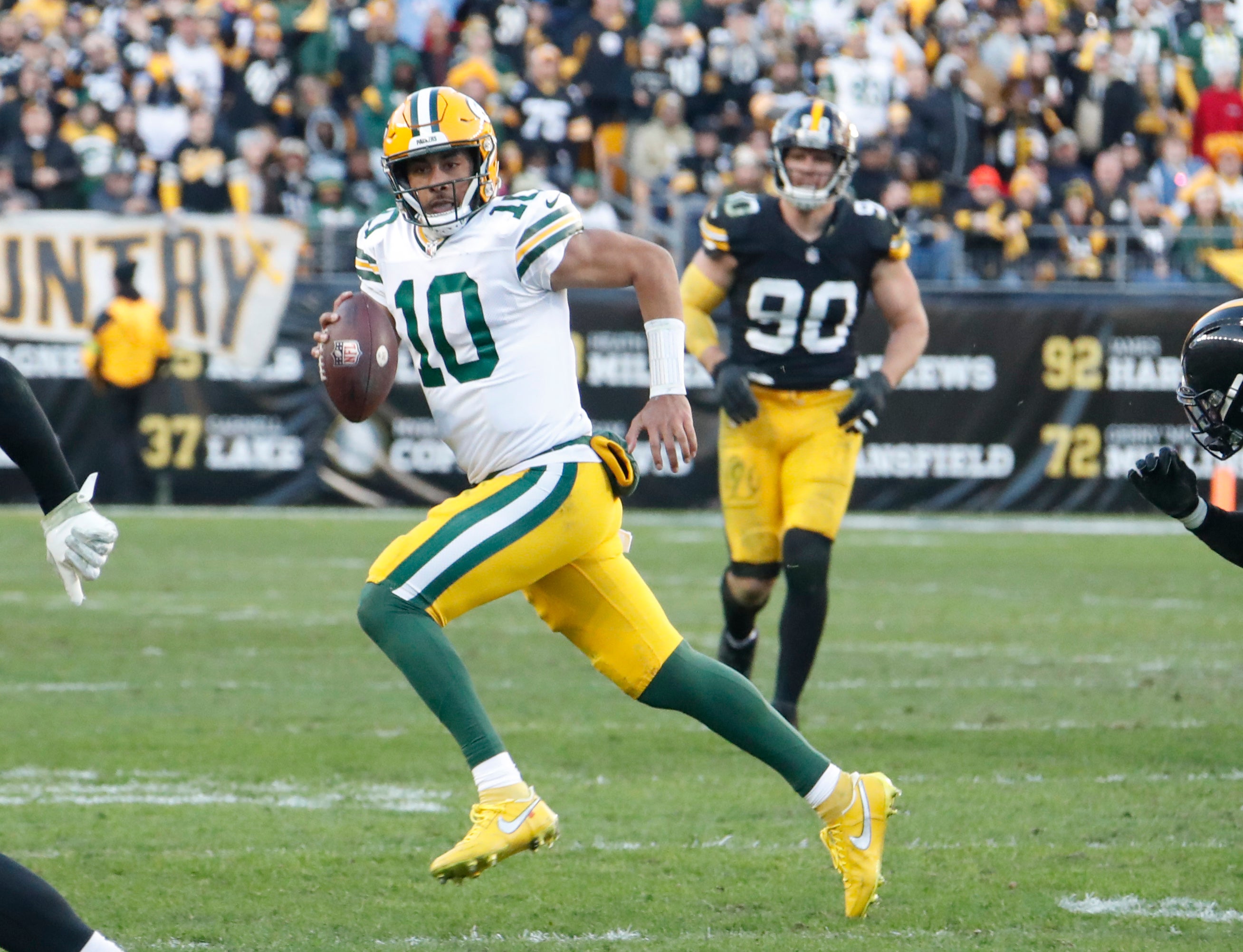
When people want to discuss the future of quarterback Jordan Love in Green Bay, financial considerations are always relevant. And there is a natural trend to compare Love's situation to Daniel Jones, the New York Giants quarterback who signed a four-year, $160 million extension last offseason.
The comparison is fair because both players were first-round picks and came to the end of the rookie contract without a clear conclusion on if they are real franchise quarterbacks or not. The Giants declined Jones' fifth-year option, which forced them to give the QB a big-time extension when he performed better in 2022. The Packers found a creative way around that: they agreed to a one-year extension with Love, replacing the fifth-year option with a cheaper, flexible contract.
And that's why the Jordan Love-Daniel Jones comparison isn't perfect. The Green Bay Packers have much more leverage (hey, Packers fans, I know you love this word since the Aaron Rodgers trade circus) than the Giants did.
In fact, the Packers have multiple options. They can get a quarterback in next year's draft and let Love play out his current deal, which goes through 2024. They can let him play out his deal even without getting a rookie QB, which would give them another evaluation season — and they could extend or franchise tag him later.
But a sensible solution if the Packers don't want Love to enter next season as a lame duck quarterback is to give him a medium-term extension. And Daniel Jones is not the parameter. Geno Smith actually is.
Seahawks and Geno Smith extension
Geno Smith was a veteran quarterback who hadn't been a preferred starter since 2014, but he played really well in 2022. That created an urgency for the Seahawks to keep him, after a series of short-term deals Smith signed as a backup.
They found a creative solution that worked for everyone, signing a three-year, $ 75 million contract. The deal had a $26.1 million signing bonus, $27.3 million guaranteed at signing, and a $25 million yearly average. The cap hits are $10.1 million in 2023, $31.2 million in 2024, and $33.7 million in 2025.
It works for the Seahawks because they have a three-year security, and only the first year was guaranteed. Seattle can keep Geno next year as a real starter or as a bridge quarterback for a rookie, or maybe even trade Smith if they want to, and the structure is very team-friendly.
It makes sense for Geno Smith, too, because he had made $17.4 million over his first 11 seasons in the NFL. So he more than doubled it right away, getting $27.5 million in 2023. And if the Seahawks decided to cut Smith before the 2024 season, the dead money would be $17.4 million — which is feasible if needed for the team, but unlikely, given financial security for the player as well.
What would a Love extension look like?
The Packers have Love under contract through 2024, and that's a big difference because Daniel Jones and Geno Smith were both slated to be free agents. That helps Green Bay in two ways. First, it gives them flexibility to structure a better contract, as Love will make $6 million in 2024. Second, it gives them leverage because they are not forced to extend him, so they will if it's a reasonable negotiation.
Getting Geno Smith's contract as a parameter and adding a couple of millions because of cap inflation, it's possible that the Packers and Love would agree to something like two years and $60 million.
Love would say that he got $30 million per season, which is a fair mid-level quarterback contract — and life-altering money for a player that has made less than $20 million so far in the league.
For the Packers, it would be a three-year, $66 million contract, a de facto $22 million yearly average without significant guarantees beyond 2024.
The Packers still have nine games left this season, so Jordan Love's performance will dictate much of this discussion — because it affects the Packers draft capital and the quarterback's market value. But a mid-term extension seems like a decent middle ground for a partnership that still lacks definitive answers.
Cover 3: Quick takeaways after Packers loss to the Steelers
Green Bay’s playoff hopes are thinner


