
Packers' attempt to recreate the 2008 QB transition model has problems in the current NFL
When the Green Bay Packers drafted Aaron Rodgers in 2005, Brian Gutekunst was a team scout. When they made the transition from Brett Favre to Rodgers, Mark Murphy was already the franchise's president. The Packers' management knew very well what they were doing when they traded up to select quarterback Jordan Love in the first […]


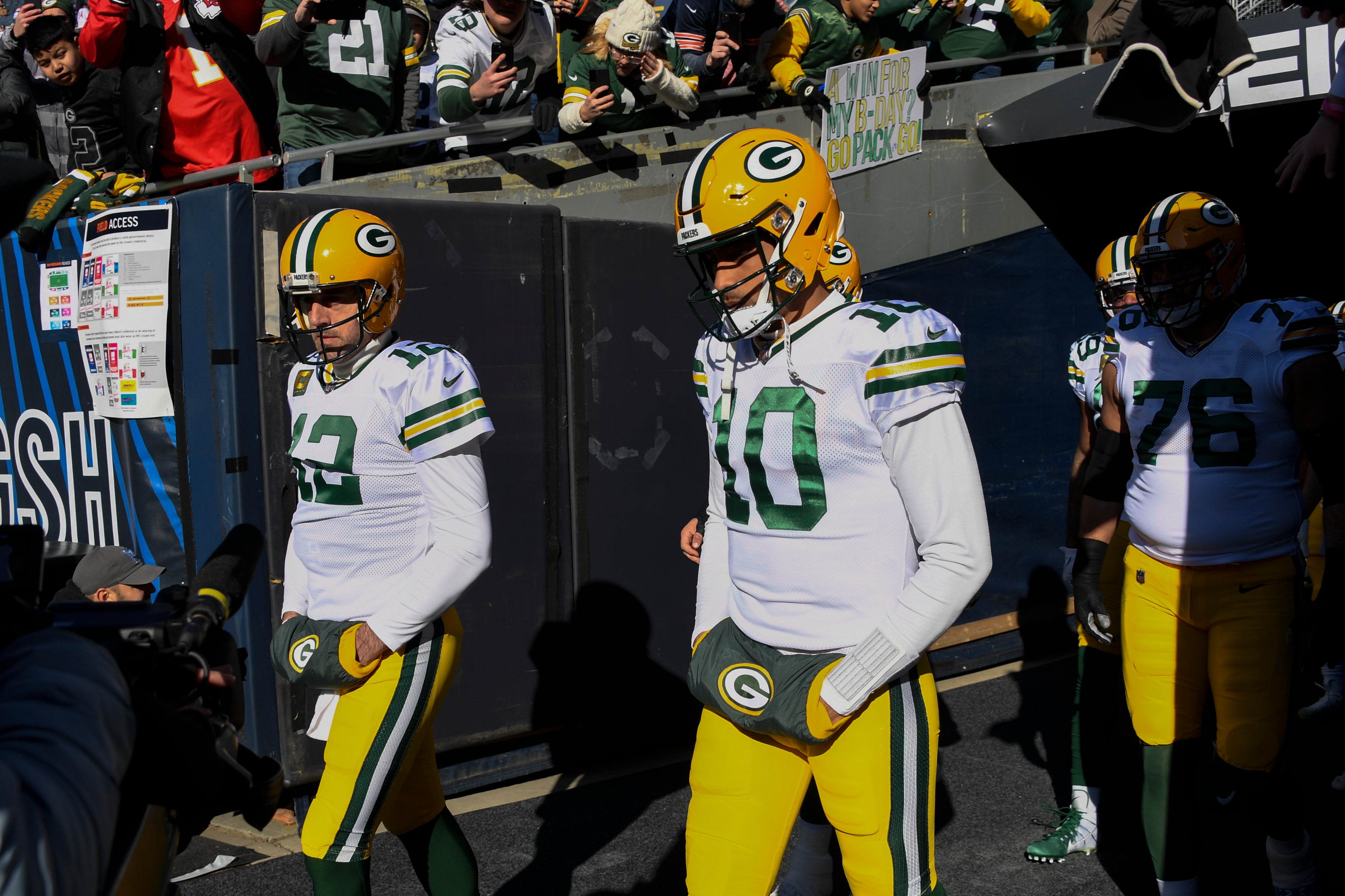
When the Green Bay Packers drafted Aaron Rodgers in 2005, Brian Gutekunst was a team scout. When they made the transition from Brett Favre to Rodgers, Mark Murphy was already the franchise's president. The Packers' management knew very well what they were doing when they traded up to select quarterback Jordan Love in the first round of the 2020 draft. The plan was clear and obvious: eventually, Love would replace Rodgers as the Packers starting quarterback.
The plan has its merits, to be fair. Love was a raw prospect, but with a high ceiling, and high-ceiling quarterbacks seldom are available at the end of the first round for obvious reasons. Moreover, as the old football saying goes, the worst time to look for a quarterback is when you need one. Since the Packers took Love, they haven't been in a clear position to select anyone better — well, except if you think Brock Purdy would be a better option, but that's a discussion for another day.
However, there are two main problems with the plan, and they may be capital sins for the Packers mid- and long-term success. And both are related to similar conclusions: the NFL is very different now compared to what it was in 2008, and the Packers roster is as well.
Rookie-scale contract
The most important big-picture discussion is how the NFL worked in 2005/2008, and how the 2011 CBA changed the landscape of the league. Before 2011, teams negotiated with rookies as if they were free agents, except that they couldn't negotiate with other teams. They had to agree to salaries, duration of the contract, structure, and everything else. Since 2011, basically every aspect of the deal is scaled, so teams and players just have to adjust minor details. The monetary difference is huge, too.
Sam Bradford was the last first overall pick of the old structure. He signed with the St. Louis Rams for six years, $78 million. Cam Newton, the first first overall pick of the new model, signed with the Carolina Panthers for four years, $22 million, and a team option in the fifth season.
Taking a quarterback early was a big commitment, and teams weren't so willing to do it — that's the reason why Rodgers fell until pick 24. With the new structure, it doesn't matter who you pick, the contract model will be the same. That incentivizes teams to get quarterbacks, because the payoff if they hit is huge.
And that's where things get complicated for what the Packers did. Between 2005 and 2008, there was a benefit to getting a young quarterback, obviously, but there wasn't a trend to take advantage of the rookie contract to build a strong roster around a young passer. When Rodgers became the starter, he quickly signed a long-term extension, and the Packers were able to surround him with talent.
Nowadays, the situation is different. Teams that drafted quarterbacks were able to exploit a market deficiency and build around them. The Philadelphia Eagles built a powerhouse around Carson Wentz and another around Jalen Hurts, the Cincinnati Bengals had several defensive veterans to support Joe Burrow, the Los Angeles Chargers have two $20 million wide receivers for Justin Herbert, the Miami Dolphins were able to acquire Tyreek Hill. There's no denying, the quarterback rookie-contract is the biggest advantage in the NFL right now.
And while it was important for the Packers to develop Jordan Love, they also threw away 75% of his rookie contract on the bench. Now, Love is finally a starter in his fourth year, and the Packers are still recovering from some sort of all-in they went into over the last couple of Aaron Rodgers years.
More impactful than that right now is that there's no more time to prove it. Jordan Love extended his contract through 2024, but the Packers need an answer as soon as possible. While a rookie would probably have at least three seasons to show if he's the answer or not, Love will have two at most. Fairly or not, he has one or two years to prove he’s worth at least a Daniel Jones-type of extension or the Packers will move on. It’s hard to find a middle ground, a mid-level second contract for quarterbacks.
If his performance doesn't improve until the end of the season, Green Bay will probably look for another option in 2024. Love may be the starter next year, but without any long-term assurances. If he's good, great. If he's not, the Packers would have a young quarterback with one year in the system, and a new rookie-scale window to work around.
Weapons
The other questionable approach was regarding the offensive weapons. And that's not about 2022 and 2023, when Brian Gutekunst drafted six wide receivers and two tight ends over two drafts. This is before that. Gutekunst took over as the general manager in 2018 and immediately drafted three receivers, but all of them on day 3. Marquez Valdes-Scantling was the only hit, considering he was a fifth-round pick, but he was nothing more than a role player. They also signed Allen Lazard off the Jacksonville Jaguars practice squad in the last month of the season, after Mike McCarthy had been fired.
Between 2019 and 2021, however, the Packers didn't invest in wide receivers whatsoever — the only pick was third-rounder Amari Rodgers, who was a big failure after the Packers gave up a fourth-round pick to move up in the third to select him.
When Davante Adams was traded and MVS left Green Bay in free agency, they were behind the eight ball.
There has been a clear movement trying to revert that trend, but every Packers receiver on the roster now is a first- or second-year player. There's a huge payoff potential with so many young talented players, but it's been a costly developmental phase, and without any assurances of success.
In 2008, the Packers roster had talented wide receivers on different timelines. Donald Driver was a decade veteran, Greg Jennings had been drafted in 2006 and was entering his prime, James Jones was a second-year player, and Jordy Nelson was a rookie that didn't take off until the 2010 playoffs.
Green Bay did what they could in 2022 and 2023 to add offensive talent. But their disinterest to invest in it before has made everything much more difficult for Jordan Love, Matt LaFleur, and the rest of the team.
Cover 3: Quick takeaways after Packers loss to the Broncos
Green Bay fell to 2-4


