
Minnesota Vikings’ run defense was a perceived problem in 2025, but the numbers tell a different story
The decision to trade Harrison Phillips didn’t have the negative impact many thought it did.


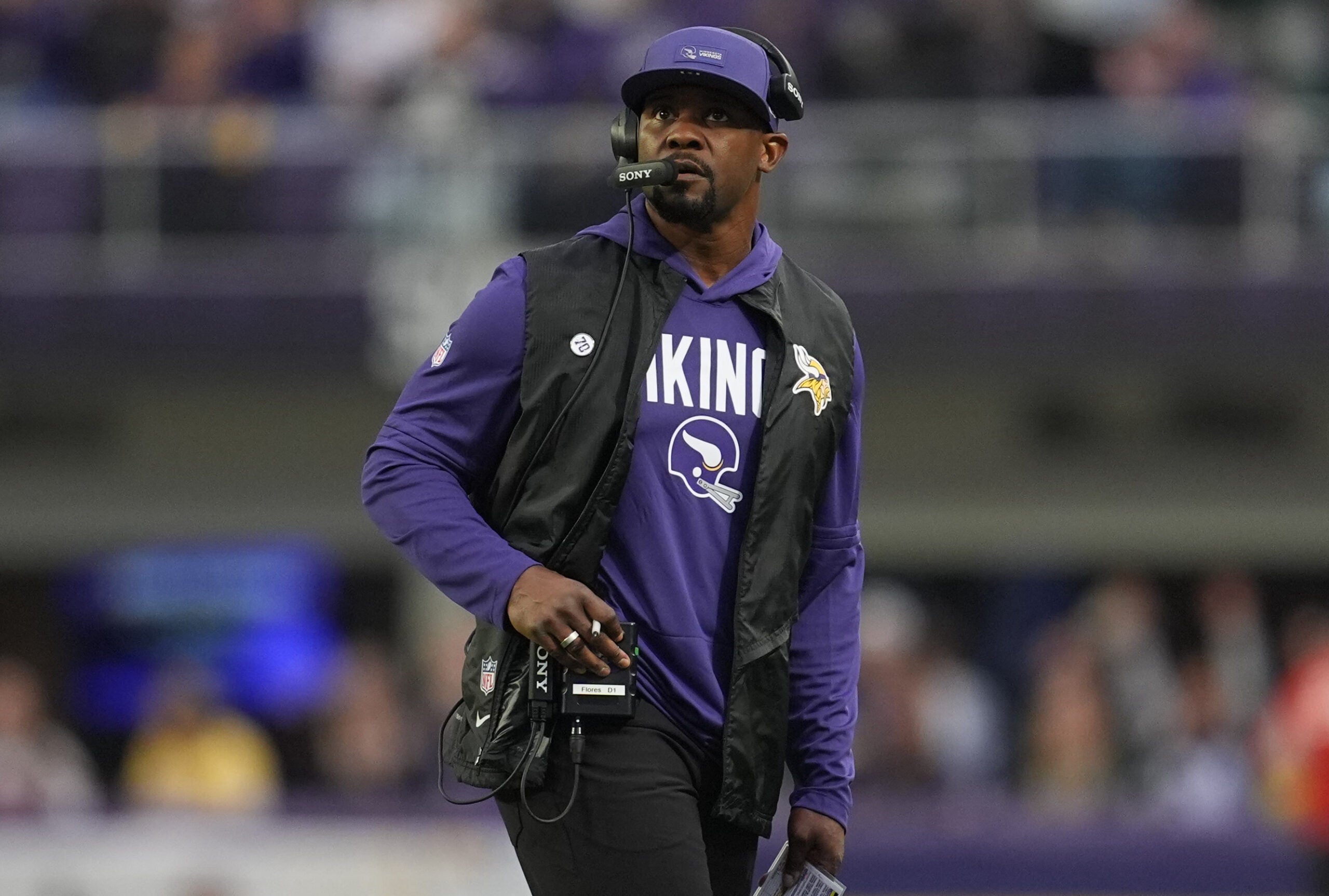
One of the biggest storylines with the Minnesota Vikings during the 2025 season was the poor run defense. It resonated quickly in Week 2 when they allowed the Atlanta Falcons to gash them for 218 yards on the day, including over 50 on the first three plays of the game alone, in a 22-6 loss.
The decisions to sign Javon Hargrave and Jonathan Allen were focused more on rushing the passer, and it led to the trade of Harrison Phillips. That move drew a lot of criticism at the time, and it didn’t stop throughout the entirety of the season.
Vikings’ run defense took major step backward in 2025
There is no denying it. The Vikings’ run defense took a big step backward from their elite unit in 2024. The counting metrics were significantly down.
| Year | Rush YPG | Rank | Rush YPC | Rank | EPA/Rush | Success Rate |
| 2024 | 93.4 | 2nd | 4.1 | 7th | 1st | 3rd |
| 2025 | 124.1 | 21st | 4.0 | 6th | 14th | 20th |
Seeing a 30.7 yards per game drop is a significant amount for the Vikings. There are a multitude of reasons for that. They struggled to get off the field on fourth downs, allowing 66.7% of fourth down conversions. How much of that is from the loss of Phillips? Well, a significant amount was, because nobody could two-gap.
They asked Hargrave, Allen, and Jalen Redmond to do a lot of slanting instead, and that maximized what they are good at. However, opposing teams were able to take advantage of that slant at times with cutback lanes in zone concepts. Here is a good example of what the slanting looks like.
Having someone who can two-gap is something important for a defense, especially when you run a 3-4 defense. Being able to two-gap can be crucial to success, especially when it comes to maximizing your linebacker play at the second level.
The issues on defense were rough and consistent. They allowed at least 100 yards in 13 games, and two of those were over 200 yards. As you might expect, the Vikings went 3-1 when the opponent rushed for under 100 yards, and 0-3 when they rushed for over 150. That’s why you hear coaches focus so much on the run game, as running the ball often leads to more wins. However, it’s not that simple, and neither is the Vikings’ lack of perceived “success in stopping the run.
Why the drop in run defense isn’t as big of a concern
The Vikings did take a step back in stopping the run, but it’s not quite as simple as you think it might be. Let’s start with this: the counting stats were up significantly, not just in yards/game, but also in attempts.
| Year | Carries/Game | Rank | Passing YPG | Rank | Total YPG | Rank |
| 2024 | 23.0 | 4th | 242 | 28th | 335.4 | 16th |
| 2025 | 31.1 | 31st | 158.5 | 2nd | 282.6 | 3rd |
The run defense year/year took a turn downward, but it’s not as simple as they got significantly worse. They did achieve their goal of improving their pass defense, which was one of the best in the league. Their sack production leveled out as well, with defensive linemen improving from just 4.0 sacks to 16.0 in 2025. That alone was so needed for the unit, as the likes of Jonathan Greenard and Andrew Van Ginkel lost some gas at the end of the season.
The other element here is the Vikings’ offense. They were significantly worse than the 2024 squad led by Sam Darnold. They constantly got the offense up over the opposing team, forcing the other team to change their game script to running the ball less and passing the ball more. It was the inverse in 2025, with the Vikings consistently playing from behind with their very poor quarterback play.
The real question here is simple: how did it end up impacting the unit as a whole? The unit showed improvement in some areas.
| Year | Points Per Game | Rank | Yards/Play | Rank | Plays/Game | Rank |
| 2024 | 19.5 | 5th | 5.3 | 13th | 63.4 | 26th |
| 2025 | 19.6 | 7th | 4.7 | 3rd | 60.3 | 12th |
They allowed just one more total point in 2025, and improved in both yards per play allowed and plays per game they were on the field. One thing that made things worse for the Vikings in 2025 was a league-leading 30 turnovers, putting the defense in a bad spot. For comparison, the 2024 Vikings only turned it over 21 times, which was tied for 17th in the NFL. That explains how, despite the yards/play and plays/game dropping significantly from 2024, the Vikings still allowed more points.
If you want to look at it from an analytical perspective, the defense was essentially the same as it was in 2024.
| Year | EPA/Play | Rank | Success Rate | Rank |
| 2024 | -0.091 | 2nd | 41.3% | 5th |
| 2025 | -0.087 | 3rd | 41.6% | 6th |
What can we gather from this information? There really is no simple answer. There are so many elements that impact each piece of information. However, the defense didn’t take a step back from an overall lens.
Look, having a nose tackle would be great from a structural standpoint, but they showed last season that their approach wasn’t a bad one, because it was a unit that showed improvement in multiple areas. They prioritized stopping the pass because it’s more efficient and explosive analytically, and their decision was the right one.
NFL Draft
Minnesota Vikings Mock Draft Tracker 10.0: Post-NFL Scouting Combine sees a massive shift in expectations for Brian Flores’ defense
The NFL Scouting Combine did a lot to shift what the NFL Draft will look like for the Minnesota Vikings.

Minnesota Vikings News
Minnesota Vikings signing Kyler Murray signals a new era for Kevin O’Connell and J.J. McCarthy
It only took two years for the Vikings to make a significant change.


