
Pros and cons for the New York Jets to keep or move on from Aaron Rodgers in 2025
The New York Jets have hired Aaron Glenn as a head coach and most of its top positions on the coaching staff. The next big decision for the franchise is what they will do at quarterback, and that starts by deciding the future of Aaron Rodgers. Two years after acquiring the future Hall of Famer, […]



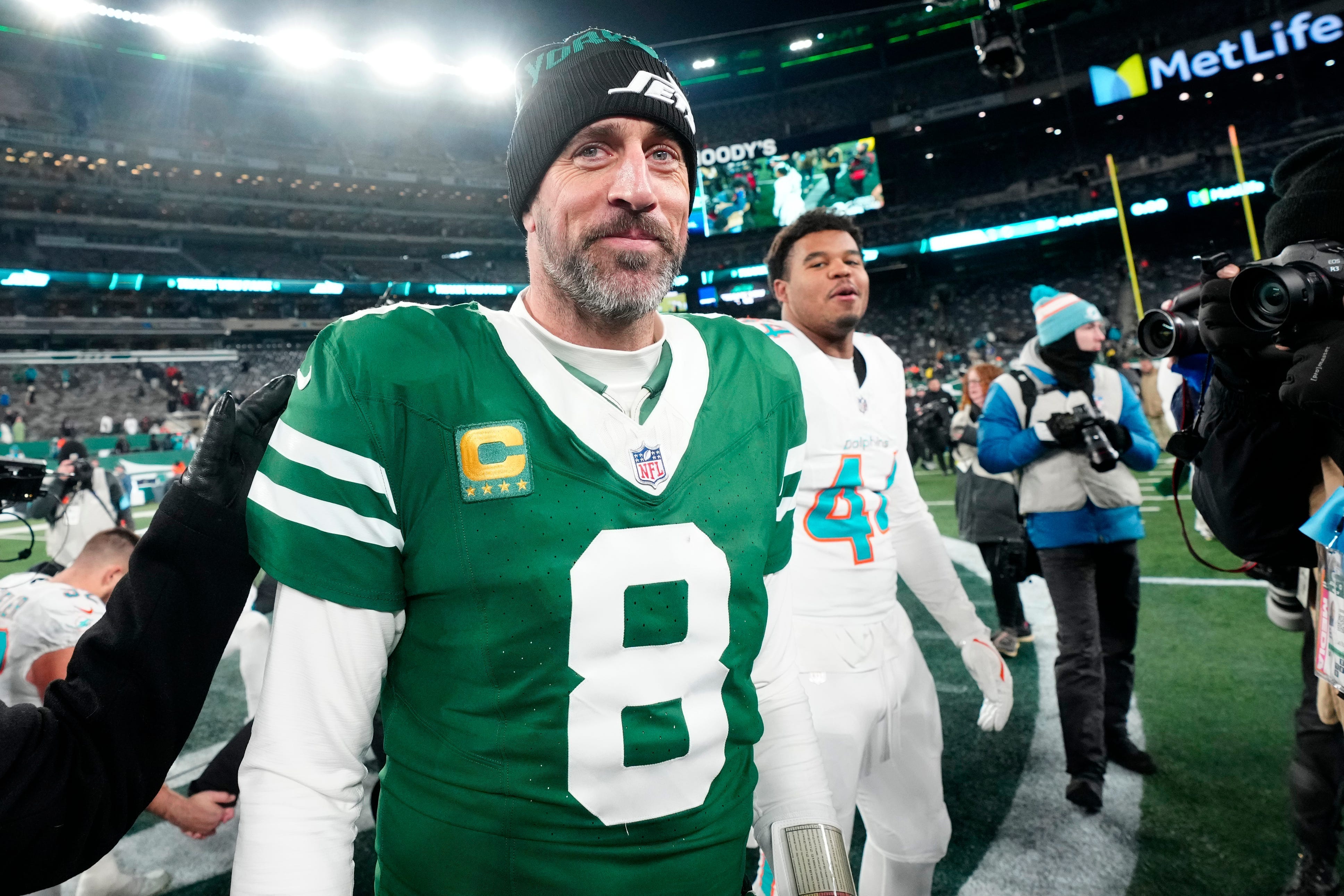
The New York Jets have hired Aaron Glenn as a head coach and most of its top positions on the coaching staff. The next big decision for the franchise is what they will do at quarterback, and that starts by deciding the future of Aaron Rodgers.
Two years after acquiring the future Hall of Famer, the Jets have a tough decision that includes several factors. Glenn has said that he is open to the idea of keeping Rodgers, but under specific conditions—the quarterback wouldn’t have as much power as he had with Robert Saleh and Joe Douglas.
Pros
Bridge quarterback
If Aaron Rodgers stays, he would be a high-level processor to help a potential young quarterback of the future. Rodgers has already mentioned his willingness to be a mentor, and his relationship with Jordan Love on the Green Bay Packers was really good.
The Jets probably won’t solve the quarterback question in 2025, so if they will have a bridge quarterback anyway, Rodgers is probably a better option than players like Tyrod Taylor and Kirk Cousins, for instance.
Higher ceiling (still)
Aaron Rodgers is obviously not what he was four years ago, but he can still play at a high level at times. In 2024, he was a much better quarterback than the perception around his play was—mostly because of what he means for the franchise, the expectations, and the team failures.
Rodgers can’t single-handedly make a team competitive anymore like he used to do in his prime, but if the Jets are able to build a strong supporting cast, the veteran quarterback can still be an efficient point guard with moments of brilliance.
This past season, Aaron Rodgers was 15th in PFF passing grade (76.3), tied with Brock Purdy and ahead of players like Russell Wilson, Trevor Lawrence, Bo Nix, Matthew Stafford, Kirk Cousins, Tua Tagovailoa, and Dak Prescott. Oh, he was also ahead of Jalen Hurts, who will play the Super Bowl on Sunday.
Controlled cost
We will talk more about the cap implications later, but the cost itself isn't prohibitive. Aaron Rodgers is slated to make $37.5 million in 2025, which is a relatively low amount of money considering that the top of the market is reaching $60 million in yearly average. Even before free agency and potential extensions, Rodgers is the ninth highest-paid quarterback in 2025 cash.
Cons
Build of the new scheme philosophy
The Jets adjusted the offensive coaching staff, moving on from Nathaniel Hackett and Todd Downing. Offensive coordinator Tanner Engstrand and passing game coordinator Scott Turner will now lead the unit, and building a long-term schematic structure should be the top priority.
And it's hard to go all-in on those ideas when Aaron Rodgers is on the field. On the Packers, Matt LaFleur had to marry his preferred concepts with what Rodgers liked to run with Mike McCarthy. Hackett and Downing built an entire offense based on what the quarterback wanted.
So if the Jets want to build for the future, Rodgers might hinder that—delaying it, or playing in a structure he's not comfortable with.
Locker room
Rodgers seems to be respected inside the locker room, and this point isn’t about that. It’s more about who will truly lead the Jets for the future. While Rodgers is there, he will be the main leader on the roster.
When he moves on, or the team moves on from him, younger players will have to emerge as leaders, and that’s important to build a fresh locker room based on what Aaron Glenn truly values.
Cap implications
While Rodgers won’t make an absurd amount of money in 2025 as aforementioned, the cap situation is trickier based on how the Jets structured his deal. If the Jets move on, they will handle $49 million in dead money—or $14 million in 2025 and $35 million in 2026 if the team uses a post-June 1st designation. But the situation will be much more serious if Rodgers plays another year in New York.
Most of his 2025 compensation would be in the form of a roster bonus, keeping his 2025 cap hit low—$23.5 million. However, his dead money in 2026 would jump to $63 million (be it all at once or split into two years). That's probably too heavy of an impact for a quarterback that isn't able to elevate his surroundings as much anymore.
Aaron Rodgers’ situation with the Jets takes unexpected turn after latest Aaron Glenn update
It’s an intriguing development


