San Francisco 49ers coach explains why they ignored their biggest draft need with curious claim
It was widely anticipated the San Francisco 49ers would place a heavy emphasis on the offensive line in the 2024 NFL Draft after it proved their undoing in Super Bowl 58. The Niners went into the offseason with right tackle and right guard looking to be clear holes on the most stacked roster in the […]

It was widely anticipated the San Francisco 49ers would place a heavy emphasis on the offensive line in the 2024 NFL Draft after it proved their undoing in Super Bowl 58.
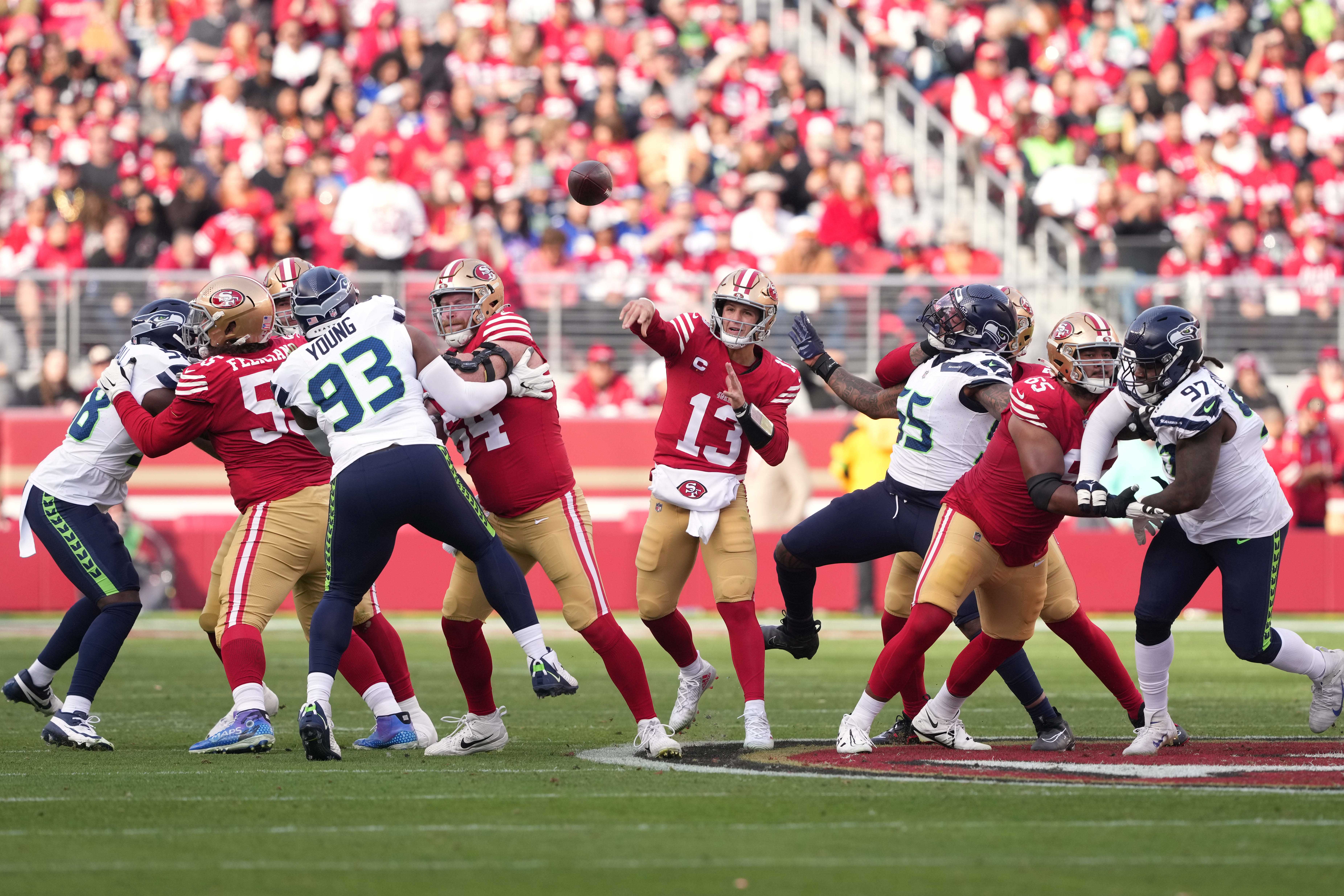
The Niners went into the offseason with right tackle and right guard looking to be clear holes on the most stacked roster in the NFL. Right tackle Colton McKivitz struggled in the overtime defeat to the Kansas City Chiefs, while Spencer Burford committed a key protection error in the extra period after replacing the injured Jon Feliciano.
As such, many anticipated the Niners to seek better long-term answers at both positions, and a pre-draft visit with Kingsley Suamataia and private workout with Roger Rosengarten pointed to the Niners taking one of those two tackles early in the draft.
Neither was selected by the Niners, who took wide receiver Ricky Pearsall 31st overall in the first round and then traded back one spot in the second round with Suamataia still on the board. He instead went to the Chiefs 63rd overall, with the 49ers taking cornerback Renardo Green a pick later.
San Francisco did take two offensive linemen in the draft, picking guard Dominick Puni in the third round and adding another interior lineman in the sixth in Jarrett Kingston.
Both Puni and Kingston have guard-tackle versatility, but the 49ers' decision to neglect the tackle spot raised eyebrows that are unlikely to have been lowered by offensive line coach/run game coordinator Chris Foerster's justification for those decisions.
Foerster said: "This is my personal opinion, if they ask me, invest in guys that touch the ball, guys that can touch the ball and score touchdowns. And then there’s a range of guys, second, third, fourth round, fifth round even, that we will find starting offensive linemen in. At some point can you draft them? Yeah, you draft Trent Williams. You pick a draft where you’re getting a difference maker.
"But there’s guys that can make a difference, that touch the ball, well into the second, third, fourth rounds, or second and third rounds, at least. And definitely in the first round. That guy that touches the ball, it makes a huge difference in the game.
"The right guard makes a difference, we’ve talked about it before, but that’s where we’re able to find fourth and fifth-round draft picks. How dominant is the difference between pick 34 versus pick 54, in offensive line play? And that’s what you’re trying to balance all the time.
"So, will we draft the best available player, all those types of things? Definitely will. And were we possibly ready to draft guys higher in the draft? Yes. But if there’s somebody that can touch the ball and make plays, in my opinion, if you ask me, ‘Chris, do you want him?’ I want the guy that touches the ball, for me. Because I think we can develop those players much more readily and have developed those players through the times because we do have specific things that we’re looking for.
"We know what we’re looking for through the course of time. That’s the advantage of being together with Kyle for so long that we kind of can pigeonhole these guys. Are we always right? Heck no, we’re not always right and nobody is on anything. Could you put five first rounders across the front? I don’t know that we have to, to have success. And it hasn’t been that case as far as running the football and protecting the quarterback.
"We don’t have five first rounders, so there’s always going to be that. But, the fact that you can throw a short pass to Deebo, even though the right tackle’s getting beat, it ends up being a 60-yard touchdown. So yeah, the right tackle blocks somebody, but if the guy gets tackled at five yards, you don’t have the 60-yard touchdown. ‘Boy that right tackle did a great job.’ What’s it matter if the guy touching the ball can’t take it to the house? So, there’s the trade off and you’re constantly playing that game.”
Foerster's assessment is understandable to a point, particularly given the level of talent the 49ers have on offense with players that can do substantial damage after the catch.
But it makes less sense when you analyze what happened in the Super Bowl, in which quarterback Brock Purdy was under consistent duress, the receivers struggled to beat the Chiefs' physical coverage and Kansas City tackled extremely well to limit the big open-field plays after the catch that are the calling card of the 49er offense. With the protection issues eventually serving as San Francisco's downfall with Purdy not afforded the time to find Jauan Jennings or a wide-open Brandon Aiyuk on third down from the Kansas City nine-yard line in overtime, Foerster's view of team building looks misguided.
And many will take issue with his claim the 49ers can develop later-round linemen. McKivitz was a 2020 fifth-round pick but gave up the eighth-most pressures among tackles (47) last season, per Pro Football Focus. Burford, a fourth-round pick, has yet to produce the consistency the 49ers are looking for despite often flashing considerable potential in the starting right guard role.
San Francisco's primary success story in that regard is a former undrafted free agent in Jake Brendel, who has blossomed into a dependable starting center who fits the offense perfectly.
But coming off a Super Bowl in which the O-Line's struggles in protection and the receivers' inability to get open were the primary issues, Foerster's claims come across as dubious and naive. Strides will need to be made by the likes of McKivitz, Burford and Puni in 2024 for him to be proven right.