
49ers lack of a TE2 standout risks denying offense yet another dimension
This time of year, it can be easy to get the impression that everything is going well for your team. Training camp brings a lot of positive reports about players, their physical condition and their performances, in turn raising expectations about a team's potential fortunes for the season ahead. Expectations for the 49ers are already […]


This time of year, it can be easy to get the impression that everything is going well for your team. Training camp brings a lot of positive reports about players, their physical condition and their performances, in turn raising expectations about a team's potential fortunes for the season ahead.
Expectations for the 49ers are already as high as they can be given their status as perennial Super Bowl contender, and the reports from training camp have only helped fuel optimism around the team.
Brock Purdy, while not perfect in practice, has showed no ill-effects from his offseason elbow surgery. Wide receiver Brandon Aiyuk is crushing it day after day and the defensive line, even without Nick Bosa as his holdout continues, is utterly dominant.
But it can't all be positive. So where are the negatives?
There could be some concern about how the offensive line has struggled against their defensive line counterparts. However, that is arguably more of a symptom of the level of talent on the D-Line and both members of a right side that is the weakest area of the O-Line, tackle Colton McKivitz and Spencer Burford, have impressed.
Bosa's holdout will obviously become more of a problem the longer it goes on, and the lack of cornerback depth is undeniably an issue. Yet it is evidence of just how good this 49ers roster is that the most obvious on-field worry from training camp is one that most would not spend a second thinking about, the lack of production at backup tight end.
Charlie Woerner, Ross Dwelley and rookies Cameron Latu and Brayden Willis are all in the mix to be TE2.
San Francisco knew more was needed from the second tight end spot behind George Kittle and subsequently spent a third-round pick on Latu and a seventh-rounder on Willis.
Yet until Monday, when former Oklahoma Sooner Willis, was reported as hauling in two catches during the team period, there had been precious little said about any of the tight ends in the mix to backup Kittle.
That is maybe not surprising at least in the case of Woerner, who is primarily a blocking tight end, while Dwelley was scarcely involved in the offense last year. However, it's fair to say more was expected of Latu and Willis.
A shrug of the shoulders would be an understandable reaction to Latu and Willis doing little to stand out in camp. The opportunities for a second tight end to make a major impact in Kyle Shanahan's offense in 2023 are likely to be few given the sheer number of playmakers the 49ers head coach already has at his disposal.
Yet there are two reasons why it is important for the Niners that a second tight end who can be a receiving threat as well as a capable blocker emerges ahead of the regular season.
Keeping Kittle fresh
The first is simple. After playing only 57 percent of the snaps as a rookie in 2017, Kittle — despite only playing a full regular season once — has played at least 84 percent of the offensive snaps in each of the last five seasons.
Kittle, with the relish he displays in the blocking game and the physicality he demonstrates in creating yards after the catch, plays a style of football that places him at greater risk of injuries.
The injury problems Kittle has had of late have bene relatively minor, but that risk would be greatly minimized if the 49ers could unearth a backup with similar duplicity as a receiver and a blocker who could take some of the burden off Kittle.
Tight ends coach Brian Fleury, per Nick Wagoner of ESPN indicated as much, last month.
“It's not that we want to take plays off of George, because he's one of the best players in the league and you want to have him out there, especially in critical moments. But we also want to have the ability to function at a high level in the event that he potentially breaks a chin strap and has to come out for a few plays."
The 49ers keenly appreciate the edge Kittle gives them with his versatile skill set, and that leaves them needing to strike a balance between wanting to preserve his body but also trying to ensure they do not surrender that advantage when he is off the field.
Fleury added:
"It's the luxury that we have that with George on the field. We're not predictable in terms of how we're using the tight end. A lot of other teams don't have that luxury. And it's something that if we don't have George on the field, we do have to be aware of is, 'Are we creating tendencies with one tight end versus another?' And so it's up to us to offset those things. It's challenging and it's something that we're aware of."
But finding an effective TE2 is not just about Kittle insurance, it's also about expanding the menu for a coach who excels at utilizing the diverse talents in his attack to create mismatches, and does from a range of personnel packages.
Adding another dimension
Last season, the 49ers were outstanding throwing the ball out of 21 personnel. San Francisco finished 2022 second in Expected Points Added on throws from 21, with only the Dolphins performing better, per Sports Info Solutions.
Having a trustworthy second tight end carrying a threat in the passing game could create opportunities for the 49ers to go 12 and 22 personnel more often while still maintaining that unpredictability.
In 12, the 49ers would still be able to get Brandon Aiyuk and Deebo Samuel on the field as receivers, with the presence of a TE2 potentially enabling San Francisco to get Kittle out into a route while retaining a possible extra pass protector on the line of scrimmage.
And even 22 would not prohibit the 49ers from getting all their top playmakers on the field. Given Samuel regularly lines up as a running back, the 49ers could put him in the backfield with Christian McCaffrey and still have passing threats between that pair, Aiyuk, Kittle and the second tight end.
The 49ers have the incredible luxury of being able to motion Samuel and McCaffrey in and out of the formation and essentially switch between 12 and 22 at will.
San Francisco doesn't need an additional tight end for their offense to be tough to defend. The depth and versatility they have at the skill positions combined with Shanahan's play-calling acumen ensures they will always present significant headaches for defenses, but those headaches would be even more severe with a second pass-catching tight end to think about in certain personnel packages.
Woerner, despite not being much of a pass-catching threat, had a role in a huge play in the NFC Championship Game two seasons, his route while split out wide helping create a hole in the zone for Jimmy Garoppolo to hit Kittle for a touchdown on a sail route.
On that play, the 49ers had two backs and two tight ends but lined up with an empty backfield in a clear illustration of Shanahan's ability to create favorable looks from an array of personnel packages.
San Francisco would have a clearer path to such plays with a more dynamic receiver at TE2 but, if none of those competing for the role emerges in training camp or preseason, it would leave the 49ers without a clear backup for Kittle and rob Shanahan of another potential weapon in his already extensive arsenal.
The fact that is arguably the most significant on-field problem of training camp for the 49ers is representative of just how strong their roster is. Still, for a team trying to get over the top and win it all, it's an issue they would rather have fixed in the near future.
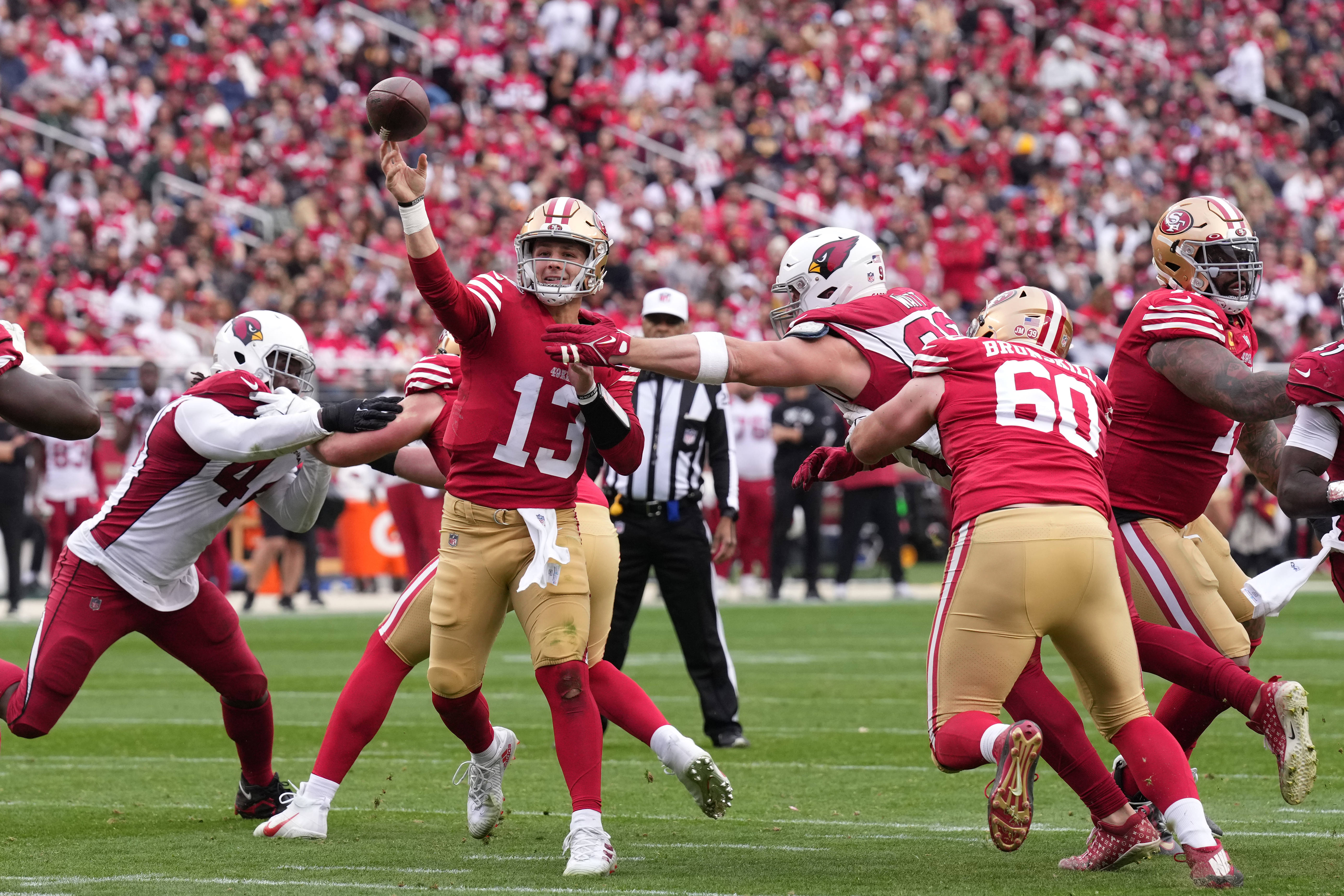
49ers Training Camp: Brock Purdy is stepping up his workload
The quarterback was back on the field on what was thought to be a day off.


