
There's one big flaw with the latest Buccaneers-Mike Evans report
As promised, contract negotiations between the Tampa Bay Buccaneers and Mike Evans came to a close on Saturday. Neither party could come to an agreement before the deadline and now, Evans' post-2023 future with the franchise is in doubt. An interesting layer was added on Friday, though, courtesy of SI's Bucs Gameday's JC Allen and […]


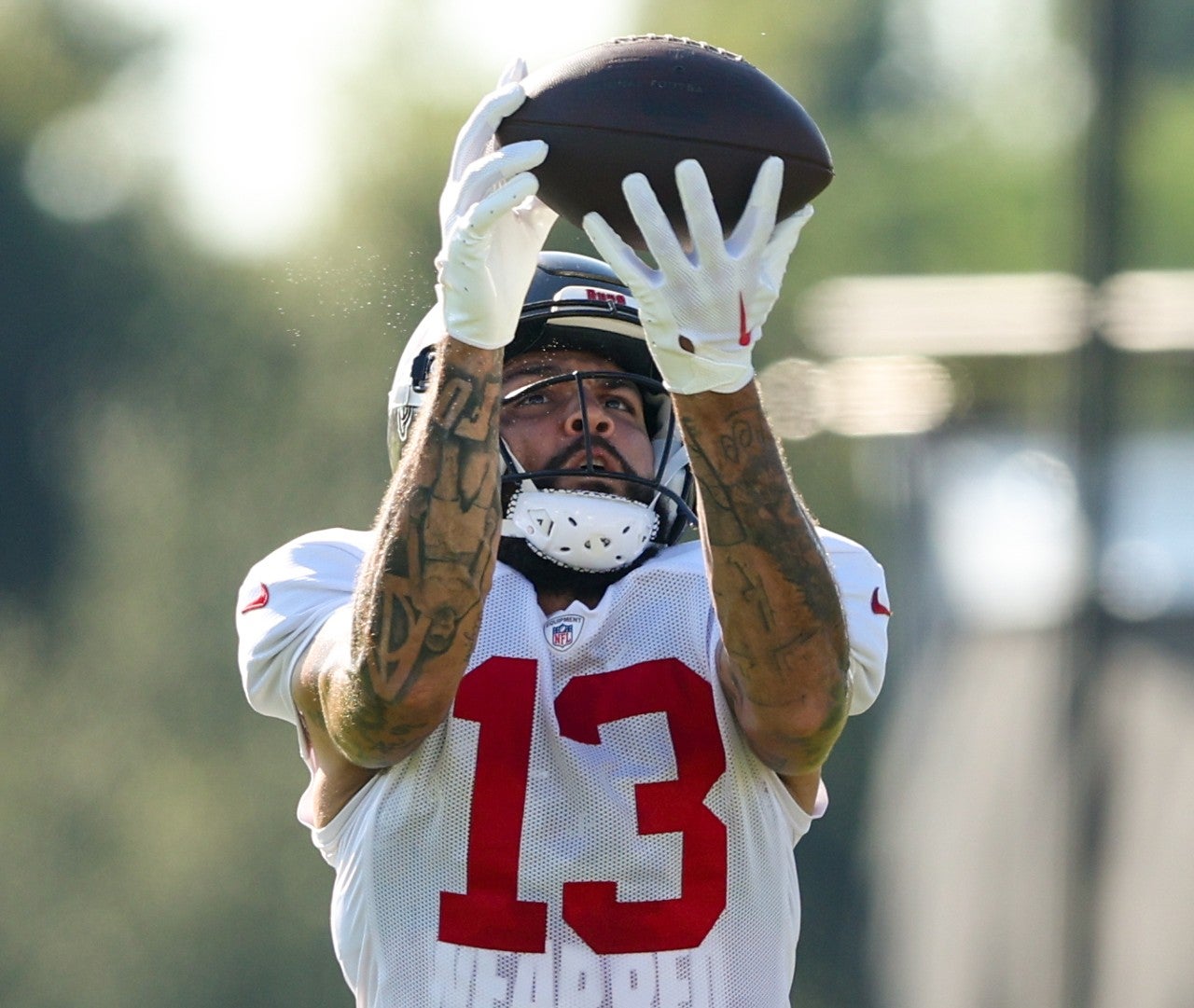
As promised, contract negotiations between the Tampa Bay Buccaneers and Mike Evans came to a close on Saturday. Neither party could come to an agreement before the deadline and now, Evans' post-2023 future with the franchise is in doubt.
An interesting layer was added on Friday, though, courtesy of SI's Bucs Gameday's JC Allen and CBS Sports' Josina Anderson:
Essentially, the Buccaneers are prioritizing homegrown players like Tristan Wirfs, Antoine Winfield Jr., Chris Godwin, and Devin White over Evans. Anderson even mentioned veteran quarterback Baker Mayfield taking priority over Evans if the former Brown and Panther has a good season.
Honestly, every name on that list makes sense, no matter how you feel about Evans' future.
Except White's.
Prioritizing White over Evans is a mistake
Plain and simple.
We don't have to go back far, at all, in order to find reasons why. Evans is on track to play out both contracts he signed with the Buccaneers. On the other hand, White demanded a trade a few months ago when he didn't get his desired extension. Sure, he apologized for it, but it was too late at that point. His frustrations got the best of him and he acted in an unprofessional manner. The contrast in how each player has handled the ugly part of the business and the resulting leadership is something that should be noted, even if White wears a "C" on his chest. In fact, that makes White's reaction all the more disappointing.
Evans is also the absolute definition of consistency. All one has to do is point to his NFL record of at least 1k receiving yards in the first nine seasons of a career. You know, the one record no other receiver in NFL history, outside of Evans, has claimed.
White is coming off one of the worst years of his career and while he has put together some really good weeks, he's yet to develop into the consistent player the Bucs need out of a top-5 draft pick. Maybe that changes this year, but don't be surprised if it doesn't considering this is Year 5 and players typically are who they are, by now.
But, here's the kicker: Buccaneers head coach Todd Bowles loves White and Lavonte David's future is in question after this year. And it'll be like that each offseason he hangs around. Bowles' defense needs middle linebackers who can fly around like White and the Bucs have Godwin to step up in place of Evans if the latter leaves. The Bucs wouldn't be completely bare like a no-White-and-David situation.
That adds an interesting layer and I'm sure it plays a part in the Bucs' current strategy or strategies.
There's also the short- and long-term cap situation
Let's step outside of White for a second. When looking at the Buccaneers cap and cross-referencing it with the potential earnings of the above players, moving on from Evans starts to make more sense.
Right now, the Buccaneers have a little more than $58.1 million in cap room for 2024. But, when considering the mega-contracts that will come with the above players, that money starts to fade quickly.
And, we've gotta go ahead and jump to the next category because it's likely to play a big role in how the Bucs spend their 2024 -and future- cap dollars.
Going back to the way it used to be
The Bucs were largely a "pay-as-you-go" team before Tom Brady arrived. Meaning, they "evened out" their yearly contractual cap hits with at-signing guarantees and large base salaries that could be borrowed from, if needed. Signing bonuses aren't typically included in the contracts and if they are, they're minimal in an NFL sense.
Just look at the contract extensions for David (2015), Evans, and Ali Marpet under Jason Licht before Brady: only Marpet received a signing bonus and it was worth $2 million. David and Evans were guaranteed a certain portion of their contract at signing (Evans was given a whopping $38.258 million at signing), which locked in the money without pushing it down the road.
Now, look at the recent extensions for Vita Vea, Chris Godwin, Carlton Davis III, and Jamel Dean and you'll see what I'm talking about. Godwin received an $18.750 million signing bonus, Dean got $11.420 million, Davis was given $10 million, and Vea received a $4,147,145 bonus. All those extensions came during the Brady Era or right after Brady retired and that's because the Bucs were still reeling (and continue to reel) from pushing money down the road from 2020-2022.
This ties into the previous point because I have a very strong hunch the Bucs will go back to their old method of paying players. It's a smart strategy, honestly, and it keeps the books in check and flexible to where they can create moves to make cap room at will, for the most part. Teams only do what Licht and co. did over the last few years when they have a realistic Super Bowl window like Brady being QB. Any other reason can be chalked up to reckless spending and poor strategy, to an extent.
If the Buccaneers do give out a big signing bonus, it'd be to Mayfield, simply because of the nature of the QB market. With all that being said, the higher base salaries/cap hits stemming from the contract philosophies will limit the money the team can use on Evans.
And when adding on the eventual costs of the void years tacked onto Dean's, David's Vea's, and other contracts, it's something that needs to be accounted for in the big picture, as well.
And one last point: If Evans truly wants a 3-4 year deal like most are saying, then that really limits the Bucs' ability to spread out the cap hit using void years or whatever other measure. Teams can only prorate money for five years over the life of a contract. So, if Evans signs a four-year deal, there's only year available to use for void puropses.
Look, overall, and this is tough to say – it makes sense for the Bucs and Mike Evans to split after the season. There are too many factors both in the short- and long-term that are affected by a hypothetical contract extension and said factors need to be invested in before the four-time Pro Bowler.
Again, except White. His name in the mix throws everything out of whack. Honestly, Anderson could've left his name out of her post and 90% of this article wouldn't exist. But, hey, we can't blame her for doing her job.
If the Bucs can find -and want to find- a way to pay White either the $20 million/year or close to it that he seeks, they can certainly find a way to pay Evans up to the $22-$25 million he deserves.
It's an easy swap and the Bucs are making a big mistake if they pick White over Evans.
Buccaneers get bad news about franchise player
The bad news just keeps coming for the Bucs.
Featured image via Nathan Ray Seebeck-USA TODAY Sports


