
Michigan emptied the bank account for elite QB Bryce Underwood, but it isn’t without major risk
It has been a difficult season for the Michigan Wolverines, who currently sit with a 5-5 overall record on the year. They will need to win at least one of the last two games against Northwestern or Ohio State to become bowl eligible. It has been a tough debut for new head coach Sherrone Moore, […]

It has been a difficult season for the Michigan Wolverines, who currently sit with a 5-5 overall record on the year. They will need to win at least one of the last two games against Northwestern or Ohio State to become bowl eligible. It has been a tough debut for new head coach Sherrone Moore, coming off of a National Championship last season.
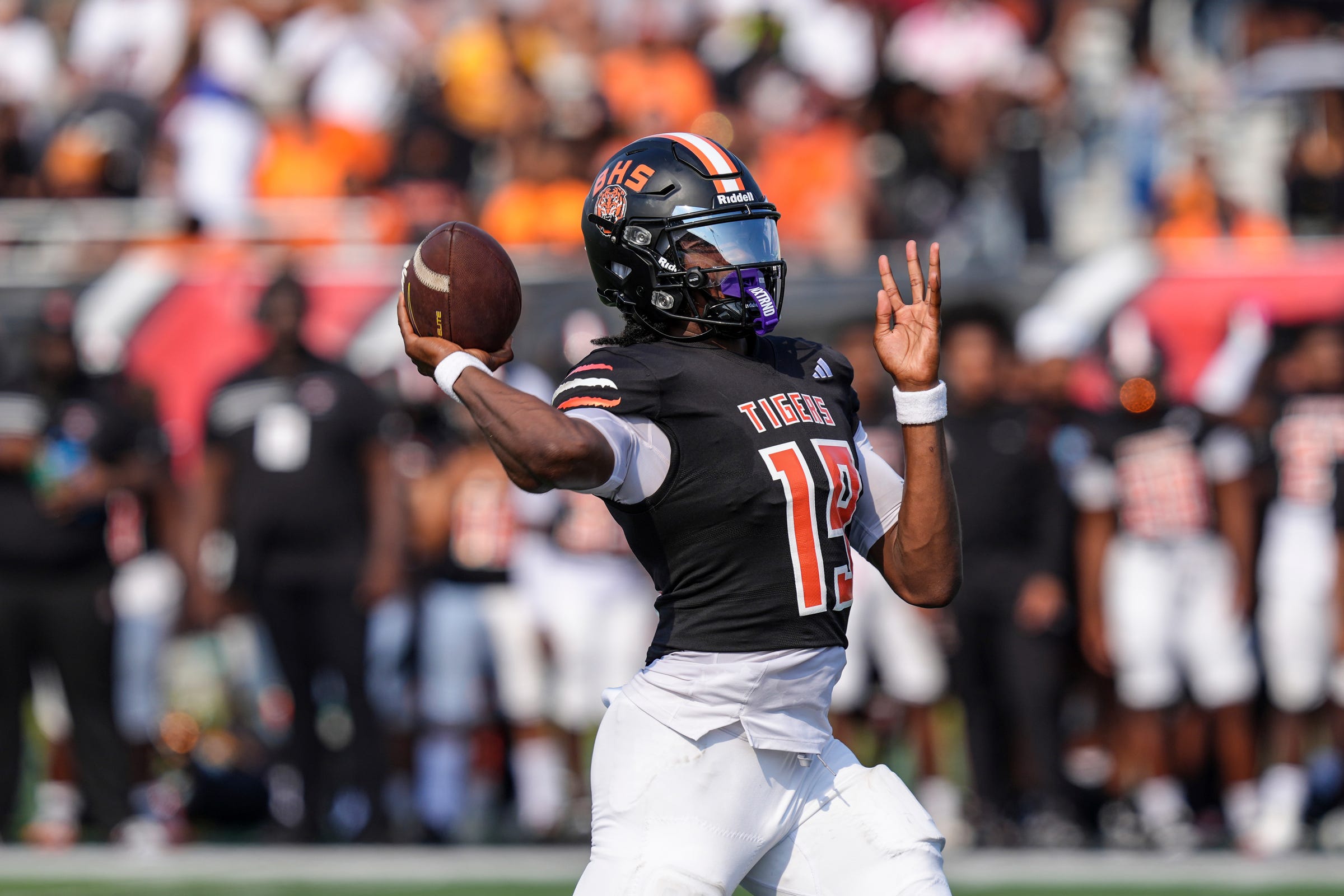
Despite those struggles, the Wolverines did receive some huge news on Thursday when elite 2025 Belleville (Mich.) High School quarterback Bryce Underwood flipped his commitment from LSU to Michigan. Underwood is considered a near-consensus top overall player in the 2025 recruiting class, and a five-star player by every major recruiting platform.
It was a massive grab, especially when you consider that Underwood is an in-state recruit. Every major program wants to keep the best players in their state at home, particularly when they are to this elite of a level. You can’t undersell the importance of this move, even if it did cost upwards of $12 million.
Dave Portnoy can help all he wants, but you are still tapping into a lot of your available funds. It’s a lot to invest in to one player.
One interesting aspect of this commitment, assuming that the price tag is legitimate, is the justification for putting so much money into one position. We have seen this conversation prevalent on the NFL level, where the salary cap is such a hot button topic. We know that quarterbacks are going to demand the biggest price tag, and there has to be a real conversation about to what level it is worth it.
We have seen both sides of this topic in recent years. Giving someone like Patrick Mahomes (Kansas City Chiefs) that big of a price tag is a good investment. He might take up a large chunk of the salary cap, but his play is going to elevate others around him. That makes the investment make sense. You might not be able to pay everyone to the level you might want, but the sacrifice is understandable for what your quarterback can provide.
We have also seen mistakes as well. Giving Daniel Jones (New York Giants) that much money was a bad investment. He isn’t the type of player who is going to supplement a lack of talent around him. There’s going to be some lapses because it limits the overall amount of talent on a roster.
Those are obviously the extreme examples, both on each side. A player like Kirk Cousins (Atlanta Falcons) is probably somewhere in between. He’s a good quarterback but is he to the level that he is going to consistently elevate others? But also, is there an answer that is better that is obtainable? Probably not, and that’s why this is a very nuanced conversation.
It is an apples to oranges example of the investment into someone like Underwood. In the NFL examples, we are talking about second contracts, and investing into a known commodity. For Underwood, you have never seen him in a Wolverine uniform. You are instead investing into what you hope he could be.
While it’s understandable why Michigan invested so heavily into Underwood, it is still unquestionably a gamble. There’s a chance it works out, but we are in uncharted territory right now in the NIL space. How this one ends could be a great example for how to, or how to not, handle offering recruits this type of money.


