
New 2026 NFL Draft projections put Texas Longhorns firmly in the early-round conversation
Texas has 16 players projected for the 2026 NFL Draft, led by Anthony Hill Jr. and Trevor Goosby as potential second-rounders. Here’s how each Longhorn fits into the early draft landscape.


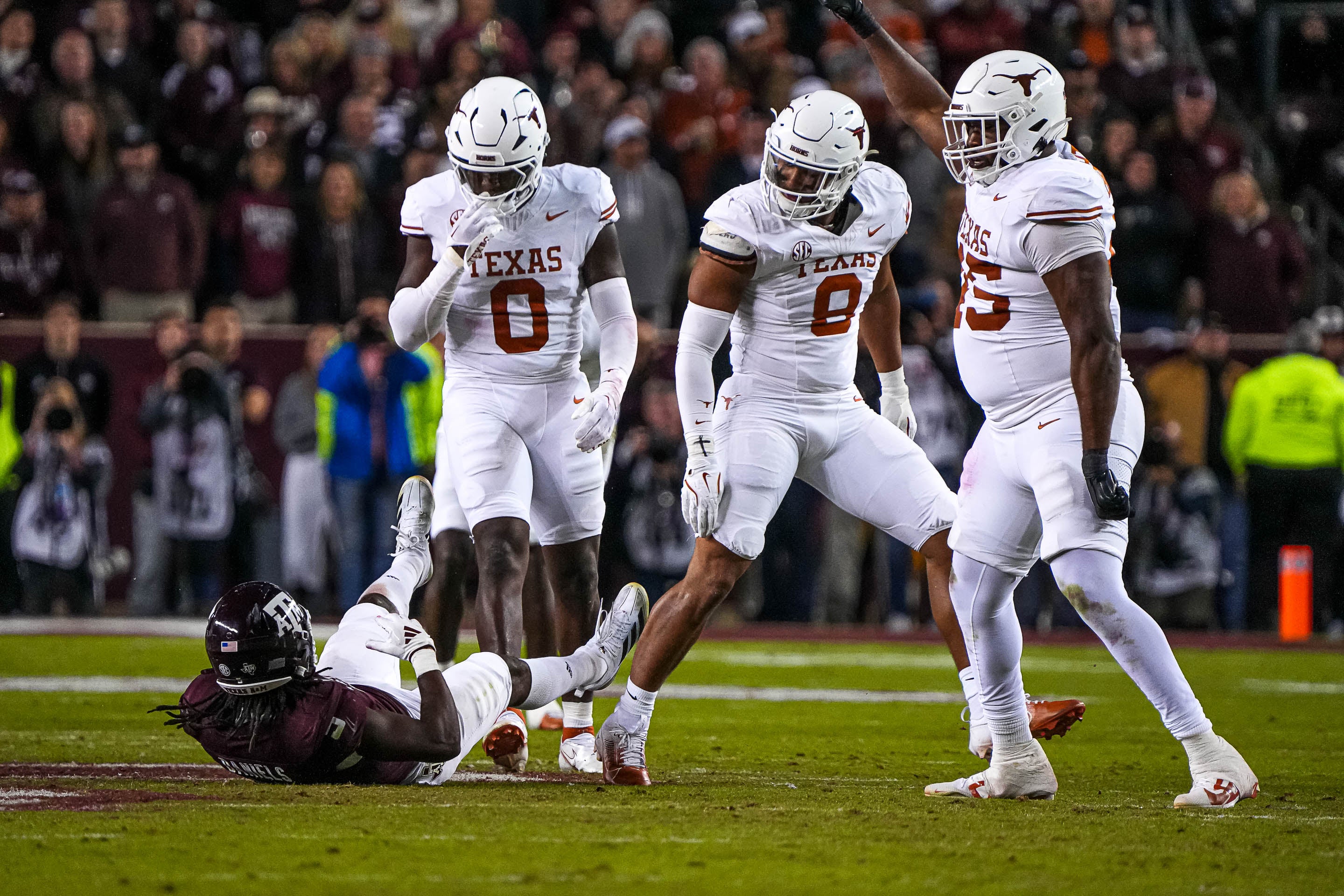
Texas still has one more game to play in Orlando, but NFL scouts have already started circling names on their draft boards.
Updated projections from NFLmockdraftdatabase.com — an aggregator that pulls from hundreds of scout evaluations — now list 16 Longhorns as potential 2026 draft picks. Some names are obvious. Others will surprise fans who haven’t been paying attention to how NFL teams actually value production and traits.
Nothing here is set in stone. Underclassmen are still deciding. Draft boards will shift over the next few months. But the early snapshot reveals something important: Texas isn’t just competing for championships anymore. They’re stocking NFL rosters with real depth.
Here’s how each Longhorn fits into the current landscape.
Anthony Hill Jr., LB – Round 2, No. 41
Hill is the crown jewel.
The emotional leader of Texas’ defense in 2025, Hill combined elite athleticism with the kind of closing speed that makes offensive coordinators nervous. He lived in the backfield all season, erased angles that shouldn’t exist, and set the tone for everyone around him. NFL evaluators love linebackers who can blitz, cover, and run sideline to sideline without breaking a sweat. Hill does all three.
His projection as a second-rounder reflects positional value more than talent ceiling — linebackers just don’t get drafted as high as they used to. But make no mistake: Hill looks like a decade-long NFL starter. The kind of player defensive coordinators build around.
Trevor Goosby, OT – Round 2, No. 38
Goosby is the other name that matters most on this list. In his first season as a full-time starter, he earned first-team All-SEC honors while anchoring the left side against some of the nastiest pass rushers in college football. NFL teams pay premium prices for tackles who can protect the blind side right away, and Goosby’s combination of size, footwork, and recovery ability makes him exactly that kind of asset.
If he declares, he won’t be available long. Teams picking in the 30s and 40s are already circling his tape.
Malik Muhammad, CB – Round 3, No. 91
Muhammad’s rise has been steady rather than explosive, but NFL teams value exactly what he brings. He played meaningful snaps throughout Texas’ 2025 season, showing discipline in zone coverage and enough speed to survive on the outside when asked.
He’s not viewed as a shutdown corner yet, but his ball skills, length, and willingness to tackle make him attractive as a Day 2 developmental piece. Corners with his profile tend to climb boards as the draft process sharpens. Don’t be surprised if he sneaks into the late second round.
Jack Endries, TE – Round 4, No. 139
Endries demonstrated dependable hands, route awareness, and sufficient blocking competence to remain on the field in multiple formations. NFL teams love tight ends who can do multiple jobs without needing a PhD in the playbook. He’s not going to be a matchup nightmare, but he’s a plug-and-play piece with long-term value as a versatile second or third option.
Michael Taaffe, S – Round 5, No. 157
Taaffe’s not the fastest safety on the board, but he might be one of the smartest. His instincts, tackling reliability, and leadership traits translate well to Sundays, particularly in split-safety systems that require communication and pre-snap adjustments. Teams value players who can contribute early on special teams and grow into rotational defensive roles. That’s Taaffe’s profile exactly.
Quintrevion Wisner, RB – Round 7, No. 231
Wisner remains a tough evaluation. He showed vision and burst in limited opportunities, but NFL teams don’t invest heavily in running backs unless they see a clear differentiator. Wisner’s projection reflects depth value more than feature-back upside. If he declares, his path likely comes through special teams and committee usage rather than as a workhorse.
D.J. Campbell, OG – Round 7, No. 225
Campbell’s projection reflects reliability more than dominance. He played meaningful snaps and held his own, but interior linemen without elite power or flexibility tend to slide down boards. Still, guards who can start games in the SEC usually find NFL homes late in the draft or as priority free agents.
Cole Brevard, DT – Round 7, No. 230
Brevard profiles as a rotational interior piece. He showed flashes of disruption but didn’t consistently command double teams or dominate one-on-ones. NFL teams value defensive tackles who can occupy space and stay assignment-sound, which keeps Brevard in the draftable conversation as a late-round developmental pick.
The free agents group
Several Longhorns project as undrafted free agents right now, though that could change with strong pre-draft workouts:
Trey Moore (EDGE) – Moore’s production never fully translated into draft traction, largely because he struggled to consistently win one-on-ones at the point of attack. He flashed effort and motor, but lacked the twitch NFL teams want from edge defenders.
DeAndre Moore Jr. (WR) – Moore’s name surfaces in draft conversations, but the projection tells the truth about how the league views him right now. He flashed explosiveness and separation ability but lacked consistent volume and refinement. Scouts see athletic traits worth developing, just not enough tape to justify a pick yet.
Cole Hutson (OG) – Hutson’s role was more situational, and the tape didn’t show enough consistency to generate momentum. Interior linemen often develop late, but for now, the projection matches his limited usage.
Travis Shaw (DT) – Shaw struggled to carve out a clear role. Without elite size or pass-rush juice, his projection reflects the brutal reality interior defenders face when they don’t dominate one specific area.
Ethan Burke (EDGE) – Burke showed effort and flashes but never consistently bent the edge or won with power. NFL teams tend to pass on edge defenders without a defining physical trait.
Jaylon Guilbeau (CB) – Guilbeau’s role was limited, and the tape didn’t create momentum. That said, corners are always in demand. A strong combine could reopen doors quickly.
Lance St. Louis (LS) – Long snappers exist in a completely different draft universe. St. Louis’ path will come through specialist workouts and camp evaluations rather than traditional draft boards.
Jelani McDonald (S) – McDonald remains a traits-based evaluation. He’s still deciding his future, and another season could significantly change this projection. If he finds consistency and versatility, the board will move.
What this means for Texas
These projections underscore what Steve Sarkisian has built in Austin. The Longhorns aren’t just producing stars at the top of the draft. They’re creating NFL-ready depth across the roster. Hill and Goosby headline the class, but the middle and late rounds tell a story of development, coaching continuity, and positional relevance that NFL teams trust.
Some players will return for another year. Others will declare early. Draft boards will shift between now and April.
But the takeaway is clear: Texas isn’t just competing for national championships anymore. They’re stocking NFL rosters with legitimate talent at every level of the draft.
Texas Longhorns News
Texas dethrones Ohio State as college sports’ most valuable program—and 13 schools are now worth over $1 billion
Texas now leads college sports financially, topping CNBC’s rankings at $1.48B as media rights, SEC revenue, and NIL deals fuel a billion-dollar boom.


