
Texas' defensive line wasn't just good in 2023, it was generational and innovative stat shows why
We have seen some dominant position groups in college football in the twentieth century. The Miami Hurricanes secondary of 2001 with Ed Reed and Sean Taylor. The USC running backs of 2004 with Reggie Bush and LenDale White. The Florida secondary of 2008 with Joe Haden, Janoris Jenkins, and Major Wright. The 2010 LSU Tigers secondary […]


We have seen some dominant position groups in college football in the twentieth century.
The Miami Hurricanes secondary of 2001 with Ed Reed and Sean Taylor. The USC running backs of 2004 with Reggie Bush and LenDale White. The Florida secondary of 2008 with Joe Haden, Janoris Jenkins, and Major Wright. The 2010 LSU Tigers secondary of Patrick Peterson, Morris Claiborne, and Tyrann Mathieu. Ohio State's receiving core seems to be loaded every year as of late
These are just a few of some of the most dominant position groups we have seen in this century during college football.
In 2023, we saw another.
It might not be a unit that comes to mind for most college football fans on first thought. But the University of Texas quite possibly had a generational defensive line this season.
To understand my reasoning behind this statement, you first need to understand the metric I am using. The metric is WAA or wins above average. This is a new statistic PFF has rolled out recently.
In it's definition,
WAA combines how well a player performed in each facet of play (using PFF grades) and how valuable each facet is to winning football games. The result is a first-of-its-kind metric in football that allows for cross-positional valuation and is predictive of future value at the player and team levels. WAA represents the number of wins a player is worth over an average college football player.
To understand the basic scoring principles of this metric, you should know that a score of 0 is good. It means you are doing your job as a player. Anything above is obviously good, and the opposite for if you score in the negatives.
The top two players in scores for this metric this year, were both from Texas.
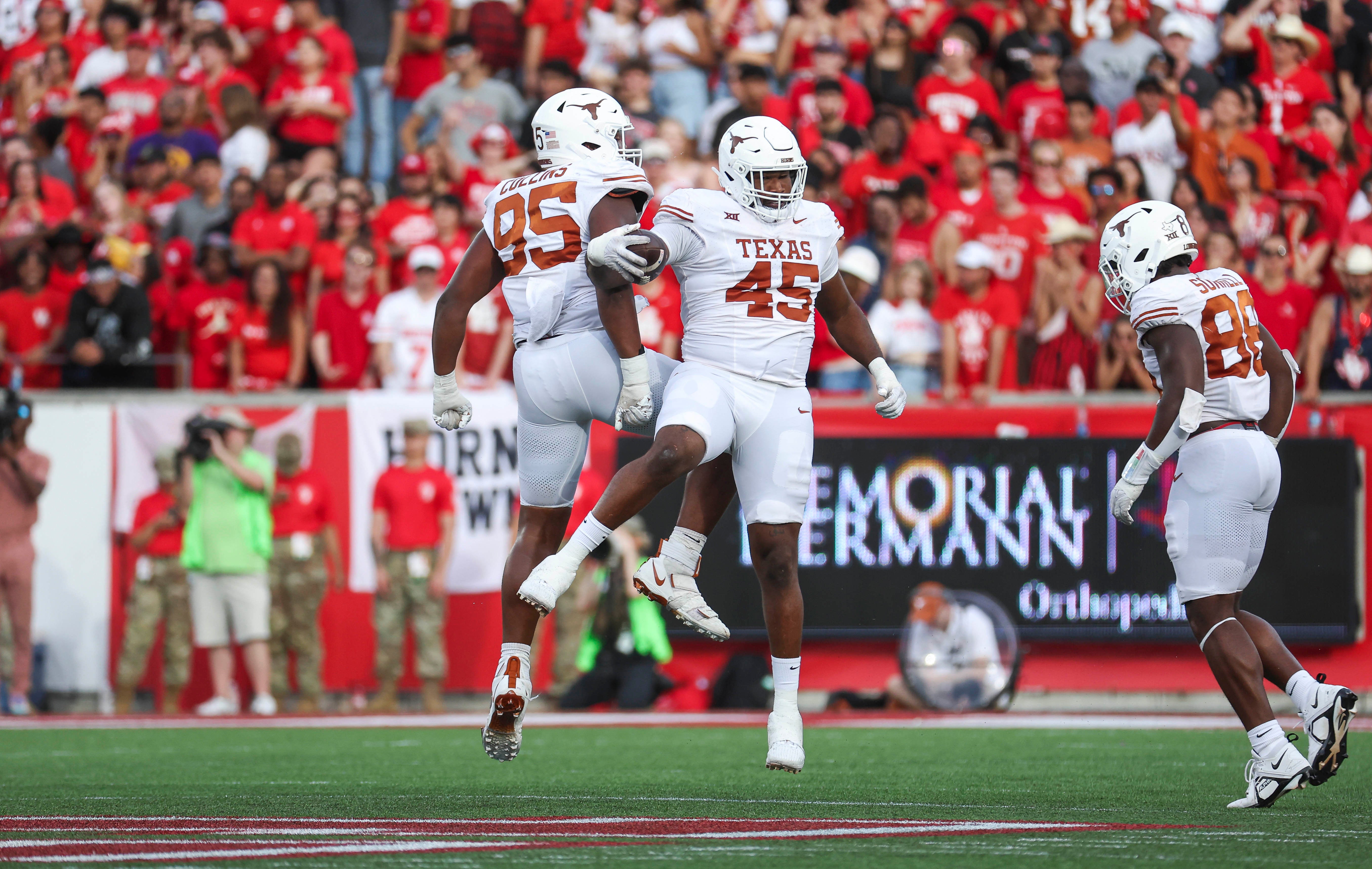
T'Vondre Sweat comes in first with a WAA of 0.44, and Byron Murphy comes in second with a WAA of 0.38. They also have Alfred Collins at T-11th with a WAA of 0.16. Michigan is the only other school with two players in the top twenty.
The only teams that came close to matching this production were the 2020 Georgia Bulldogs and the 2018 Ohio State Buckeyes. The Bulldogs had two players in the top twenty in this metric. Devonte Wyatt was first with 0.28, and Jordan Davis was seventh with 0.16. The Buckeyes had who came in at ninth with 0.23, Robert Landers who came in at tied fourteenth with 0.18, and Davon Hamilton also tied at fourteenth with 0.18.
If you're an NFL Draft fan, odds are you have heard about T'Vondre Sweat and Byron Murphy.
Alfred Collins didn't declare, so he is a name to write down for next year, and he is not someone people should sleep on.
Collins posted a PFF grade of 80.0 during the 2023 season, with an 80.6 pass-rushing grade and a 71.5 run-defense grade. With Sweat and Murphy heading to the NFL, he is primed for a breakout year to solidify his status.
Whatever happens to Longhorn football moving forward, fans should the 2023 defensive line its due: It was a generational unit that shouldn't be forgotten.


