
Cody Glass's latest stepping stone in Nashville promises a bright future
Cody Glass didn't get to go home for Christmas break. "Too risky," he says. "Knowing my luck, I probably would have been stuck in Winnipeg." As the Nashville Predators returned to the ice at Bridgestone Arena for morning skate ahead of their matchup with the Dallas Stars, Glass was among many players who stuck around […]

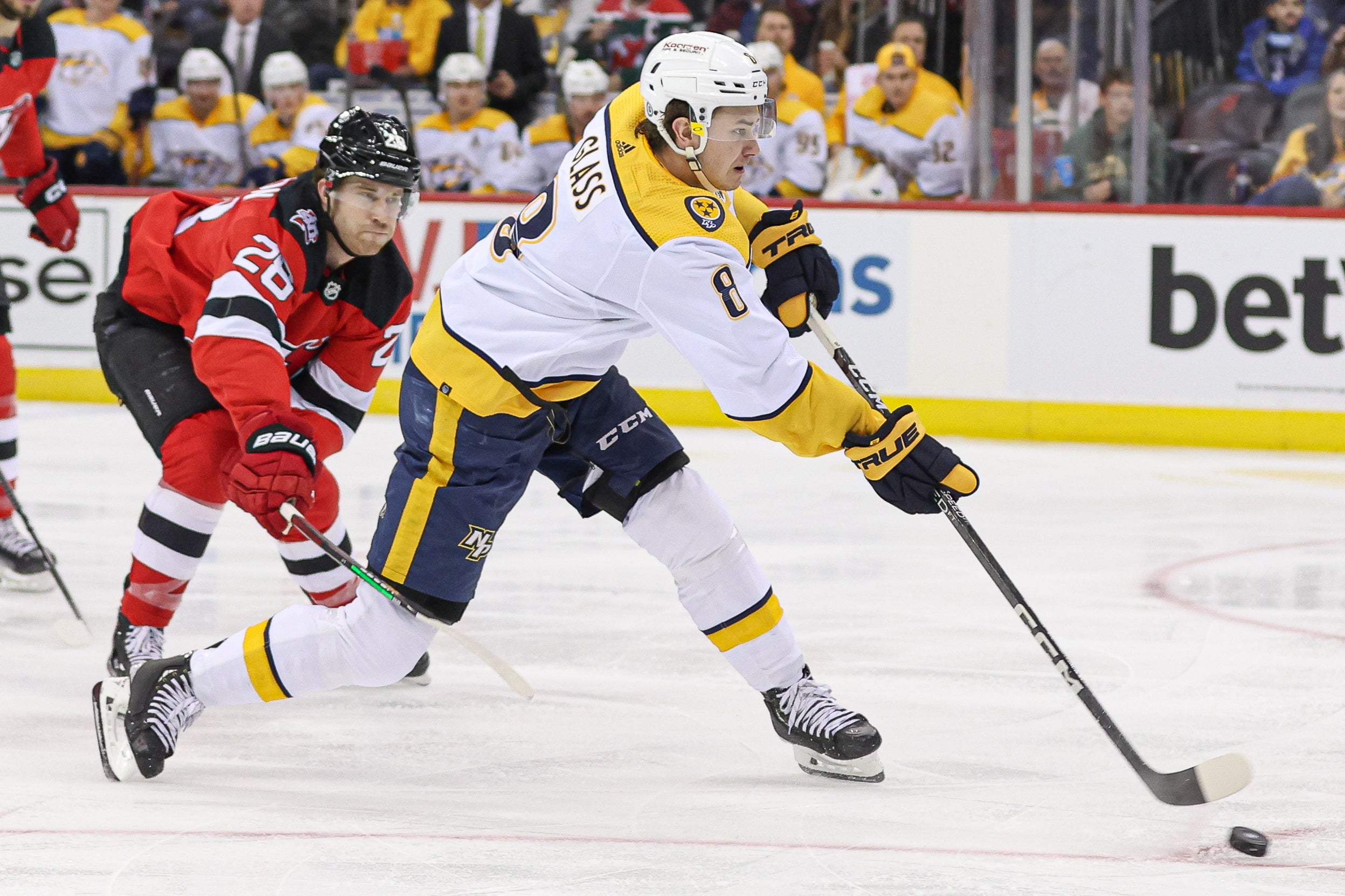
Cody Glass didn't get to go home for Christmas break.
"Too risky," he says. "Knowing my luck, I probably would have been stuck in Winnipeg."
As the Nashville Predators returned to the ice at Bridgestone Arena for morning skate ahead of their matchup with the Dallas Stars, Glass was among many players who stuck around Nashville for the break, knowing that the winter storm that cancelled flights all across North America over the last few days was not something to test.
Instead, Glass had to settle for a "FaceTime Christmas" with his family, including father Jeff and brother Matt, both of whom live in his hometown of Winnipeg, Manitoba.
"It was a relaxed Christmas for sure, which was fine," Glass said. "Those things can get a little hectic."
While a trip back home was not something Santa could deliver for Glass on Sunday, he did get a chance to play in front of his family a couple weeks ago, when the Preds played the Jets at Canada Life Centre. It was a moment that Glass called "a dream", especially considering how important his father and brother have been in his life.
But the unfortunate truth for many NHL players is that sometimes family has to wait. Playing in the NHL, especially playing top minutes against elite players, is not something to be taken lightly.
It would have been nice to see family in person on Christmas. But Cody Glass has a job to do.
Cody Glass's new role "a stepping stone" for him
After getting healthy scratched ten times this season, most recently on December 8th, Glass finally seems to have settled into an everyday position on the team. He's played in all nine games for the Preds since that date, mostly at the center position, while also getting time on the power play.
"I'm just kind of doing the right things and I'm getting rewarded with ice time," Glass explained. "I feel like I'm player who kind of builds confidence and gets more comfortable on the ice when I play more. I see the ice better, I get more puck touches and that's where kind of my game comes out."
In that time, Glass has been an excellent two-way forward for the Preds. He's collected five points (one goal, four assists) and his underlying numbers are impressive; his shot attempt share (52.3%) ranks 3rd among forwards on the team in that span, and his expected goal share (51.1%) ranks 5th.
But that's only half of the story; the other half is who he's been playing against.
Against the Edmonton Oilers, Glass took on the task of stopping Connor McDavid and Leon Draisaitl. No small task for a young center in the NHL, but Glass played very well against the Oilers' dynamic duo.
"Going from where I've been in the past to now I'm line matching with McDavid," Glass said. "It was kind of funny going through it, but at the same time, it was a great challenge for me. If I can play with them, then I can play with anybody in the league."
"It was a really good stepping stone for me. You can't shut down McDavid. The only thing you can do is kind of maintain them. And I felt like I did a decent job of doing that."
Glass led his line with Nino Niederreiter and Tanner Jeannot, holding McDavid scoreless at even strength.
"I was telling guys, 'Yeah, I was line matched against them and held McDavid to only two points,'" Glass said with a laugh. Then he added, still smiling: "I think they were on the power play though."
But power play points aside, Glass's role against the Oilers taught him a valuable lesson.
"Just being able to skate with them and kind of prove to myself that I'm capable of playing with those kinds of players, it's a good confidence boost for me."
Studying opponents as part of the job duties
Two days after beating the Oilers 4-3 in overtime, the Predators traveled to Chicago to play the Blackhawks. With his new role in mind, Glass was ready to use the confidence gained from two nights earlier as a guide to shutting down Patrick Kane and Max Domi, the top offensive threats for a floundering Blackhawks team.
Coming off a win, and knowing he'd just kept one of the world's best players from scoring a goal, should make things easier for Glass, right?
Wrong.
"That was a lot harder, I think" Glass said.
"McDavid and Draisaitl are very offensively skilled," Glass explained, "but you kind of know where they are at all times. With [Max] Domi and [Patrick] Kane, they're sneaky players that hide. I think that's kind of more dangerous. You always have to keep your head turning."
An offensive player that "hides", as Glass puts it, is one that finds soft areas of the ice and waits for the puck. Maybe they wait in the shadow of a defenseman whose attention is focused on another player. Maybe they sit just off your hip, moving quickly when they notice your momentum is going the other way. Or maybe they literally "hide" on the back door, waiting for a one-timer or tip opportunity.
Which is almost exactly how the Blackhawks scored to tie the game in the 2nd period. Glass lost Kane in transition and never quite found him before Connor Murphy sent home a shot from the blueline. Kane was right there on the backdoor ready to tip home a rebound, having just hit the post only seconds earlier.
"Patrick Kane is one of the sneakiest players to ever play the game," Glass said. "So, it was a lot to go from a really fast team with McDavid and Draisaitl to a team that was kind of slower pace and sneaky. It was a good change of pace, but also a good stepping stone up, where every night you have to be ready and really know your opponent."
Knowing your opponent is key to executing any game plan, in any sport. But it's especially important for a "shutdown" role player in hockey because, if done correctly, your team can effectively neutralize the opponents' top offensive threat.
For a team like the Nashville Predators, who do not seem bound for the playoffs, and who have a very confusing long term plan, it's especially crucial that young players like Cody Glass find a role they are successful in.
Using offensive skills to hold off opponents
Two days after Chicago, the Predators came home to face the Colorado Avalanche. This time, Glass drew the Avs' top line with J.T. Compher, Mikko Rantanen, and Artturi Lehkonen.
While the end result for the Predators was an overtime loss, Glass was able to hold the Avs' top unit in check. Rantanen had a sensational night, getting off 13 shots on goal and finishing with a goal and an assist. But Glass was able to generate some offense in response, finding Matt Duchene on the back door just as a power play expired to give Nashville a 2-0 lead. It was a crisp, tape-to-tape pass that only a confident player would attempt.
As John Hynes pointed out on Tuesday, one of the keys to Glass being able to challenge skilled opponents is his offensive skill.
"I think in this league, to be able to shut down [good opposing forwards] is to generate offense against them," Hynes said. "When you play against top lines, if you can play offense against them, and you're a good offensive player, sometimes their attention to detail defensively isn't as good and you can expose that."
"You want to be able to put not just defensive players on the ice against those guys, you want to put guys that can generate offense against them. And I think [Cody Glass] has done a good job of that."
Coming into the league, Glass was seen as a top end offensive player. Scouts praised his vision, playmaking, and puck skills, seeing him as a top six level player with a moderately high ceiling.
Nearly 100 games into his NHL career, Glass's .37 points per game suggests a slower development in that area than was expected, but this season for Nashville he's been improving more noticeably.
Last night against the Dallas Stars, Glass again was an offensive force in the Dallas end. His line led the Predators in expected goals for at 5-on-5 and was a consistent presence thwarting the Stars' attack. If it weren't for a late goal by Roope Hintz to put Dallas ahead 3-2 with 52 seconds left, the Predators might have earner their first points against Dallas.
"I thought they did a good job," Hynes said of Glass's line. "Just unfortunately that last minute, that line found a way to score a big goal. For the most part, I think they did a good job."
These are all lessons learned for Glass as he's figuring out his new role. But the good news for Glass is that he has a clear role defined for him for the first time in his NHL career.
A clear direction and a bright future
Cody Glass seems to have fully accepted the challenge the coaches have given him. He knows how important it is to scout his opponent, learn their tendencies, and understand their strengths and weaknesses. He clearly wants to work as hard preparing for an opponent as he does during the game, and so far he's been successful at doing so.
"He's a really smart player," Hynes said when asked about Cody Glass's new role on the team. "He's got good size, good skating, good hockey sense. I think he's really growing in his confidence and his competitiveness against those style players."
But it hasn't always been this way for Glass.
With the Vegas Golden Knights, it took a while for Glass to finally see action. He made his debut on October 2nd, 2019, two years after he was drafted, and even scored a goal in his debut against the Sharks.
But after that, Glass says his role with the Golden Knights was never quite clear.
"I didn't know really what my role was," Glass said. "That's where I think I kind of got stuck."
"I played the power play when I was there, but I was third third line, fourth line. When I was on the power play, that was really good, because I knew I could play my game. I could play with skilled players."
Inconsistent playing time, not having skilled line mates, and a lack of communication about his role on the team all contributed to Glass's inability to thrive in Vegas. Clearly, by putting him on the power play, they thought he was a skilled player. But sticking him on the third line during 5-on-5 play sent a mixed message.
Today, Glass doesn't blame coaches or management for that.
"It was one of those things where I couldn't really put my game together. I kind of put that on myself. Obviously I want to make it work, and I want to do the best I can, but sometimes it just doesn't fit. I'm just trying to find that and I feel like I'm finding it now. But I just need to do it consistently."
In July 2021, Nashville acquired Cody Glass in a three way deal with Vegas and Philadelphia. The trade involved former Preds defenseman Ryan Ellis and former 2nd overall pick (in the same draft as Cody Glass) Nolan Patrick.
Glass says that in his time in Nashville, he's found more consistency when it comes to communication from the coaching staff and management, especially when it comes to his role on the ice.
"I think I've had more conversations with management here," Glass said. "Everybody's very talkative here with me. I just have a better idea of what they want from me and what kind of player they want me to be. That's a huge help."
In Nashville, Glass has found clearer expectations, more frequent conversations, and better feedback on how to grow his game in the NHL.
"I feel like in Vegas, it was kind of more quiet. It was an older team [in terms of age of the players]. So it was more of me kind of figuring out for myself, which is hard. But here it's kind of more clear cut what they want for me and that just gives me a better sense of direction with my development."
As the Nashville Predators are struggling to find their identity for this season, and while they still have an unclear path forward to regaining a competitive edge in a bloodthirsty Western Conference, the emerging development of Cody Glass is certainly a bright spot.
— Featured image via Christopher Hanewinckel/USA TODAY Sports —


