
Late-game heroics weren't a problem for Caleb Williams, it’s what happened before and here's how Ben Johnson can fix what's missing
The 2024 season showed us a lot about Caleb Williams but because of the situation he was faced with, it's hard to accurately predict how things will actually change for the better under a stronger situation in 2025.The Chicago Bears' offense was one of the worst overall units in football when it came to efficiency […]


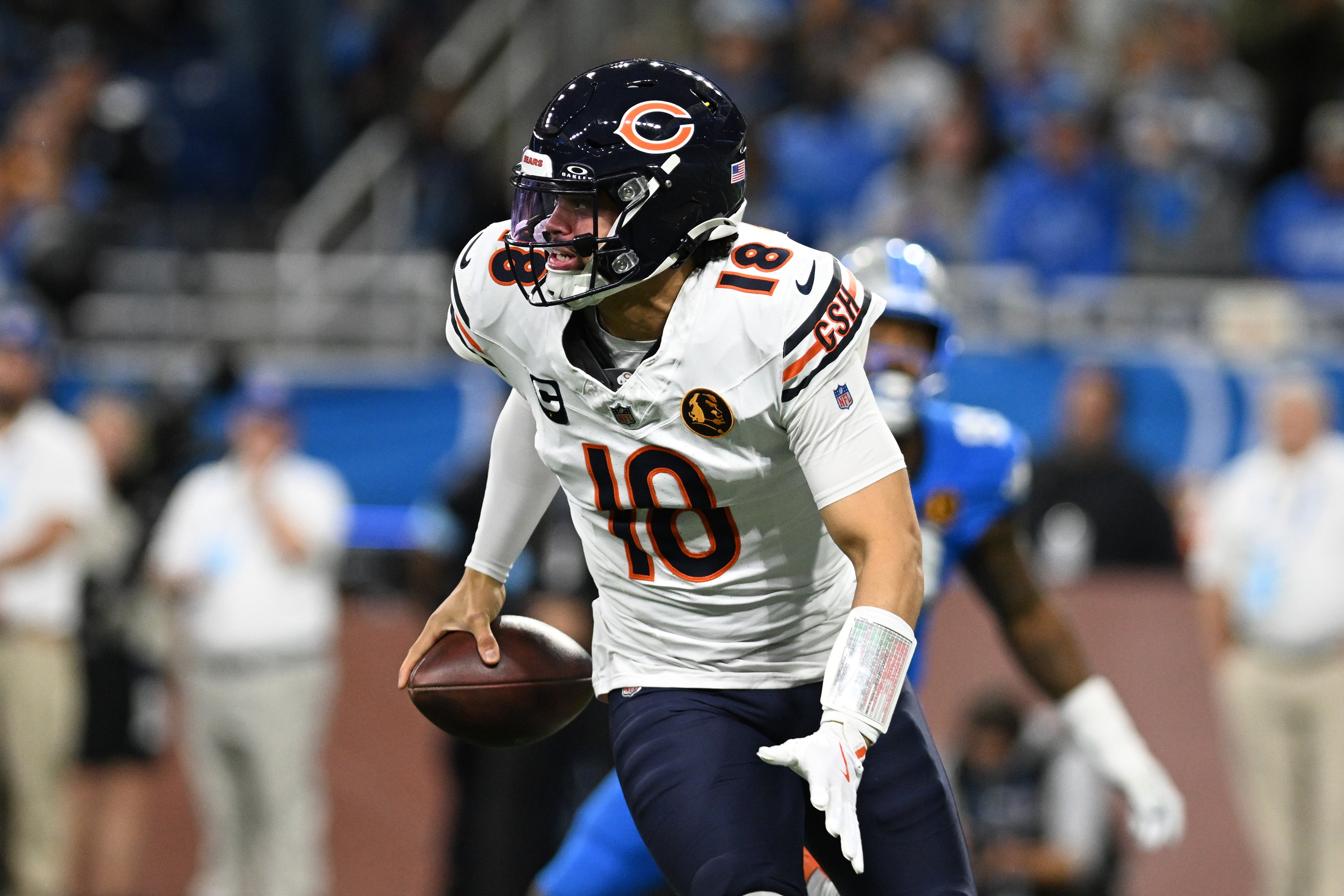
The 2024 season showed us a lot about Caleb Williams but because of the situation he was faced with, it's hard to accurately predict how things will actually change for the better under a stronger situation in 2025.
The Chicago Bears' offense was one of the worst overall units in football when it came to efficiency and overall productivity.
Part of the blame goes on the former rookie quarterback, but not all. Between a struggling offensive line and overall gameplan, Williams entered into every game with one hand tied behind his back and it was clear.
Even still, Williams showed some of the flashes that made him the first overall pick, particularly his late game brilliance that caught the eyes of those around the league.
"What we thought about [Williams] was, when the lights are bright, he was going to show up," head coach Ben Johnson said. "It felt like the game slowed down a little bit for him and he was able to just go out and find an open guy and get a completion."
While Johnson was referring to a practice setting, he already had that expectation in his mind about his new quarterback because that same level of clutch showed up during multiple games in 2024.
When the lights were bright, Williams showed up and put his team in winning situations. In the fourth quarter last season, Williams ranked Top-5 in passing yards (1,108) and passing touchdowns (10) with only two interceptions while playing in the toughest situations imaginable nearly every single week down the stretch.
Now, the wins didn't marginalize as expected in those moments for a multitude of reasons, but it's hard to blame Williams for not being able to close games out after getting his team into position to win.
What we can blame is how the offense was structured and operated throughout the first three quarters that created those unnecessary moment of truth moments for the young quarterback to try and conquer. Let's start from the beginning.
Lack of early game structure/rhythm
This was one of the main problems that plagued the Bears' offense throughout the 2024 season. The opening scripts were absolutely terrible and predictable week in and week out.
Chicago went all 17 games without scoring a first drive touchdown. Of those 17 games, 13 opening drives ended in a punt or turnover on downs, and only six total points were scored by the Bears on their first offensive drive.
By comparison, let's look at the Lions' offense under Ben Johnson. Detroit scored six touchdowns on the opening drive of the game in 2024.
As far as early game success goes, Lions' quarterback Jared Goff ranked inside the Top-10 in positive play percentage and explosive play percentage during the first quarter alone, according to Sports Info Solutions. Williams ranked 35th in positive play percentage and 33rd in explosive play percentage in the first quarter among 35 QBs with 50+ attempts.
Playing from behind / Poor situations
As a result, the Bears played from behind, A LOT. Which in turn put Williams into poor situations where the offense became one-dimensional and forced to pass in the second-half, sometimes fully abandoning the run game to catch up.
Chicago's offense had 213 rushing attempts in the second-half, which ranked 23rd in the NFL. And 308 pass attempts, which ranked 6th. Detroit, on the other hand, was 8th in second-half rush attempts with 260 because they rarely played from behind and even if they were Johnson still tried to keep defenses honest.
During the first three quarters, Chicago's offense averaged 11.12 points per game while the Lions averaged 26.64 points per game in quarters 1-3.
Games such as Week 11 against the Jaguars is a great example. Detroit scored a touchdown on six consecutive drives to create a 42-6 lead in the third quarter. In Week 6, Detroit held a 37-9 lead over the Cowboys by the 4th quarter.
To further stress the poor situation Williams faced in the third quarter, he led the NFL with 16 sacks and only Sam Darnold had more total pressures faced. Goff was only sacked six times in the third quarter all season long.
All of this created catastrophic situations entering the fourth quarter. Yet, Williams more than once flipped the switch to will his team back into it.
Ben Johnson's role in helping Caleb Williams become a complete QB
It all starts with creating a solid gameplan. Sounds simple enough? Yet it was something two head coaches and three different offensive coordinators struggled to do in Chicago throughout 17 games.
Johnson is an innovative play-designer who aims to take the pressure off his quarterback. Jared Goff isn't the smartest or most athletic quarterback. What Goff did very well was operate within structure that prioritized clean pockets, high-percentage throws, and plays that built off one another.
With Williams, Johnson's first goal was the stripping and rebuilding his mechanics. Things like footwork, drop, and timing are critical in his offense. As far as the play-calling goes, Williams needs to be on the same wavelength with Johnson.
Back in late October, Williams said something that resonated with me. He said "I do want to be able to control as much as I can" and it was an overlooked statement.
Williams wasn't saying that he wanted to do it himself or that he didn't trust his teammates. He was saying that he wanted to be in command of this offense and have the trust from his coaches to operate the scheme on the field. Basically be an extension of his play-caller.
Now, let's look at what Johnson said about Williams before the team exited for summer break:
"We've loaded him up," Johnson said. "We're tried a number of different things: long play calls, multiple plays at the line. Tempo. We've dabbled here, there and everywhere really throughout the springtime. Some come a little bit more natural than others for him, but I do think we've seen him get better in really all facets."
The coaching staff is putting everything on Williams' plate early on to see what he can handle, and can't handle, which will continue to happen into training camp.
Williams needs to be able to understand the full playbook, opening game plans, possible audibles, and multiple reads throughout the entire game and it needs to be second nature. Most importantly, he needs confidence that the offense can work as intended.
If Williams and Johnson can work to put it all together, he won't just be a 4th-quarter wizard trying to save the game, he'll be a true franchise QB that can dominate games through all four quarters, just like Johnson was able to do in Detroit with Jared Goff.
Latest national ranking hints the Chicago Bears’ bold offseason plan might be paying off sooner than expected
Can the unit live up to it.


