
Ryan Poles explains how the draft board might have fallen out of the team's favor specifically at the RB position during the 2025 NFL Draft
One of the biggest gripes during the 2025 NFL Draft this weekend from the Chicago Bears fan base was the decision not to heavily pursue adding one of the running backs in such a deep class until the final round of the draft.The expectations were too high at the position for what the Bears were […]


One of the biggest gripes during the 2025 NFL Draft this weekend from the Chicago Bears fan base was the decision not to heavily pursue adding one of the running backs in such a deep class until the final round of the draft.
The expectations were too high at the position for what the Bears were willing to accomplish in this draft and part of it is the team's fault, and part of it is just the way the board fell for Chicago.
Bears head coach Ben Johnson and general manager Ryan Poles addressed the position multiple times leading up to the draft regarding the possibility of making a significant addition and even did extensive work on many of the top RB prospects.
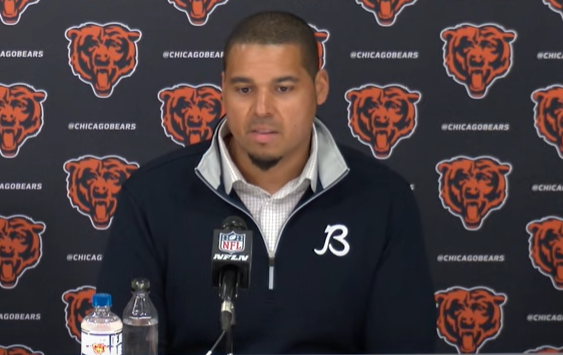
After the draft, Poles explained how the board danced away from the team in terms of missing out on the opportunities to land one of the coveted impact running backs.
"Every draft has these pockets that you just don't fall into," Poles explained on Saturday. "If you're going to be disciplined and you're going to let the board dictate how you do things, it just happens that way. Because of that, you end up in some really cool situations and acquiring talented players who might come from a different position that maybe you would have liked. At the end of the day, you're increasing the talent on your football team and I do think you can get into trouble if you start trying to manipulate things to get into certain pockets where you end up hurting the team in the long term"
That's a long drawn out response but essentially the Bears weren't willing to be aggressive and move up to target that specific position. They preferred to instead use the board to their advantage, even if it didn't work out as they would have hoped in terms of landing a top RB.
The complaints all started on the opening night when the Las Vegas Raiders selected the top running back in the class, Ashton Jeanty, sixth-overall. The fifth-overall pick, eventually held by the Cleveland Browns was heavily rumored to be up for grabs again if the offer was fair and the Bears opted to stick with their No. 10 pick and select tight end Colston Loveland.
"Definitely let the board do it's thing, which always puts you in a real comfortable position. You're not forcing certain needs. I think a lot of mistakes can be made there," Poles said on Thursday. "We felt confident with the way that it was going to play out, we were looking at the numbers, we made phone calls up and back just to see what the landscape was. At the end of the day, the way it fell, we felt really comfortable."
In the second-round, the Bears held the 39th and 41st overall pick but watched as both Ohio State backs, Quinshon Judkins and TreVeyon Henderson, went off the board at picks No. 36 and 38. As a result, the Bears pivoted to the best player available in WR Luther Burden III at pick No. 39 and traded out of the 41st overall pick.
In that trade, the Bears also gave up the 72nd overall pick in the third-round, which would have put the team in range to select another back they brought in for a visit in Iowa's Kaleb Johnson, whom the Pittsburgh Steelers selected 83rd overall.
"We had a number of players that we were interested in on our board, kind of looked at our needs that were underneath and teams that were below us and felt there was a good chance that we could add some picks in that group," Poles explained about the trade. "Ended up falling exactly that way."
On Day 3, the Bears made two more trade downs and seeing who went off the board prior to the team's selection was telling. At pick No. 109, the Bears moved down following an early run of RBs coming off the board with Bhayshul Tuten and Cam Skattebo getting drafted in the early fourth-round. By the time the Bears selected at pick No. 132, four more backs in Trevor Etienne, Woody Marks, Jarquez Hunter and Dylan Sampson were off the board as well.
Heading into the fifth, more quality backs were available but the Bears opted to take another trade down opportunity with the Rams that netted a key future fourth-round pick. Jordan James, Jaydon Blue, and DJ Giddens all were selected by the time the Bears were back on the clock.
A similar trend occurred in the sixth with Ollie Gordon II, Devin Neal, and Tahj Brooks being selected ahead of the team's position.
Finally, in the final round of the draft, the Bears had a back land in their laps in Kyle Monangai out of Rutgers. Monangai was the 22nd running back selected in the draft.
"We believe he can come in and compete," Poles said about Monangai. "We like his contact balance and again just the physical nature of how he plays football and his pass protection is really good as well."
So, all in all, the Bears still got the bruiser back who adds the pass protection value they were hoping to land, but at a much later point in the draft than many anticipated.
Perhaps that was to plan, or perhaps the draft got away from them and the Bears were forced to adjust throughout the weekend. Either way, the team came out of the weekend with top players to help the team at various different position while still taking their swing on a running back they valued late in the draft. It's hard to fault the process seeing the final results.
