
Packers' wide receiver group sparks fascinating debate about the future
The entire group of wide receivers on the Green Bay Packers' active 53-man roster has an $8.13 million cap hit. They might lack an elite option, but the combination of production and cost is somewhat close to a perfect scenario in terms of roster-building. But that might change soon. Christian Watson and Romeo Doubs were […]


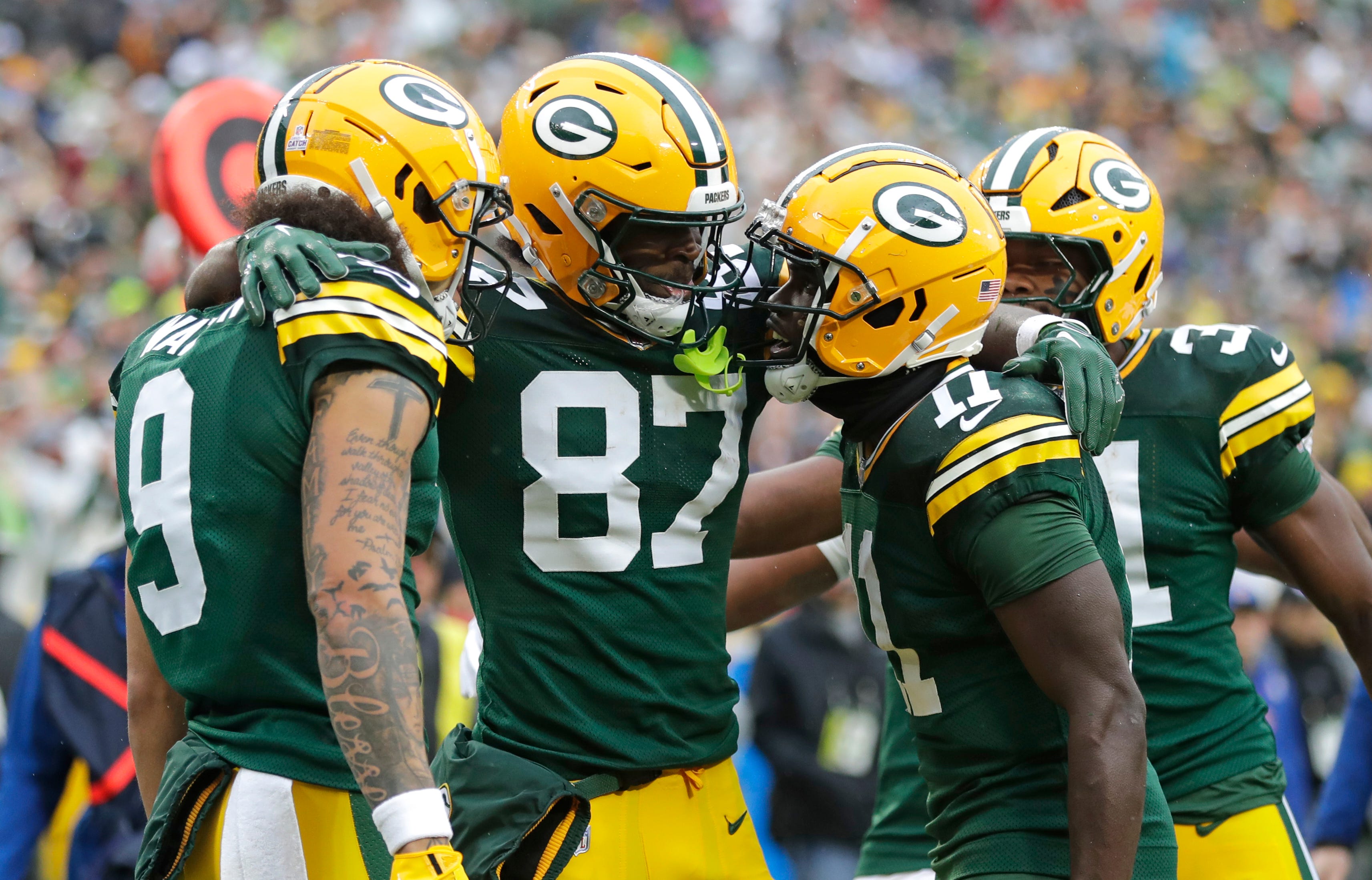
The entire group of wide receivers on the Green Bay Packers' active 53-man roster has an $8.13 million cap hit. They might lack an elite option, but the combination of production and cost is somewhat close to a perfect scenario in terms of roster-building.
But that might change soon. Christian Watson and Romeo Doubs were both drafted in 2022, so they will already be extension eligible in 2025, which is also the last year of their rookie deals. Jayden Reed and Dontayvion Wicks have two more years of cheap cost, but they will become extension-eligible after next season as well.
And based on the wide receiver market, it's hard to project any realistic scenario in which the Packers keep more than two of them. Justin Jefferson is making $35 million a year, CeeDee Lamb is right after him with $34 million. Ja'Marr Chase will certainly surpass Jefferson this offseason, likely getting close to $40 million. Decent wide receivers are also making a lot of money. That secondary market includes $18 million a year for Christian Kirk, $17.5 million a year for Jerry Jeudy, $13 million a year for players like Darnell Mooney and Gabe Davis.
What could they make
Right now, it feels like Jayden Reed might be the primary option for the Packers to re-sign. He has been the most productive and consistent pass-catcher of the group. But Green Bay will still have another year or two of cheap production there.
Watson and Doubs are the ones bringing more intrigue right now, because it's really tough to evaluate what they offer and how much they can cost.
The former second-round pick lacks production. He's had 1,653 receiving yards combining his three seasons with the Packers — with one game left, which won't change the big picture. That's less receiving yards than Marquez Valdes-Scantling had in his first three seasons, and the Packers refused to pay him the $10 million per season the Kansas City Chiefs offered. Even with inflation, that doesn't sound promising for a big extension.
So yes, Watson is extremely important for the Packers' offense and he brings another dimension to attack opposing defenses. But when it's time to negotiate, production and injuries have to be a factor.
Romeo Doubs has had slightly less production, with 1,642 receiving yards, but more total receptions (140 to 98). He is more consistent and Jordan Love relies on him, but his skillset is certainly more easily replaceable. At the same time, his profile might be less enticing on the market, bringing his value down — and potentially making a reunion easier for the Packers.
Likely outcome
The Packers don't need to rush their decision. Watson and Doubs might fight for early extensions, but the CBA doesn't give them much leeway.
At the same time, the Packers have bigger priorities among players selected in 2022. Green Bay has the only trio of starting offensive linemen from the same draft class, and that includes their two bookmark tackles — Rasheed Walker and Zach Tom. Right guard Sean Rhyan can wait, but it would make sense to lock Walker and especially Tom up as soon as possible.
Meanwhile, it makes sense for the Packers to wait on Watson and Doubs. A fourth year would give the team more information about their production and what they can do on the field. It also gives the Packers more time to evaluate the rest of the room, and how imperative Watson and Doubs are for the offensive operation.
If one of them plays so well in 2025 that he becomes indispensable, the Packers will gladly pay the difference. But waiting is the way to go.
