
Jaxson Dart, Jalen Milroe, and Quinshon Judkins headline 2025 NFL Draft prospects to watch in bowl season
The college football bowl season offers one last opportunity to observe 2025 NFL Draft prospects before the offseason chaos begins. While all-star games and the NFL Scouting Combine are the final elements in assessing a prospect before the draft in April, these competitive matchups provide the best insight into an individual player's abilities. Some of […]


The college football bowl season offers one last opportunity to observe 2025 NFL Draft prospects before the offseason chaos begins. While all-star games and the NFL Scouting Combine are the final elements in assessing a prospect before the draft in April, these competitive matchups provide the best insight into an individual player's abilities.
Some of the top 2025 NFL Draft prospects may choose to opt out of bowl games that are not part of the College Football Playoff due to the real risk of injury. However, many seniors and top underclassmen still have the chance to boost their draft stock before making the transition to the NFL.
We have examined the matchups in each bowl game to identify 10 prospects who can significantly enhance their prospects with strong performances. This is not a ranking of the top 10 talents participating in all the bowl games; rather, it is a list of 10 players who stand to gain the most from impressive showings.
Ranking Prospects to Watch in Bowl Games
10. T.J. Sanders, DT, South Carolina
The combination of Dylan Stewart and Kyle Kennard is one of the most formidable pass-rushing duos in the country. However, the South Carolina defensive front stands out as the best in the nation because they feature two exceptional interior disruptors alongside them.
T.J. Sanders is one of the top penetrating defensive linemen heading into the 2025 NFL Draft, having recorded 32 pressures, five sacks, and 24 run stops while playing next to these two standout players. His production could be even higher if he weren't competing for plays with such elite talent.
Nevertheless, Sanders is well-regarded in evaluation circles. At 6 feet 4 inches and 290 pounds, he posted similar numbers in 2023, but his performance this year has been more consistent. His strength and awareness have improved significantly, suggesting he should be starting on an NFL defense by 2025.
As he prepares for his matchup against Illinois, Sanders is considered a top-50 prospect. A disruptive performance in this game could propel him into the first round of the draft. While Illinois presents a decent challenge, they are severely undermanned in their offensive line and may struggle to contend with the Gamecocks' quartet of disruptive players.
Interior linemen Josh Kreutz, Josh Gesky, and Brandon Henderson have been graded as average or worse by Pro Football Focus throughout the season. As a result, we could see Sanders have a standout performance on this significant stage.
9. D.J. Giddens, RB, Kansas State
D.J. Giddens has proven to be a remarkable successor to Deuce Vaughn, posting back-to-back seasons with at least 1,226 rushing yards and seven touchdowns. This year, with Avery Johnson taking over as quarterback, Giddens elevated his performance, accumulating 1,343 rushing yards and 258 receiving yards. Standing at 6 feet 1 inch and weighing 212 pounds, he now faces an important decision regarding his future.
With 518 career carries, Giddens has little left to prove. While not exceptionally fast, he is efficient and adept at finding open space after being contacted. Impressively, 1,925 of his 3,088 rushing yards came after contact, averaging 3.72 yards after contact per carry over his three seasons.
I expect Giddens to run in the high 4.5-second range at the Scouting Combine; therefore, his lack of top-end speed isn't a significant concern. The NFL has seen more upright backs like Giddens achieve success despite not fitting the traditional mold, as they consistently reach their spots within the rhythm of the offense and manipulate pursuit angles to shed tackles. Giddens is well-suited as a change-of-pace back.
Rutgers’ run defense ranks near the middle of the pack, allowing nearly 150 rushing yards per game. However, they give up five yards per carry, which is tied for 103rd in the nation. Giddens should thrive in this matchup, and a strong performance against an out-of-conference opponent would provide the right momentum to push him closer to the early Day 3 range in the upcoming draft.
8. Kyle Monangai, RB, Rutgers
Giddens is likely to have the advantage against Rutgers, but the same cannot be said for Kyle Monangai when facing the Kansas State defense. The Wildcats boast an elite run defense, significantly bolstered by their secondary. This is a challenging unit to penetrate, and Monangai has struggled to create plays on his own when his team is outmatched.
While Giddens is expected to be categorized as a power-based backup in the NFL, many believe that Monangai has the potential to emerge as a starter. Standing at 5 feet 9 inches and weighing 209 pounds, he has been a cornerstone of the offense for the past two years, surpassing 1,200 rushing yards in each season and scoring 21 touchdowns during that span.
Monangai is quick and powerful, thanks to his low center of gravity. His advanced statistics and usage have been nearly identical over these two years, demonstrating his ability to maximize his opportunities, even when playing behind an overmatched offensive line. However, the question remains: does he possess the necessary top-end speed to become a standout NFL starter?
His matchup against Kansas State will provide crucial insights into that question.
7. Harold Fannin Jr., TE, Bowling Green
Already the most productive tight end in FBS history, Harold Fannin Jr. has impressive statistics, totaling 100 receptions for 1,342 yards and nine touchdowns. As he approaches his final game of the 2024 campaign — and potentially the last game of his collegiate career — it would be great to see him face a higher level of competition than Arkansas State. Fortunately, he still has one more year of eligibility left.
Despite the matchup, it remains crucial for Fannin to showcase his skills. His usage has been reminiscent of Jaheim Bell's, but at an even higher level, and Bell was selected in the seventh round last year.
Fannin has excelled as a high-volume target, an explosive receiver, and a rushing threat. However, his NFL projection is uncertain due to his size, standing at 6 feet 4 inches and weighing 230 pounds.
A creative NFL offense could utilize Fannin in various roles: as a slot receiver, an inline tight end, out wide, or even in the backfield. Most NFL teams tend to shy away from fully embracing versatile players, so Fannin must dominate every opportunity he gets to demonstrate that he deserves significant investment and a key role in a weekly game plan.
6. Noah Thomas, WR, Texas A&M
Noah Thomas stands out in his class as the only playmaker with an impressive 6-foot-6 stature, making his combination of size and agility particularly striking.
Similar to former Florida State and current Philadelphia Eagles receiver Johnny Wilson, Thomas is likely to find a role in the NFL as a powerful slot receiver or a hybrid tight end. Teams are always eager to take a chance on someone with such a rare physical profile.
Although Thomas has some limitations, he is viewed as a superior athlete compared to Wilson, and his history of fewer drops is noteworthy. Over the past three years, he has recorded only four drops on 108 targets, indicating he has a stronger projection than Wilson. Some scouts have placed him in the middle of the Day 2 draft range.
One concern for Thomas is his lack of consistent involvement and production. He has only had three games with more than three receptions this season and two games with over 65 receiving yards.
As a junior, Thomas needs to build on his breakout performance against Auburn in Week 13 to justify making the jump to the next level. Otherwise, returning to Texas A&M may need to be considered.
5. Jaylin Noel, WR, Iowa State
Iowa State's impressive wide receiver duo of Jaylin Noel and Jayden Higgins has made significant strides towards becoming top-100 picks in the upcoming NFL Draft. Each receiver surpassed the 1,000-yard mark this season, solidifying their status as one of the elite pairings in college football. Nevertheless, evaluations of Noel, in particular, have been lacking.
At 5-foot-11 and 200 pounds, Noel is a slot receiver who appears capable of handling a high volume of NFL targets. While not the fastest player on the field, he is quick and adept at finding open space, excelling against zone coverages. What makes him especially intriguing is his performance in situations where many smaller receivers struggle.
This season, Noel has only dropped 5.3% of the passes thrown his way, with just four of his 109 targets hitting the ground. Additionally, he has made 17 out of 36 contested catches throughout his career, demonstrating toughness at the catch point that is uncommon for someone under 6-foot-2. His skill set is reminiscent of what Jarvis Landry showcased during his time at LSU.
The upcoming game against Miami in the Pop-Tarts Bowl presents an excellent opportunity for Noel to demonstrate his athleticism against one of the more physically talented teams in the nation. The Hurricanes' secondary has faced significant challenges with discipline, but they possess the length and speed typical of a strong defensive unit. Noel must capitalize on this opportunity.
4. Quinshon Judkins, RB, Ohio State
TreVeyon Henderson has emerged as the standout back in Ohio State's impressive running game, leaving Quinshon Judkins to handle much of the tough work between the tackles and in the red zone.
While Judkins has performed well, accumulating 839 yards and 10 touchdowns with an average of 5.4 yards per carry, he has struggled due to a series of injuries affecting his offensive line. Since Week 6, Judkins has only managed more than 46 yards in two games.
The advanced statistics indicate that 2024 isn't an unusually poor year for Judkins, as his numbers for yards after contact per attempt (3.24), forced missed tackles, and breakaway rate (39.8%) remain close to his career averages. The main issue is that he’s getting hit immediately, leaving him little room to maneuver.
Looking ahead to the matchup against Oregon, it’s unlikely that this will resolve all his problems. In their previous game, Judkins was dealing with a hand injury, which contributed to his only fumble of the season. With the Buckeyes making further changes to their offensive line, there is a possibility that Judkins could find enough running lanes to overcome his recent struggles.
If he cannot improve his performance, Judkins' status in this running back class may remain uncertain. He is undoubtedly a talented player with the potential to be a quality starter in the NFL; however, his recent slump since mid-season has raised enough doubts that he could potentially fall out of the Day 2 picks in the 2025 NFL Draft.
3. Mykel Williams, EDGE, Georgia
If Mykel Williams' standout performance against Texas in the SEC Championship Game is any indication of his potential moving forward, the excitement surrounding this highly athletic edge rusher is well-deserved.
He has consistently proven to be the best athlete on the field in nearly every game he has played, boasting the skills to be a top-five pick in the 2025 NFL Draft. However, raw talent alone isn't enough.
An ankle injury limited Williams during the first half of the season, and it took him several weeks to regain his rhythm upon returning to the field.
His less impressive performances against Ole Miss and Georgia Tech raised concerns about whether he could maintain a high level of intensity or if his profile had too many red flags to overlook. Despite his potential to become a star, Williams saw a decline in mock draft rankings this season.
After recording 10 pressures and two sacks over two games against Texas, the lanky pass rusher is now in a position to turn his impressive performances into a top-10 draft pick. While Arizona State will likely rely on its strong running game to disrupt Williams, it might not be sufficient to contain him.
2. Jalen Milroe, QB, Alabama
Hopes were high for Jalen Milroe to reach new heights under first-year head coach Kalen DeBoer, but the pairing failed to produce lasting results. Instead of utilizing Milroe as a key component of a strong offensive scheme, DeBoer often made him the primary engine of the unit, asking too much of him to create plays with both his legs and arm.
As a result, Milroe had a decent but not exceptional season.
Milroe's throwing motion, accuracy, decision-making, and playmaking ability have been inconsistent, leaving him as a highly gifted athlete more than a slam-dunk quarterback prospect. He will need the right coaching staff, a strong supporting cast, and time to develop in the NFL. Milroe is expected to enter the 2025 NFL Draft class, but he plans to play against Michigan in the ReliaQuest Bowl.
This game presents a pivotal opportunity for Milroe to demonstrate whether he has adapted to coaching and made any necessary adjustments against a talented team fresh off a significant upset win.
Currently, he is viewed as the third-best quarterback in the class, but a strong performance against Michigan could help him gain more recognition leading into the offseason.
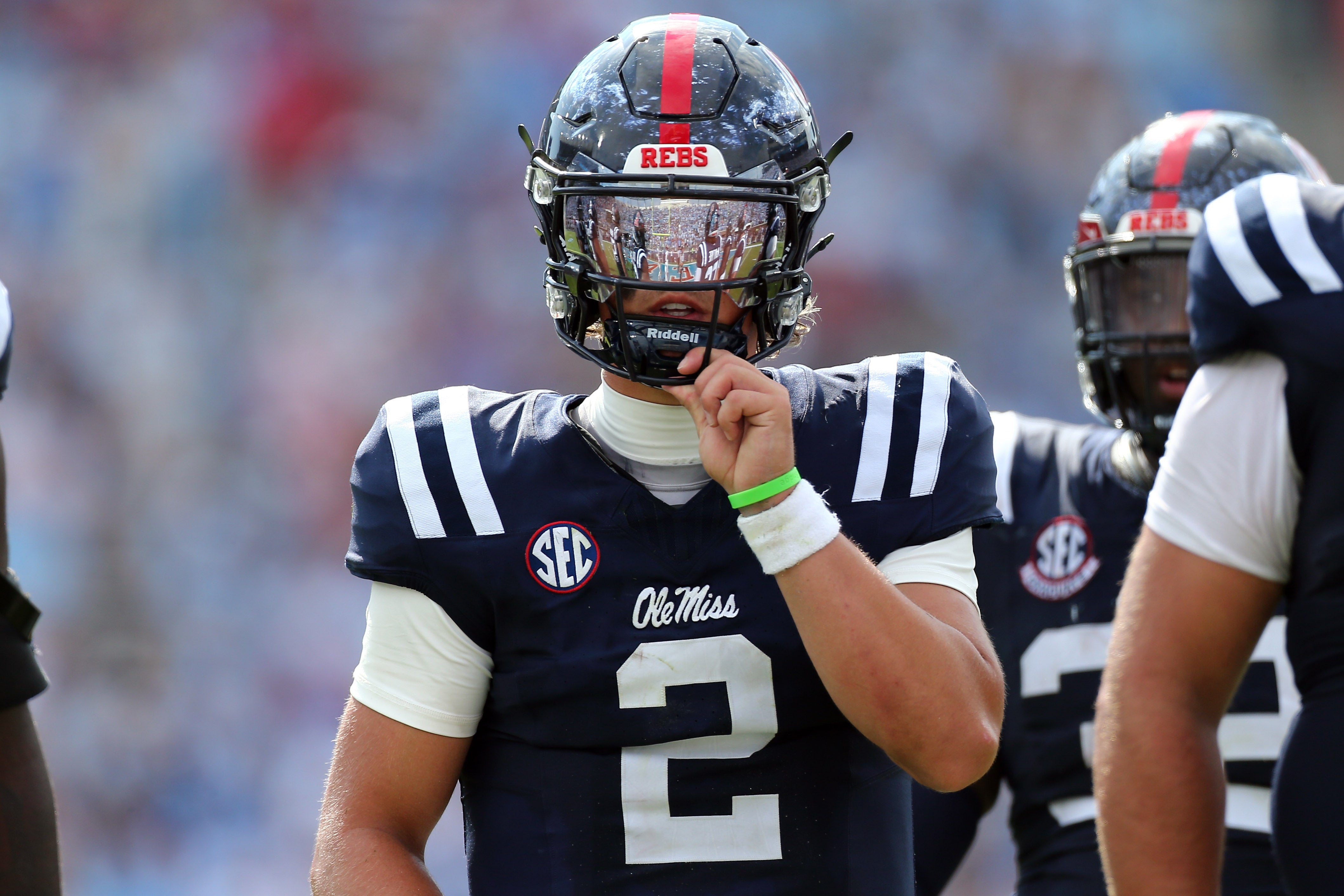
1. Jaxson Dart, QB, Ole Miss
Front offices that prioritize analytics will appreciate Jaxson Dart's profile. His impressive production, efficiency, and consistency over the past three seasons suggest he could become a reliable game manager in the NFL. However, could we consider aiming higher for someone who possesses both NFL-level skills and the ability to execute a scheme effectively?
It’s possible that we’re undervaluing the Ole Miss star, despite some eye-catching and rough turnovers. With 77 touchdown passes against only 27 interceptions while averaging nearly 11 yards per attempt, he showcases the qualities of a rhythmic passer with a solid arm, yet the excitement around him hasn’t matched his impressive output.
Could a standout performance against Duke in the TaxSlayer Gator Bowl shift perspectives? Dart is set to play, and if he puts on a strong showing, he may convince skeptics of his potential to be a franchise quarterback.
