
Bengals demonstrate the blueprint for stopping Titans run game
One of the main causes for the Tennessee Titans 20-16 loss to the Cincinnati Bengals on Sunday was the difficulties Tennessee had in the running game. Typically, the Titans are a run-first offense that relies on the legs of Derrick Henry to carry them to victory. On Sunday, Cincinnati had Henry bottled up for just […]


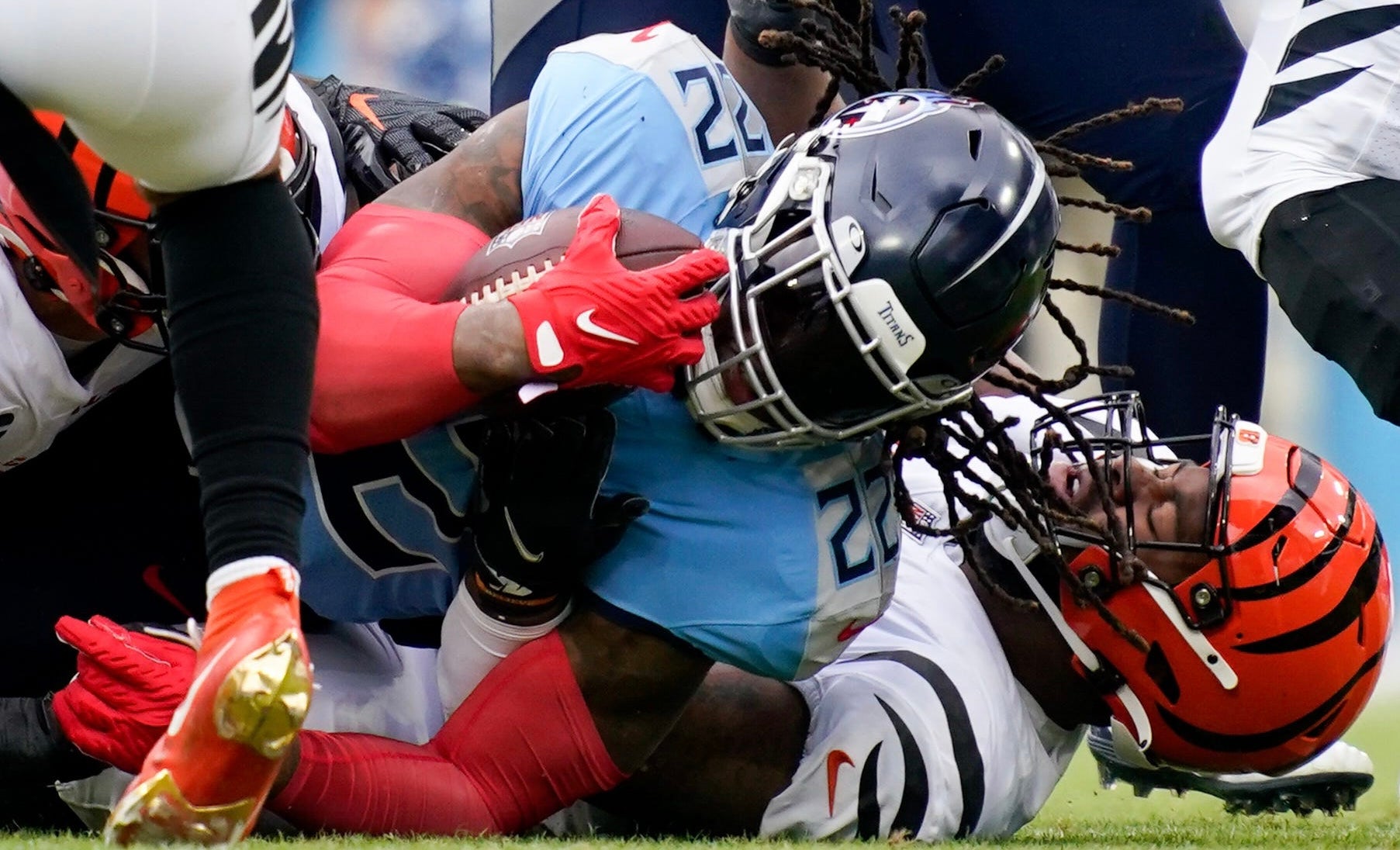
One of the main causes for the Tennessee Titans 20-16 loss to the Cincinnati Bengals on Sunday was the difficulties Tennessee had in the running game.
Typically, the Titans are a run-first offense that relies on the legs of Derrick Henry to carry them to victory. On Sunday, Cincinnati had Henry bottled up for just 38 rushing yards on 17 carries. Nine of those 17 carries went for one yard or less.
Any time an opposing defense gets ready to face the Titans, the biggest concern is finding a way to contain number 22. The Bengals just demonstrated the blueprint to stopping the Titans' run game, and every NFL team should start taking notes.
The Blueprint
The Bengals defense was often stacking eight or nine players in the box and mixing in the occasional nickel blitz to disrupt Henry behind the line of scrimmage. By using a Bear Front and winning 1-on-1's against Tennessee's offensive line, Henry very rarely got back to the line of scrimmage before being met by a defender.
The "Bear Front" is a defensive front used in run defense that is designed to oppose heavy personnel from the offense on short down and distances. It is common in goal line defense, or as we saw on Sunday, against a team that leans on running between the tackles.
When used correctly, both of the guards and the center are covered. The defensive linemen line up directly on top of their shoulders, while the defensive ends use outside leverage on the tackles.
By doing this, most of the gaps are filled early on by players at the line of scrimmage. That then leaves most second-level defenders (like a blitzing nickel or linebacker) to roam freely and attack the football. There is less pressure to plug the holes, and more focus on hitting the ball carrier.
Bengals linebacker Logan Wilson spoke to this after the game. "I think it starts up front," Wilson said. "Our D-linemen did a heck of a job on him and really allowed linebackers and the back-end guys to kind of run free and make tackles. I think we did what we planned on doing."
A well-designed plan was well executed, and Tennessee could not come up with any answers.
The Answers
Anytime an opposing defense puts such a premium on stopping the run, more opportunities will be there through the air. It's no coincidence that Ryan Tannehill and the Titans' passing game has been more successful in weeks that Derrick Henry has less of an impact.
Throwing the ball is not the answer, though. Sure, it may be a quick way to get points or keep a defense honest, but the real way to exploit a Bear Front defense comes down to an offenses counter-punch.
For starters, winning 1-on-1 matchups in the trenches can create big plays in the running game. Because so many players are in the box and plugging a hole at the line, an offensive line that can get a running back to the second-level leaves very few defensive players left to make a tackle.
That wasn't the case for the Titans, who admittedly lost the "physicality battle" on Sunday afternoon, as reflected in their rushing statistics.
"I would think so," said Henry when asked if Cincinnati was the more physical team. "We just couldn't get anything started in the run game. They had a plan they came in and executed."
The other way to beat a Bear Front defense is by getting to the edges with your run game. That however, is not a strength of Henry, who prefers to run North and South and get a head of steam. The two times Tennessee used backup running back Dontrell Hilliard on the ground, he gained an average of eight yards per carry.
Whether it comes through Hilliard's usage, a different scheme for Henry, or simply just winning the matchups in front of them, the Titans need to find an answer for their rushing woes.
If adjustments are not made, the blueprint used by the Bengals will be used by every opposing defense moving forward, and the Titans are going to have a really tough time.
Image via Andrew Nelles / Tennessean.com-USA TODAY NETWORK
