
3 ways the Bengals can help Jake Browning play better
Cincinnati Bengals fans of all demographics could tell by the end of the first quarter last Sunday. The drop-off from Joe Burrow to Jake Browning is staggering to behold. Not the most shocking revelation, but undeniable regardless. If the Bengals want to stay in the playoff race, they need quality quarterback play from Browning. A […]


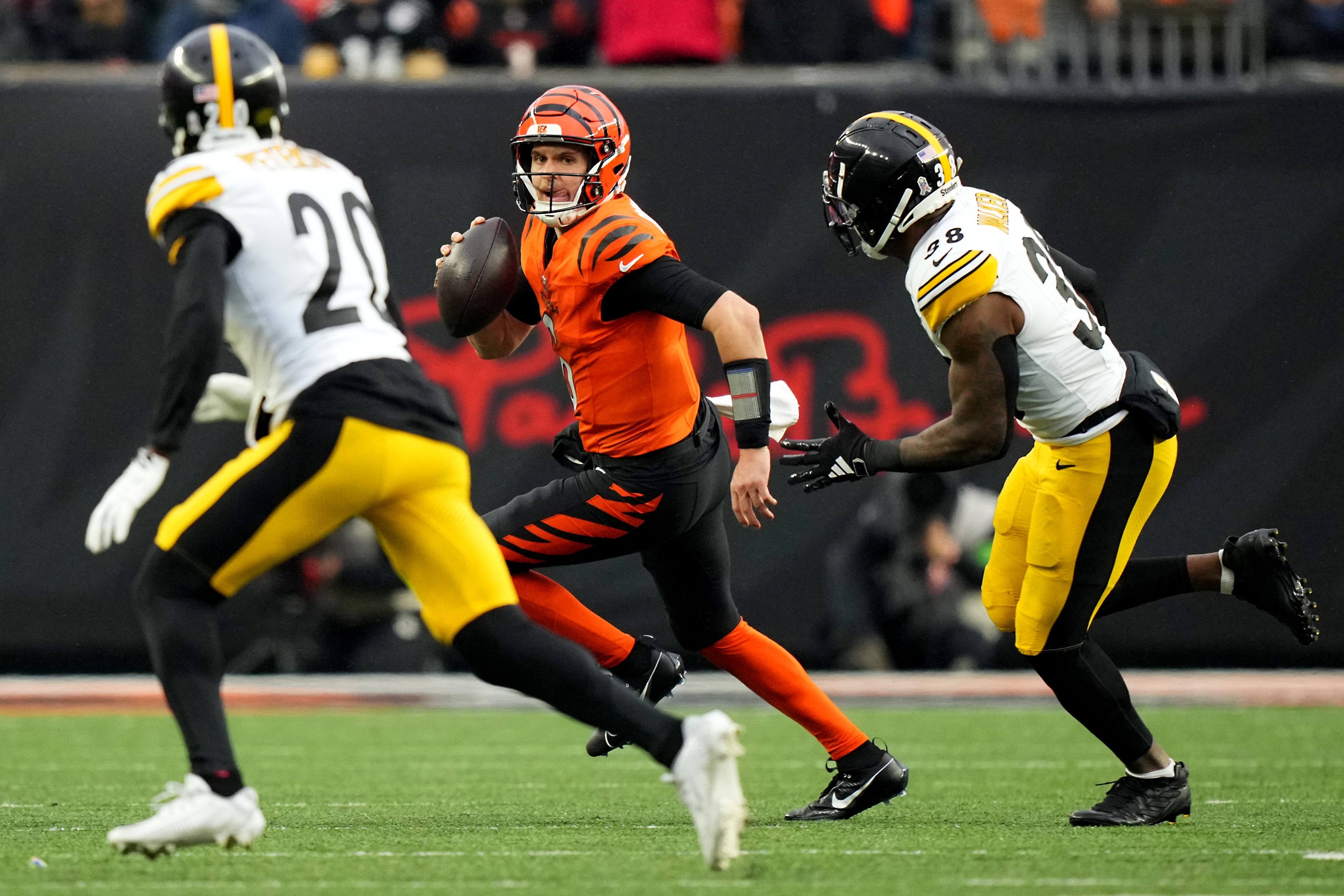
Cincinnati Bengals fans of all demographics could tell by the end of the first quarter last Sunday. The drop-off from Joe Burrow to Jake Browning is staggering to behold. Not the most shocking revelation, but undeniable regardless.
If the Bengals want to stay in the playoff race, they need quality quarterback play from Browning. A defense that relearns how to contain opposing rushing attacks and their own run game finding success would definitely help their chances, but Browning playing mistake-free and efficiently would make the biggest impact.
How can this be achieved? A three-step solution cannot solve a problem so complex and nuanced, but these steps would indeed make Browning better for the time being.
Fall in love with play action
Don't concern yourself with needing to establish the run game before spamming play action. It statistically doesn't matter no matter how many anecdotes you gather. Play action is an offensive cheat code, a way to generate easy yardage off simplified decision making for quarterbacks combined with defensive manipulation. The defense may say they don't respect the run game, but they have to at the snap. They don't have a choice.
Pro Football Focus grades are not an end-all metric, but they tell enough of the story through 12 weeks of action. Higher grades are simply more prevalent for play action.
QBs graded 85 or higher on play action passes: 10
QBs graded 75 or higher on play action passes: 19
QBs graded 85 or higher on non-play action passes: 4
QBs graded 75 or higher on non-play action passes: 11
The Bengals usually don't run a lot of traditional play action with Joe Burrow, one of the smartest quarterbacks in the game who prefers watching post-snap safety rotations and general coverage evolutions. Not even a high-speed processor like Burrow could escape the play action differential this season. His non-play action grade of 72.3 is much lower than his play action grade of 86.1. Even still, the processing speeds of Burrow and Browning are nowhere near comparable.
Account for that with plays that any quarterback can execute. Straight drop-back play fakes, play action rollouts, simplified RPOs, run them all to dumb down the scheme.
Diversify the run game
Whatever you think this entails, you're correct. For the past calendar year, the Bengals' run game has had a singular identity of Joe Mixon running gap-scheme concepts out of shotgun. It was efficient in 2022 when defenses were keeping both safeties back, creating lighter boxes for Mixon to churn four yards nearly every time. It's become far too predictable to replicate that moderate success.
Four yards is all the Bengals can dream of when running the ball now. No one truthfully respects Browning dropping back to pass, so they're going to sellout against the run based on the tape they have. They know what's coming when Browning hands the ball off.
Go under center, try counters and power. Whip out well-timed draw plays to create more manageable second and third down opportunities. Use any other running back aside from Mixon every now and then. Make sure Chase Brown doesn't collect dust on the sidelines.
Pretty much anything the Bengals' run game can try, should be tried.
Quick throws > max protection
Not every opponent is going to have a T.J. Watt pinning his ears back to get to Browning, so it's understandable why the Bengals often had Cody Ford and extra tight ends to pass protect against the Steelers. Simple math states that added blockers means fewer receivers on the play; fewer receivers for a secondary to cover for a handful of seconds.
Added protection should give a quarterback added time to get the ball downfield, but Browning cannot be trusted with added time in the pocket. He missed too many opportunities last week on plays that took more than 2.5 seconds to develop.
Give him half-field reads that force the ball out of his hands quickly, and in turn, give defenses more receivers to account. One-on-one matchups can be easier to identify and exploit, and Browning doesn't have to worry about preventing pressures from becoming sacks.
