
49ers in an excellent position to build on the traditional strength of the roster in 2024 NFL Draft
With Brock Purdy emerging as an MVP contender at quarterback last season while throwing to a stacked cast of weapons, the offense is the clear strength of the San Francisco 49ers’ roster going into the 2024 NFL Draft. That may seem an obvious statement to make for a team led by the game’s pre-eminent offensive […]

With Brock Purdy emerging as an MVP contender at quarterback last season while throwing to a stacked cast of weapons, the offense is the clear strength of the San Francisco 49ers’ roster going into the 2024 NFL Draft.
That may seem an obvious statement to make for a team led by the game’s pre-eminent offensive mind in Kyle Shanahan, but that certainly hasn’t always been the case for San Francisco. Indeed, the Niners for many years have leant on the strength of their defensive front and, while those outside the building may view fixing a shaky offensive line as San Francisco’s biggest need in the draft, internally the offseason priority may well have been to shore up a defensive front that last season was often alarmingly ineffective outside of Nick Bosa and put it into a position to succeed in the immediate future and in the long term.
The Niners have taken significant steps towards doing so. Though parting with veteran defensive tackle Arik Armstead to save salary cap space was a move the 49ers did not want to make — especially after his best pass-rushing season since 2019 — they quickly addressed his departure with a trade for a younger player in Maliek Collins who statistically outperformed Armstead last season. Prior to that, the 49ers added a durable rotational interior lineman in the form of Jordan Elliott.
On the edge, having taken in-season swings on Randy Gregory and Chase Young that netted disappointing returns in 2023, the 49ers made a surer bet on an experienced and productive veteran, signing Leonard Floyd to a two-year deal.
Floyd has 39.5 sacks in his last four seasons and offers the Niners an explosive and flexible complement to Bosa who has proven adept at cleaning up pressures from teammates during his career. A more adventurous gamble was made with the signing of Yetur Gross-Matos, who has outstanding physical traits and potential inside-out versatility but a distinct lack of production during his time with the Carolina Panthers.
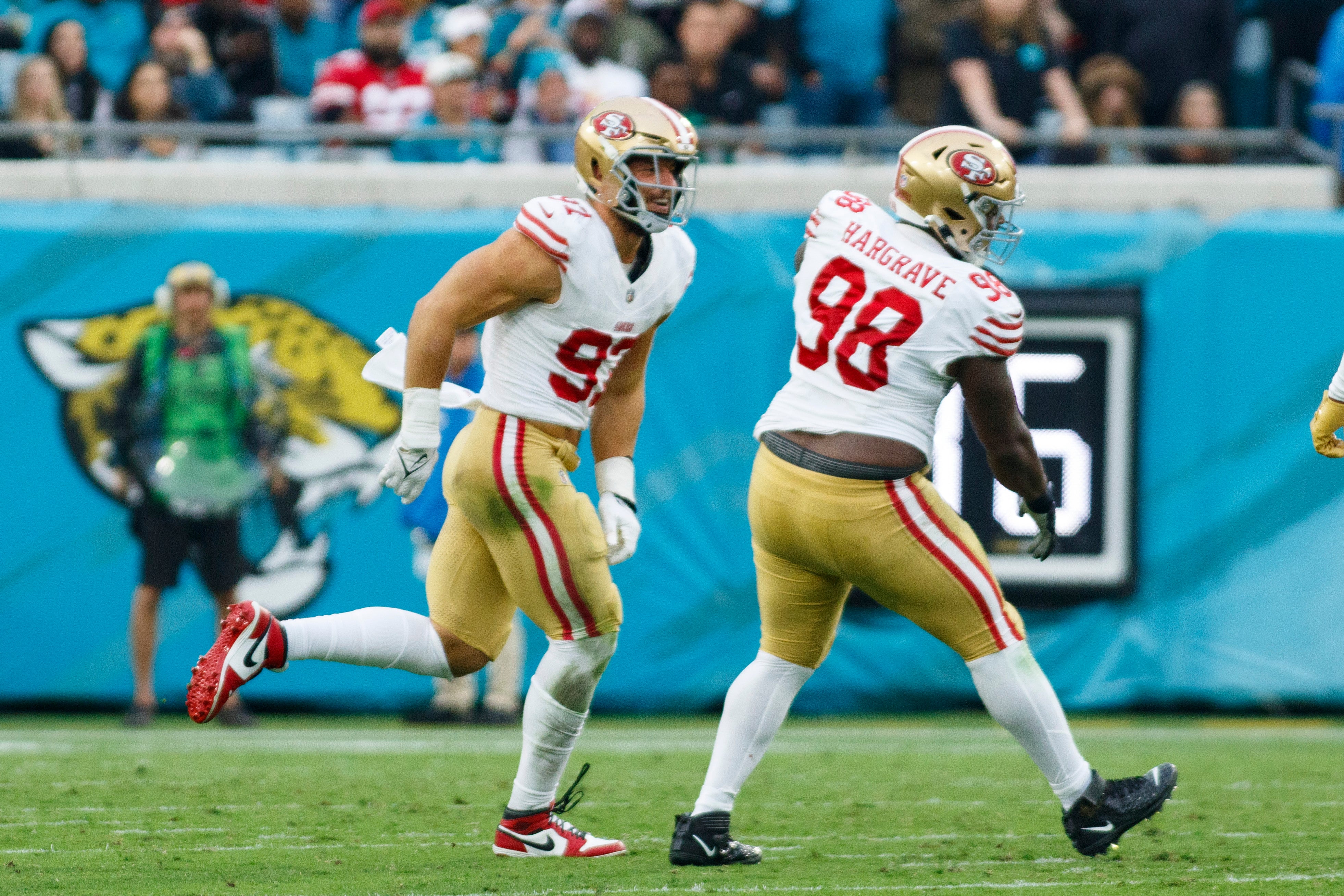
Still, with Floyd and Collins entering the fray to join Bosa and Javon Hargrave on San Francisco’s starting defensive front, the 49ers are in an excellent position to succeed in the short term at a traditional area of strength.
But the Niners would still benefit from adding to their depth both on the edge and on the interior of the defensive line and, despite neither of those spots being the strength of the 2024 class, they may see this draft — in which they have 10 picks including a first-rounder for the first time since 2021 — as a clear opportunity to improve their long-term outlook on the D-Line.
And none of the additions they made in free agency should prohibit them from doing so.
The gift of flexibility
Floyd’s two-year deal is worth $20 million and contains a max value of $24 million, but with nearly $11 million of that tied to signing bonus that is prorated across the life of the deal plus three additional void years, he counts only $3.4 million against the cap this year.
Next year, when he has a $7.9 million base salary, the 49ers could move on from him as a post-June 1 cut and save $7.95 million with just a $2.15 million dead cap charge. Gross-Matos’ two-year, $18 million deal follows a similar structure with a signing bonus spread over additional void years. The Niners can save $8 million by designating him a June 1 cut next offseason. The dead cap charge is just $1 million.
Collins has a $10 million cap number next year, but the 49ers can cut him at any point to be free of that without any dead money charge.
Obviously, the 49ers haven’t acquired those players with the intention of moving on from each of them after a year, but the arrivals of Floyd and Collins have given San Francisco dependability up front and roster flexibility next offseason.
The 49ers can draft players at both edge and defensive tackle knowing they can operate in a rotational role in year one under significantly less pressure to produce because of the presence of Collins and Floyd. If the rookies excel and outperform their more experienced and more expensive colleagues, it is easy for the Niners to move on from those veterans, whose mentorship could be critical in the development of any potential D-Line draft picks.
Extra motivation
Finding rookies with the talent to make the most of the influence of those veterans in their maiden season and contribute early would be a huge boost for the 49ers considering the situation they found themselves in down the stretch last season, when injuries to Armstead and Hargrave led San Francisco to give Javon Kinlaw, Kevin Givens and practice squad defensive tackle T.Y. McGill higher than usual snap counts at defensive tackle.
That lack of depth on the interior, combined with poor play on the edges in that area of the game, saw the Niners' run defense take a significant step back. It was a slide they did not arrest until the Super Bowl defeat to the Kansas City Chiefs.
In addition to landing Collins and Elliott to atone for the losses of Armstead and Kinlaw, the 49ers kept Givens around for another season and will be hoping for a first full healthy season from Kalia Davis after some encouraging flashes when the 2022 sixth-rounder briefly got on the field last year.
Yet there is clearly room in the rotation for a rookie whom the Niners could develop into a starter with a year in which they serve as an additional safety net while playing behind Hargrave and Collins.
With Hargrave 31 years old and Collins set to turn 30 before the season starts, it would behove them to find such a player in the draft, and avoiding a scenario akin to last year may be additional motivation to do so.
It is a similar story on the edge. Floyd is 31 and, with Drake Jackson and Robert Beal Jr. the only other likely candidates to be on the 53-man roster at the position behind Bosa, Floyd and Gross-Matos, there is an obvious opening for a pass rusher who can initially play solely on true passing downs only before assuming the mantle from Floyd.
Recognizing the opportunity
The Niners appear to have recognised the opportunity they have to set themselves up for the future at both spots.
They held a top-30 visit with Alabama edge rusher Chris Braswell and Ohio State defensive tackle Michael Hall Jr, both likely day-two picks. The Niners also had visits with Western Michigan's Marshawn Kneeland and Brandon Dorlus of Oregon. Dorlus is more of an interior player at the next level, but both have the inside-out versatility to make an impact at both spots.
On top of those visits, the 49ers were in attendance for the pro day of Illinois defensive tackle Johnny Newton, a first-rounder who could fall into their grasp at 31 if teams are scared off by his recent foot surgery. Newton would be an ideal successor to Hargrave as an excellent gap-shooting interior lineman with big-time run defense upside.
In other words, the Niners clearly appreciate that this draft gives them a chance to stack their depth up front and have the luxury of once again being able to dictate games by sending waves of defensive linemen at opponents.
In doing so, they can also obtain potential succession plans on the edge and at defensive tackle. The holes at right tackle and on the interior of the offensive line might be widely seen as more pressing issues, but there’s every chance the 49ers regard the chance they have to firmly re-establish their strength on the other side of the trenches as too enticing to pass up.
