
Free agency market shows what the Packers can prioritize early in the draft
Seven of the ten most expensive contracts given to offensive linemen on average per year in free agency this offseason were signed by… interior players. Historically, tackles are the highest-paid players at that unit, but a confluence of events and a new trend around the league have made guards and centers much more valuable. And […]


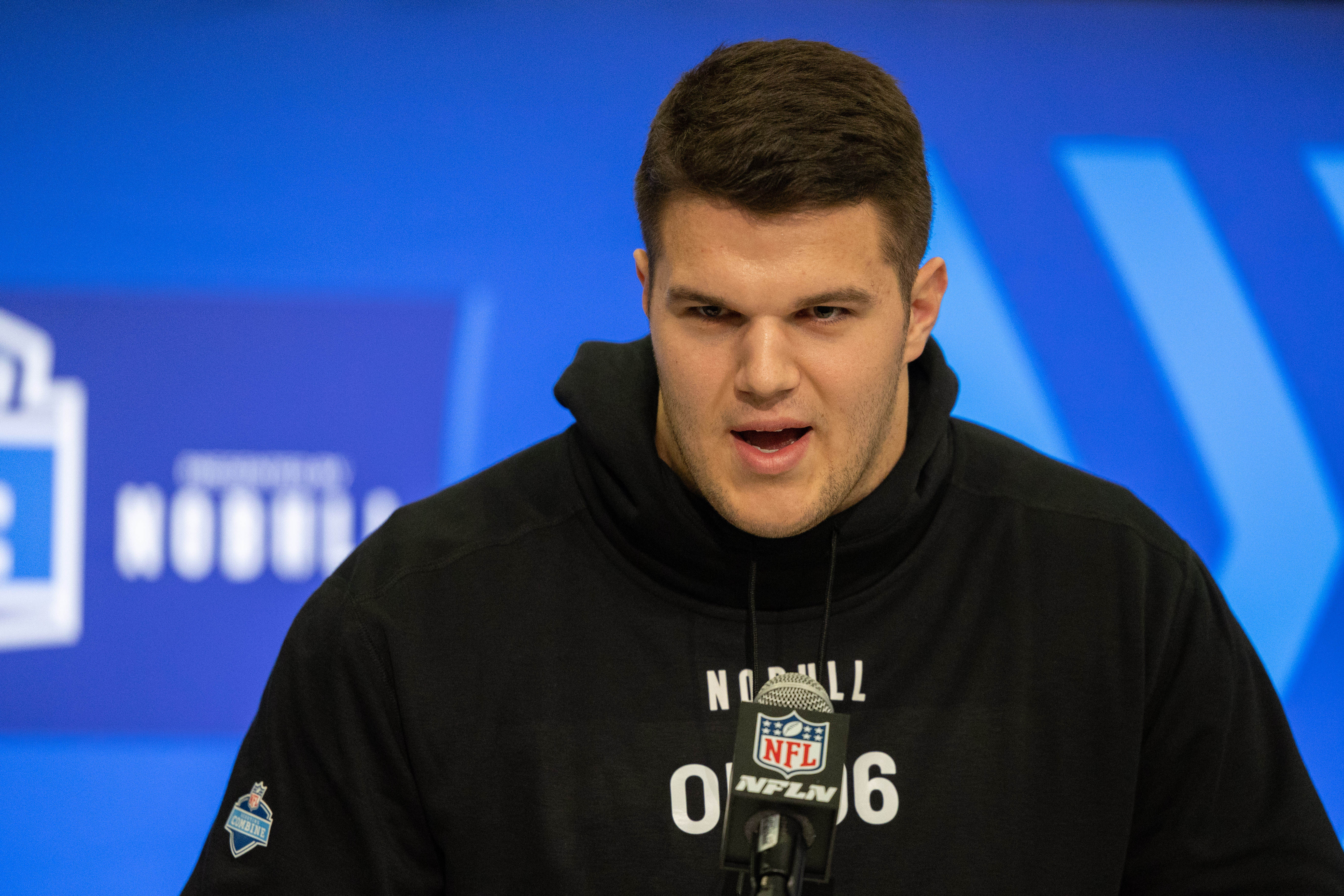
Seven of the ten most expensive contracts given to offensive linemen on average per year in free agency this offseason were signed by… interior players. Historically, tackles are the highest-paid players at that unit, but a confluence of events and a new trend around the league have made guards and centers much more valuable. And now, the Green Bay Packers have to find a way to exploit that trend moving forward.
10 biggest contracts signed in free agency among offensive linemen:
- G Robert Hunt, Carolina Panthers (5-yr, $100 million)
- T Mike Onwenu, New England Patriots (3-yr, $57 million)
- G Jonah Jackson, Los Angeles Rams (3-yr, $51 million)
- T Jonah Williams, Arizona Cardinals (2-yr, $30 million)
- G Damien Lewis, Carolina Panthers (4-yr, $53 million)
- C Lloyd Cushenberry, Tennessee Titans (4-yr, $50 million)
- G Jon Runyan, New York Giants (3-yr, $30 million)
- C Tyler Biadasz, Washington Commanders (3-yr, $29.25 million)
- C Aaron Brewer, Miami Dolphins (3-yr, $21 million)
- RT Jermaine Eluemunor, New York Giants (2-yr, $14 million)
Positional value
Right now, the three highest-paid offensive linemen in football are still left tackles — Houston Texans' Laremy Tunsil, New York Giants' Andrew Thomas, and San Francisco 49ers' Trent Williams. That makes sense, because tackles are still more valuable than guards and centers on the field.
According to a study from Pro Football Focus, the top 32 tackles in the league in 2020 added 6.00 wins above replacement during the season. Meanwhile, the top 32 guards added 4.89 wins above replacement. Centers were the least impactful position in football, with a combined 2.53 WAR.
Market
If tackles are still more important for the success of the team, why are guards and centers getting paid that much in free agency? There are two main reasons for that.
The first one is a natural difference in valuation over the last few years. With defensive tackles increasing their value and perception, offenses are counterpunching it with better guards — the Packers, for example, are comfortable keeping Elgton Jenkins inside, where he plays at a higher level, instead of adapting him to a more valuable position.
The second point is related to an NFL rule. There is not a specific franchise tag for each position on the offensive line, but rather a unified number. In 2024, this number was $20.985 million — and $19.04 million for the transition tag.
Therefore, going back to the first point about positional value, teams are more inclined to apply franchise tags on tackles than on guards and centers. As a consequence, top interior offensive linemen reach the free agent market more frequently. Meanwhile, teams are incentivized to extend tackles early, and the players themselves are motivated to accept these offers to avoid a tag scenario.
Surplus value
Even though tackle is a more valuable position, guard has become a pretty important one as well. Landon Dickerson got $21 million per season in his extension with the Philadelphia Eagles. Three other guards are getting $20 million or more per season: Atlanta Falcons' Chris Lindstrom, Panthers' Robert Hunt, and Indianapolis Colts' Quenton Nelson.
It means that taking a guard early in the draft has a big potential to generate surplus value.
The 25th pick of last year's draft, Dalton Kincaid, signed a contract with a $3.356 million average. BJ Ojulari, the 41st pick, is making $2.149 million per year. Even considering inflation, a high pick by the Packers would make something in that vicinity.
If Green Bay is able to find a day 1 starter at right guard and he is as good as Jon Runyan, which is fairly realistic for a high draft pick, he's already generating between $6 million and $7 million of surplus value if compared to the open market. The value can go as high as $18 million if a high second-round pick plays like a top 5 guard in the league.
Roster outlook
Both the guard and center positions are short- and long-term needs for the Packers. Right now, after Runyan departed in free agency, former third-round pick Sean Rhyan is expected to start at right guard, and he hasn’t shown a high level of play consistently enough. Moreover, the immediate (and only) backup is Royce Newman. Additionally, center Josh Myers is entering the last year of his rookie deal, and there’s no backup at this position.
The need is real, both for an immediate starting right guard, for a future starting center, and for depth.
What does it mean?
Usually, Brian Gutekunst uses the first round to get players from premium positions — cornerbacks and edge defenders are the most frequent ones.
But if this class presents the opportunity to select a projected interior offensive lineman, it might make sense in terms of value — Graham Barton, Troy Fautanu, and Jackson Powers-Johnson, for instance.
Historically, Gutekunst has been open to take less valuable positions, like guard and running back, in the second round — so the 41st pick, originally from the New York Jets and acquired by the Packers in the Aaron Rodgers' trade, is a place to keep an eye on.
