
Explaining how an NFL run game works: Film Breakdown
In this film breakdown, we’re going back to the basics, looking at the most popular run concepts in the NFL, including how they’re schemed up, how they work, and who runs them the best.

Running the football is the back-bone of just about every successful NFL and college offense. Teams who establish the run early and often may make it look very simple; however, this is not the case, and there is so much more that goes into a successful run game than meets the eye.
The basic concepts that an NFL run game is built on are pretty simple, but there are dozens of wrinkles within those plays that are all designed to create the perfect play against whatever defensive front they get. In this video, I dive into the blocking required for these plays such as reach blocks, overtakes, double teams, pulling lead blocks, etc.
Explaining How an NFL Run Game Works: Film Breakdown
Disclaimer: The following is a transcript of a YouTube video titled “Explaining How an NFL Run Game Works: Film Breakdown” The content is for informational purposes only and was originally presented in video format.
In this video, we're gonna break down run concepts that you'll see in college and in the NFL, along with some of the most common variations in add-ons. Now, if you look through an NFL playbook, teams are gonna have 10, 15 different ways of running outside zone, for example. So I'm not trying to drown you with information and break down every single play; but these are the general concepts that make up 90 to 95 percent of run plays in football.
Outside Zone is a horizontal run concept where instead of trying to get vertical push and movement off the line of scrimmage, you're putting lateral stress on the defense to flow with the run and protect the perimeter, which can open up cutback lanes if the linebackers over pursue. The key blocking techniques in Outside Zone are the reach block and overtake combo.
With a reach block, you're trying to gain outside leverage on the defender by attaching your playside hand to the playside armpit and getting the helmet across the midline. So if you split the defensive lineman down the middle the blocker's helmet should be on the outside half of his body. On a successful reach block, the back should be able to run through that gap without the defender being able to disengage and make the tackle.
As with pretty much any block, if you can create vertical displacement and put the defender on the ground, then you've won the rep.But all you really need from a reach block is to seal off the play side shoulder. So those are the single blocks in outside zone. The combo blocks I refer to as overtakes. This starts out as a double team, but the play side blocker is going to climb to the second level, and the blocker on the back side reaches the defensive lineman.
Reach blocks are difficult because usually you're trying to cut off a defender that has a leverage advantage. if a tackle is reaching a three tech on the backside and they both accelerate towards the play side when the ball is snapped, the tackle would need a significant athletic advantage to cut him off. So with an overtake, the frontside blocker occupies that defender so the other blocker can secure his reach and then he climbs to the second level to block the linebacker.
An outside zone is basically a combination of reach blocks, overtakes, and climbs based on the alignment of the defensive front. A lot of teams use the covered, uncovered blocking rules, where if alignment's covered, meaning there's a defender in his play side gap, he's gonna reach that defender. And if he's uncovered, he climbs to the linebacker.
You'll also sometimes see a numbered system where the first playside defender is a zero and it expands out in increments of one and each blocker is responsible for the corresponding player. The running back's aiming point on outside zone is the butt or the outside foot of the tight end, and then they're reading the first two defenders, which I'll call one and two and working front side to backside.
If the play side tackle wins, his reach block and establishes outside leverage, he stretches the run to the edge. But if the defender has outside, leverage the backs eyes, then go to number two and he makes the exact same read If the second defender's reached, he's gonna hit the B gap, and if not, he cuts it back. It's really important here for the running back to press the outside even if it's unlikely for him to actually continue the run off tackle because you need to influence the linebackers to flow in that direction and set up easier angles for the blockers.
Now the variation of outside zone I've been discussing so far, I call that stretch zone where the backs first read is to hit the lane outside of the play side tackle. And if you have a fast running back and an athletic tackle, you can run stretch zone and hit big plays off of that.But in practice, especially the NFL level, that's a really difficult block to win because the end man on the line of scrimmage is usually told his first priority is to not let the ball outside of him.
So most teams, when they run outside zone, they're actually running a variation called wide zone or mid zone, which I use interchangeably. And the difference here is the playside tackle, instead of trying to reach the endman and establish outside leverage, he bases him out with inside leverage, and now the running back's first read is the B gap off the tackle's inside shoulder. So in summary, and this is just how I frame it in my head, outside zone is the broad category of horizontal zone runs with reach blocks and overtakes.
Stretch zone is when the play side tackle is reaching the end man and the running back's first read is to the edge. And wide zone or mid zone, they aren't trying to reach the defensive end, and the back's first read is the B gap.Inside Zone has similar blocking rules to outside zone with the double teams and overtake combos. But the priority here is getting vertical displacement.
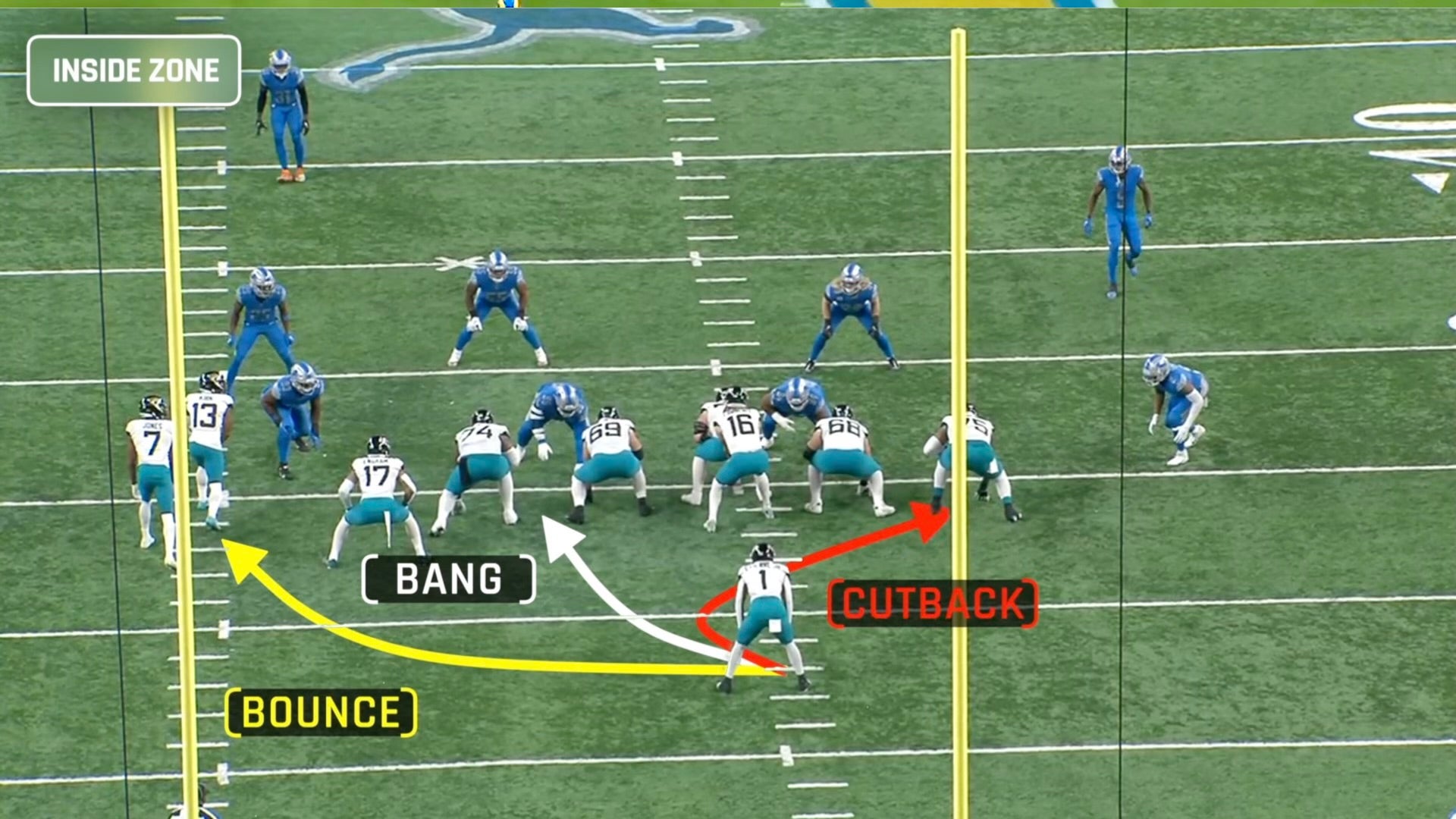
The running backs. Aiming Point is the play side guard, and his first read is the play side A Gap, which is the bang read, and then he can either bounce it or cut it back outside. Instead of taking a flat lateral step to the play side like they would an outside zone, the offensive linemen step downhill at a 45 degree angle. If their gap is covered, they're trying to drive the offensive linemen off the line of skirmish and if they're uncovered, they're going to work the double team to the backside and then climb to the second level.
Most of the variations of inside zone depend on how the offense handles the backside defensive end. And Inside zones most often run to the weak side of the formation. So the tight end will have a one-on-one with the defensive end, and teams will also run split zone where they have the tight end come across the formation and block the defensive end on the backside. This block from the tight end is called a sift or a slice block, and it's effective because it can serve a similar purpose as jet motion, and cause the linebackers to hesitate and not flow as aggressively to the play side; which creates more favorable blocking angles at the second level.
It's also good against 5 man fronts because it lets the offensive line basically ignore the backside end and treat it as a 4 man front. So they're still getting their double teams and then the sift block kicks out the end man and prevents them from impacting the play.And this applies to outside zone as well. You'll see a lot of outside zone with a sift block across the formation.
Now we're moving into the gap scheme runs, and I'm going to start with duo, which is often referred to as power without the puller. The key point here is double teams along the defensive line to the back side of the play. So if they're handing it off to the right, you're gonna see double teams washing out the D line to the left. The linebackers will get blocked as they trigger downhill, and if they're blitzing, the O line will come off their double teams to prevent backfield penetration.
But the blockers aren't trying to quickly climb to the second level, the priority is to sustain the double teams. It's always run to the strong side, so the side of the formation with the tight end,And the Running Back's reading the play side linebacker, so his initial track is going to be directly towards him, and then he makes his decision based on how the linebacker plays it.If he fits inside, the running back, bounces out to the C Gap. And if he fits outside, he bangs through the A or B gap.
A lot of the big plays on duo come when the defense clouds up the interior and the running back bounces outside because the unblocked defender is going to be a cornerback or a nickel, which is a favorable matchup. A couple of variations of this are duo kick and duo wrap.With the kick variation, instead of having the tight end one on one with the play side defensive end, he works downhill on a double team with the tackle, and then they have another player come and kick out the defensive end.
This kick out block can be from a full back or a wide receiver, and he's trying to widen the defender out and open up the C gap if the running back bounces outside. Duo wrap looks a lot of times pretty similar to counter because the running back is taking a counter step away from the run and the offense is pulling someone from the backside. This can be a receiver, a tight end, or an offensive lineman.
And the Rap Player's gonna pick up the most dangerous secondary support player, so normally you'd have the play side receiver blocking the safety, and the corner would be unblocked But with Duo Wrap, the receiver blocks the corner, and the wrapper takes the box safety, which gives you a hat for a hat on the play side, meaning no one's left unblocked.
Power is a gap concept where you're pulling a lineman from the backside of the formation, the front side tackle and guard double team, and the tackle works back to the will linebacker, the center has the lineman to his backside on a down block, meaning he's angle blocking away from the run. And then you need to get two players on the move, one player to kick out the play side end, and another to lead block through the C gap.
If you're running two back power, it's usually going to be the fullback and the guard. You can either have the guard kick out the defensive end and the fullback lead, or the guard can wrap and be the lead blocker with the fullback on the kick. And then one back power will most often have the guard and tight end as the pullers, and again, they can fill either of the two roles.
You can also have the tackle or tight end kick out the playside end and have both pullers as lead blockers, and that variation is called lock.Counter is almost identical to power. The main difference is the running backs footwork with counter, the running back takes a counter step away from the run to create misdirection for the linebackers and set up easier blocking angles.
In the NFL, the most common version of counter is with the guard and tight end as pullers. But at the college, and especially the high school level, you'll see a lot more GT counter where the pullers are the backside guard and tackle.
Another variation is counter solid, which gets two pullers without having to pull an offensive lineman. This is usually done with 2 tied ends and it limits the potential for negative plays where you have the guard pulling and the defensive tackle rushes into the backfield through the vacated gap. Trap and wham are two very similar concepts that take advantage of aggressive defensive linemen getting upfield.
On both of these plays, the offense is leaving one or two linemen unblocked and baiting them to run into the backfield. A wham block is from the tight end, most often on a three technique, and a trap block is from an offensive lineman, usually a guard. The two variations of trap are short trap and long trap. Short trap has the guard working two gaps over to the three tech, and on long trap he's moving three gaps over to the defensive end.
Like I said, Trap and Wham exploit aggressive defensive linemen by influencing them into the backfield and taking them out of the play Leaving someone unblocked frees up an interior player to climb to the second level immediately. And it also gets the linebackers to think the offense is running power or counter and work over to the back side of the play. So the running back can hit the A gap and the blockers can easily seal them off. very common run concept, at least in the NFL.
So when teams do run it, it's a really effective change up that can catch defenses off guard. Pin pull is a perimeter run concept that gets blockers on the move in space, and it's a great way to attack the edge of a defense. Normally the blocking rules are if you have someone in your backside gap, you down block or pin them in the opposite direction of the run, and if not, you're going to pull to the front side.
The first tight end off the tackle has a crack block on the Mike linebacker, where he's coming from outside leverage, blocking the play side shoulder, and preventing him from working over the top.And the play side defensive end is either going to be left unblocked initially, and then kicked out by the first puller, or you can have multiple tight ends on the front side to pin him down and let both of your pullers get downfield.
Crack toss is similar to pin pull, except the front side tackle is almost always one of the pullers. instead of handing it off, the quarterback tosses it to the running back to help 'em get to the edge more quickly. And then depending on the front, you're going to have a crack block on the defensive end. are a good way to take the fight somewhere else if a team's struggling to block on the interior, so if you're trying to run outside zone and Aaron Donald's blowing up every reach block, you can run pin pull or crack toss where he has less of a chance to impact the play.
And the final concept we're going to discuss is the draw, which is meant to take advantage of linebackers over committing to pass coverage. This is an inside run where the quarterback gets into his drop and influences the linebackers to spread out. The tackles are going to pass set.
Usually they'll under set and try to force the edge rushers upfield. And the guards set and then climb to the linebackers who ideally have gotten a lot of depth in their zone drops. Teams run this most often on obvious pass situations, and a lot of times fans view this as a surrender play call, 10 and the defense is selling out to protect the sticks, you can sometimes convert on a draw play more easily than just throwing up a prayer into double coverage.
Thanks for watching, if you have any suggestions for other explainer videos like this, let me know in the comments. They take a lot longer to do than player breakdowns, so it's not something I can pump out every week, but I'm definitely planning on getting through as many of these topics as possible.
If you like this video, then be sure to check out more NFL and college football film breakdowns on YouTube, Instagram, TikTok, Facebook, and Twitter!
