
The stat that’s telling a big lie about the Detroit Lions’ defensive line that you have to stop believing
It’s time to stop talking about this stat


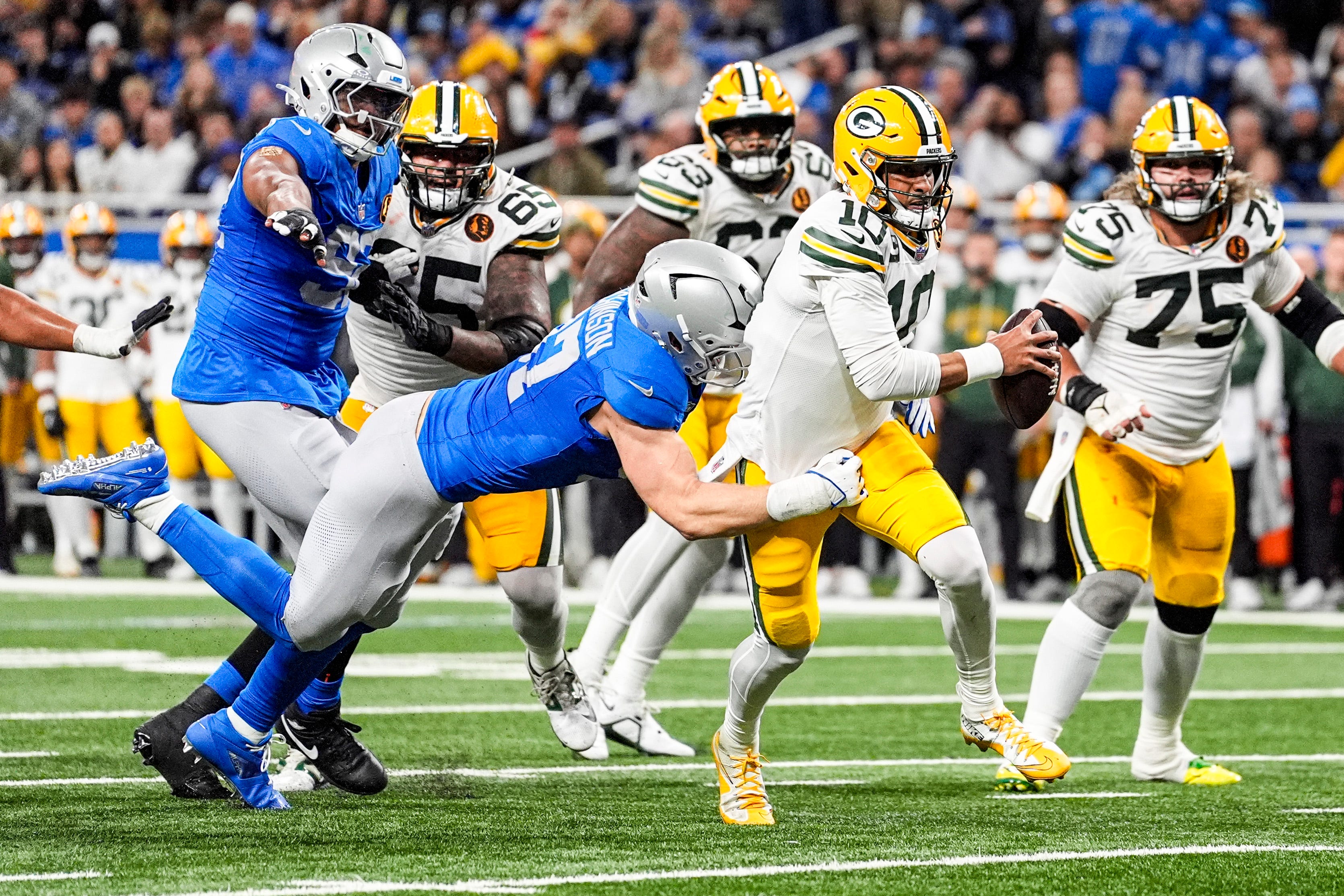
The Detroit Lions’ defensive line had a rough showing against the Green Bay Packers. At least that’s how a lot of Lions fans saw it. A lot of that thought stems from the fact the Lions didn’t sack Jordan Love once. I can fully understand how that is annoying. You want your line to have as many sacks as it can, but did the Lions really ever get a chance to do that on Thursday?
Talking with Lions head coach Dan Campbell on Zoom Saturday morning, he said after watching the film, there were only three times in that game when he felt the Lions generated pressure. A lot of that comes from Love throwing the ball out fast. But if you get on the old NFL Next Gen stats, you’ll see that Love had a time to throw of 3.09 seconds. That’s all day, right?
Time to throw is a stat that Lions fans have been throwing around a lot this season. I get it. The Lions are allowing the highest time to throw in the league this season at 2.99 seconds per attempt.
Time to throw can be a very misleading stat and can support false narratives
When you see that, you think there’s no way that the Lions are generating any pressure. How could that be when they’re generating the fifth-highest pressure percentage in the league this season at 38.7%? That’s better than the Seelers’ 32.3%, and they are allowing the league’s lowest time to throw at 2.65. They have two more sacks than the Lions. It’s a skewed stat.
How is it a skewed stat? Let’s dig a little deeper. When Love was kept clean on Thursday and had no pressure, his time to throw was 2.31. That is really fast. The league average is between 2.69 and 2.81 seconds, and it helps put the Lions’ situation in extra perspective when you add in the fact that 19 of Love’s 33 dropbacks were kept clean. That shows you exactly what Campbell is talking about. There was no time to generate a pass rush because it was dang near an immediate snap-and-pass situation.
Then, when you look at Love’s time to throw when pressured, and you see it at 3.57, you might go, “How the heck does it get worse?” Well, let’s show you right here on video.
First off, the Packers are in max protect here. So good luck to most defensive lines trying to get pressure fast in the first place. Still, the coverage is good downfield, and the Lions do bring pressure and move Love off his spot, so he’s forced to scramble around and then throws a bad pass.
This is a successful play for the Lions’ defense. But it took Love seven seconds to throw the ball, and that drastically skews things when calculating average time to throw. Focusing on the time to throw makes this look like it was an effective snap from the Lions defense when it wasn’t. When you take out stuff like this, you’re more likely to see more plays where the Lions got pressure like this:
So what does this tell you? It tells you the Packers had a pretty common game plan against the Lions. Get the ball out fast, get the Lions to respect the short pass, and then hit them with the long pass when they drop into short coverage instead of bringing pressure. That’s how you get a 51-yard touchdown to Christian Watson.
With all this said, the Lions’ defensive line is not the problem. The problem is that the Packers had a good game plan, and it worked. That’s despite the Packers facing the fifth-highest pressure rate of the season at 43.8%. That’s higher than the 38.7% rate they faced against Myles Garrett and the Browns.
Look, none of this is an excuse. The play has to be better. The Lions have to get more pressure, and most importantly, they have to get home. Lions DC Kelvin Sheppard knows that, and that’s why he is enacting some changes schematically going forward.
All I’m saying is that time to throw really doesn’t tell the story of the Detroit Lions’ defensive line, and things aren’t as bad as they seem. That’s it.
