
Packers are staring down an uncomfortable reality with a decision they hoped to delay now looking unavoidable
Rashan Gary is an obvious cut candidate.


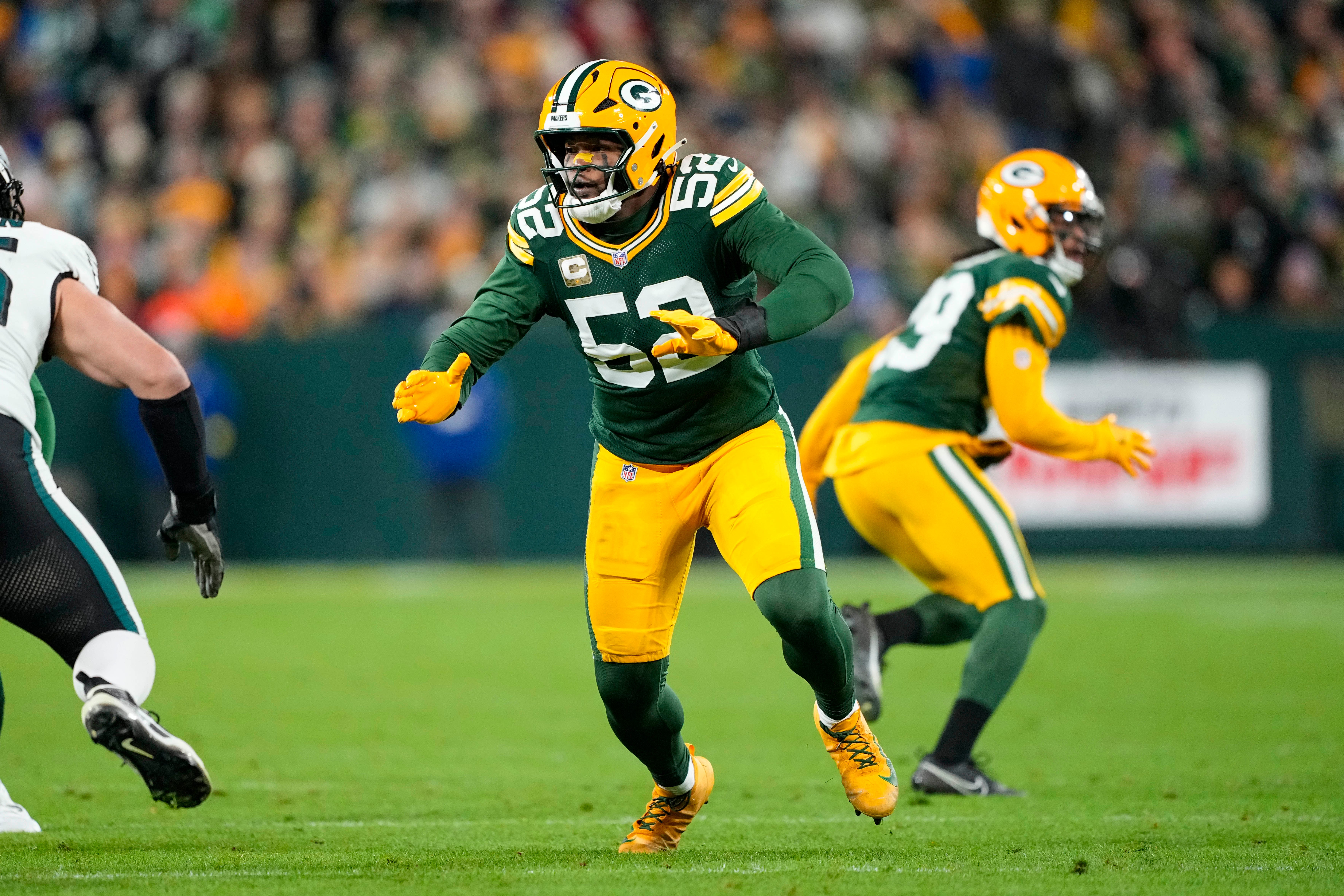
Process is always more important for an analyst than results, because it is sustainable and repeatable. When the Green Bay Packers decided to draft Rashan Gary right after signing Za’Darius Smith and Preston Smith to four-year contracts in free agency, it was fair to question their decision.
Even if Gary ended up being good, the Packers would have lost a significant part of his rookie contract on the bench, limiting the team’s surplus value with a relatively high first-round pick. When he eventually reached a high level of performance, it was time to give him a big contract.
And now, under a big deal, Gary hasn’t lived up to it. Again, the process was never ideal — and in this era where players on their rookie deals are so important for a team’s success, not generating enough surplus value is a killer.
The Packers have a tough decision to make
Rashan Gary signed a four-year, $96 million extension during the 2023 season, when he was back from a knee injury and was still playing at a high level. Eventually, though, his performance declined.
The edge defender, who was once expected to be a top 10 player at his position, became a non-viable leading rusher for a team — and after the Packers acquired Micah Parsons, Gary couldn’t even produce as expected as a secondary rusher.
The defender is under contract for two more seasons, slated to make $19.5 million in 2026 and $22.5 million in 2027. However, there are no guarantees left, and the significant savings in case of a release or trade make his situation intriguing. Realistically, the Packers have four alternatives.
Keep it as it is/simple restructure
The first and not very likely scenario at this point is Gary staying on the roster and still making his projected $19.5 million. It’s a lot of money based on his production, and his cap hit will be $28.021 million. The Packers could work around that to lower the cap hit, but that would only make the problem worse down the road.
Paycut
The second and probably ideal scenario for the Packers is if Gary is willing to take a paycut, actually reducing his 2026 earnings. In this case, the player and his agent would have to green light the adjustment, which is not always easy to do. And if you offer a paycut and the player doesn’t take it, you’re basically forced to trade or release him.
But by keeping Gary under a revised deal, the Packers would free up some cap space and keep a player that has at least rotational value behind Micah Parsons and competing for snaps with Lukas Van Ness. This is particularly relevant because Kingsley Enagbare is set to hit free agency.
Trade
That’s not exactly a likely scenario at this point because it’s hard to find a team willing to give up draft capital for the right to pay Gary $19.5 million in 2026. It’s not necessarily a prohibitive amount of money, but it’s certainly overpriced based on Gary’s recent production.
Nevertheless, if there’s a team willing to do it, maybe considering the possibility of a new extension to alleviate the cap hit in 2026, the draft compensation would be low. In terms of cap impact, it would work the same as a release.
Release
This seems, right now, the most likely outcome. If the Packers cut Gary, they would have $17.042 million in dead money (earnings already paid that haven’t hit the cap yet), but would save $10.978 million against the cap in 2026 and $31.021 million in 2027, giving the team massive financial flexibility over the next two years.
Theoretically, it would be possible to apply a post-June 1 designation to split the dead money over two years, but the Packers don’t like and don’t need to do that.
It’s unfortunate for the Packers that Rashan Gary hasn’t played as well as he once did, even though the process was never right and the surplus value never came to fruition. But now, general manager Brian Gutekunst will have to face a troubling reality to maximize his resources.
