
David Blough has a plan for Terry McLaurin that Kliff Kingsbury never would’ve used in a thousand years as Commanders OC
Terry McLaurin had the best year of his career under Kliff Kingsbury in 2024, but there was always one issue with his usage that could’ve led to even better results if done differently. David Blough intends to change that in 2026.


It’s a new year for Terry McLaurin and the Washington Commanders, which means it’s a fresh start for the offense. Especially when considering new offensive coordinator David Blough is running the show.
McLaurin had a career year in 2024 under Kliff Kingsbury, snagging 82 catches for 1,096 yards and a career-best 13 touchdowns with quarterback Jayden Daniels at the helm. Both players were looking to build off that in 2025, but injuries clearly derailed the chances of that happening.
Despite the success under Kingsbury, one issue was clear with McLaurin’s usage: Far too often was he lined up on the outside of the left of the offensive formation, as McLaurin was locked into the same spot 73% of the time in both 2024 and 2025.
It makes sense why that kind of predictability makes life easier for opposing defensive coordinators, who could shade coverage toward one side of the field and trust they’d find Washington’s top target there on nearly three out of every four snaps. For whatever reason, this is what Kingsbury always did with his top wideouts and it never really made a ton of sense.
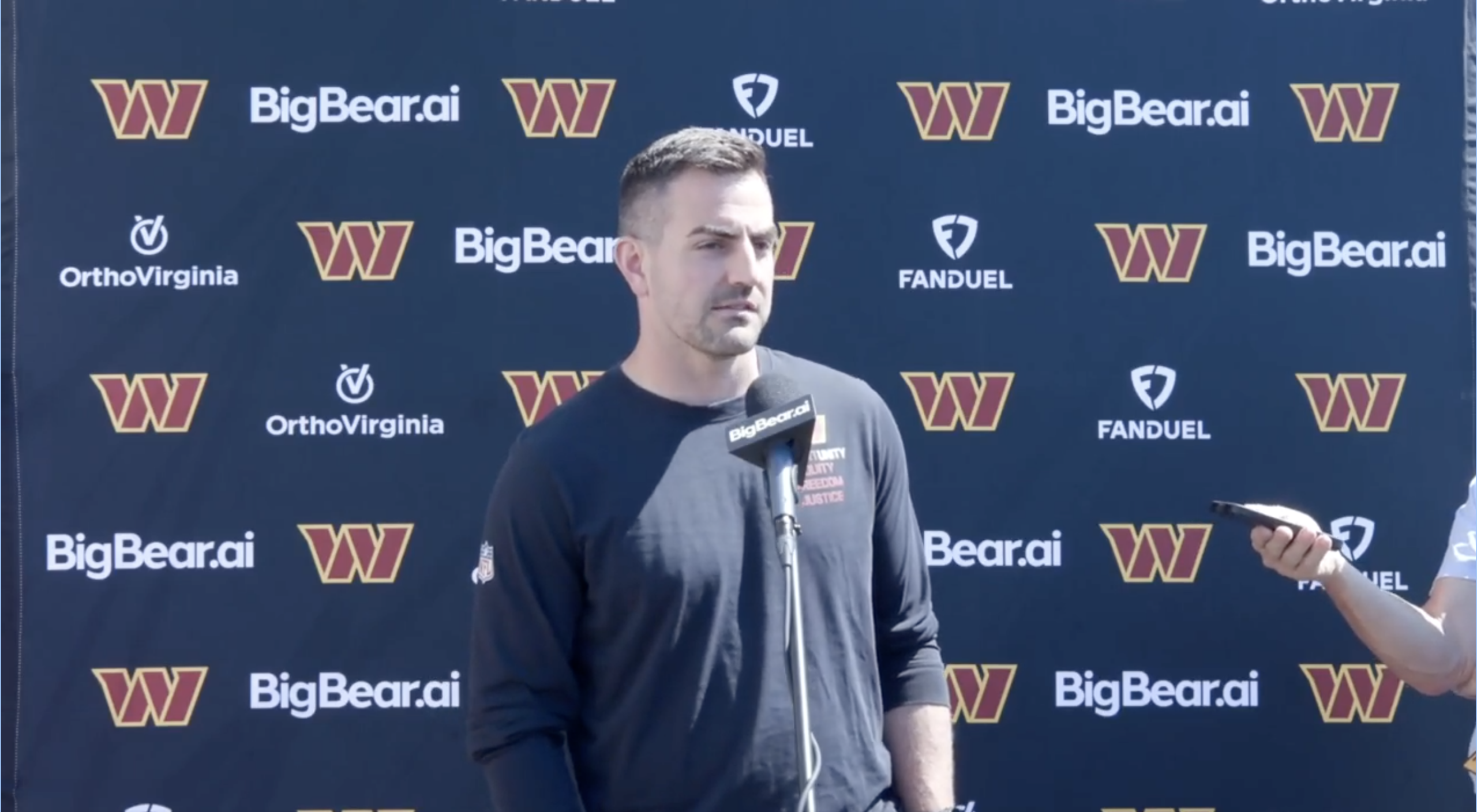
That’s about to change, as Blough noted Tuesday when he spoke with reporters ahead of Commanders OTAs.
“I think, you know, we may move him around a little bit more [and] we’ll do the things that he does well to try to put us in advantageous positions,” Blough told reporters ahead of Commanders OTAs. “He’s done an excellent job, so far, with handling what we’ve thrown at him. And we’re going to keep asking him to keep pushing the envelope to build on the great career he’s already had, and then try to take another step.”
David Blough’s plan for Terry McLaurin can help a below-average receiver room
Sure, McLaurin is a true X receiver. He wins off the line with burst and strength, he tracks deep balls as well as anyone, and he can turn slants and curl routes into house calls. There’s no question he belongs on the outside. At the same time, keeping him there at an exclusive rate leaves value on the table.
The proof showed up in McLaurin’s slot production during 2024. He led Washington in yards per route run out of the slot at 2.38, a strong number by any measure. He also led the team with 245 receiving yards from the slot and tied for first with two receiving touchdowns from the inside, matching Jamison Crowder.
Terry McLaurin’s career stats
McLaurin was selected in the third round of the 2019 NFL Draft and quickly became one of the Commanders’ best players. Below are his stats since joining the NFL:
- Receptions: 498
- Receiving yards: 6,961
- Receiving touchdowns: 41
- Yards per reception: 14.0
- Accolades: 2x Pro Bowler, 1x Second-team All-Pro
- Games played: 107
Blough’s desire to move McLaurin around becomes even more important when you consider the current state of Washington’s receiver room. Outside of McLaurin, the options are shaky at best.
Treylon Burks is a former first-round pick who never panned out. Dyami Brown had a solid 2024 campaign with the Commanders, but flamed out in Jacksonville last season. Luke McCaffrey hasn’t shown much through his first two NFL seasons and while third-round rookie Antonio Williams is the most intriguing addition, he’s still a rookie who has yet to take a regular-season snap.
That lack of proven depth is precisely why getting creative with McLaurin matters so much. Moving him around the formation forces defenses to adjust on the fly instead of setting their coverage before the snap. When a defense has to account for McLaurin in the slot, on the boundary, or even in motion, it creates favorable matchups for everyone else in the offense. Burks, Brown, McCaffrey, and Williams all benefit from softer coverage when the defense is chasing McLaurin across the formation.
Moving Terry McLaurin around can help Antonio Williams start faster
Williams, for his part, adds another layer to that equation. He projects as primarily a slot receiver, but he showed the ability to win from the outside at Clemson as well. His versatility, combined with McLaurin’s expanded usage, gives Blough the flexibility to create mismatches across the board rather than relying on one player in one spot.
The bottom line is the Commanders have to find a way to get the most out of less-than-stellar receiver corps. Washington doesn’t have the luxury of a loaded room where defenses have to pick their poison. McLaurin is the clear alpha, and the supporting cast carries legitimate questions. Blough’s willingness to scheme around that reality rather than ignore it is encouraging.
Blough and the Commanders are still building the new offense, which takes time. But ultimately, the final product should be a viable boon for both McLaurin and the passing attack.
