
If J.J. McCarthy wants to win the Minnesota Vikings starting quarterback job, he needs to do these five things
It’s a long road for Minnesota Vikings quarterback J.J. McCarthy to win the starting job, and these five things will need to be present.


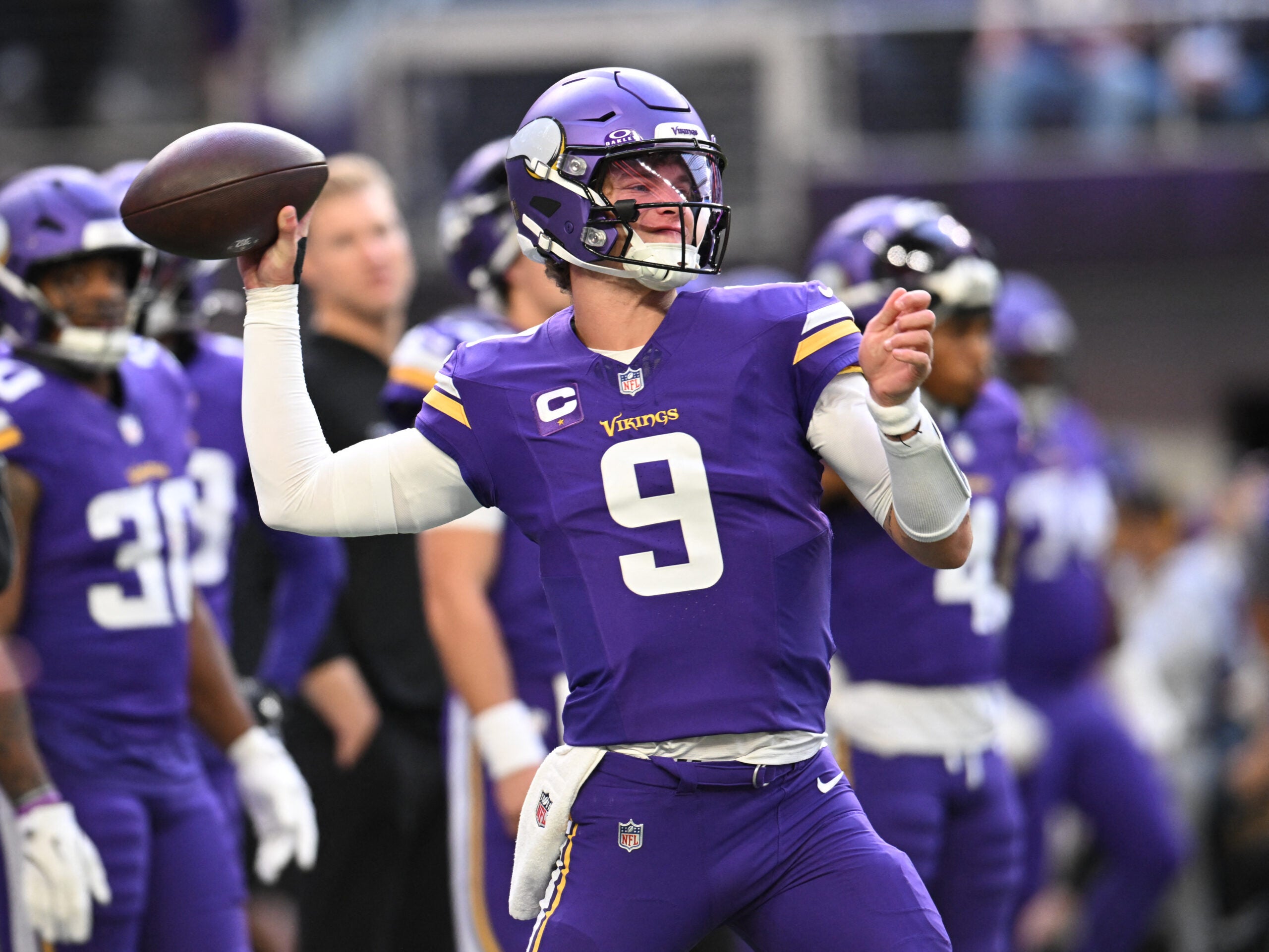
The Minnesota Vikings quarterback competition between J.J. McCarthy and Kyler Murray will define the 2026 season, and the former faces a steep climb to earn the starting job. With training camp approaching and joint practices against the Baltimore Ravens looming as a critical evaluation point, McCarthy needs to check several boxes if he wants head coach Kevin O’Connell to hand him the keys to the offense.
The Vikings have made their priorities clear: winning now matters more than long-term projection. That framework shapes everything about how McCarthy will be evaluated this summer. These five things won’t guarantee McCarthy to get the starting job, but they will need to be present.
Improve the underlying efficiency numbers
McCarthy’s raw stats from his first 6 starts paint a rough picture. In Weeks 1-12, McCarthy ranked 41st among qualifying quarterbacks in the following categories:
- EPA/play: -0.294
- Success rate: 37.7%
- CPOE: -8.7%
His air yards per attempt, however, ranked first, meaning he was attacking down the field at an aggressive clip. That explains some of those poor numbers, but it’s not the entire story.
The final 4 starts told a different story. EPA per play jumped to 4th. Success rate climbed to 2nd. His air yards dropped from 9.6 to 7.8 per attempt as the offense simplified things, and the results followed. Those numbers are encouraging, but context matters. The defenses that McCarthy faced at the end of the year were brutal
- Washington Commanders: 31st
- Dallas Cowboys: 32nd
- New York Giants: 27th
- Green Bay Packers post-Micah Parsons injury: 28th
McCarthy has not yet shown he can produce those numbers against quality defenses. That doesn’t mean he can’t. It means he hasn’t. There’s a difference, and the Vikings know it. Finding a way to improve against the top defenses will be crucial.
Clean up the mechanics
McCarthy has always been more of a bullet passer. Reports out of OTAs and mandatory minicamp suggested his touch improved this spring, but McCarthy has looked good in practice before. He dominated joint practices against the New England Patriots, outshining Drake Maye, who went on to lead his team to the Super Bowl 6 months later, and McCarthy looked good enough before his meniscus injury that the beat writers were discussing whether he might beat Sam Darnold.
The mechanics need to be clean and constant. His footwork, linking his upper and lower half, utilizing the drive step, and layering the ball over linebackers with touch need improvement. Patrick Mahomes and Josh Allen both needed roughly 3 years to fully marry their off-platform brilliance with mechanical consistency. McCarthy doesn’t have that kind of runway. O’Connell has made it clear that this competition is about 2026, not 2027 or 2028. If the mechanics are fixed, that becomes the biggest differentiator between what we saw last season and what could emerge this fall.
Become a more consistent processor
When McCarthy was on, he looked comfortable in the pocket. He stepped into throws, climbed when pressure came, and let the offense breathe. When he wasn’t on, he looked lost. His processing delays made the offensive line look worse than it was, often holding the ball an extra quarter-second to half-second, which saw windows close down the field. McCarthy’s 15 turnover-worthy plays on 243 attempts (4.8%) were astronomical, while his 19 big-time throws (7.3%) showed the ceiling. Ultimately, the gap between those peaks and everything else was too wide.
Murray can throw with anticipation. He can hit dig routes, corners, speed outs, and comebacks, which will come into play in the competition. McCarthy needs to prove he can match or exceed that level of processing, because this competition isn’t about potential alone. If it’s close to a tie, the edge probably goes to McCarthy because of age and future cost. If one side wins outright, 2026 production is all that matters.
Tighten up ball placement
McCarthy’s off-target rate to Justin Jefferson was 28% last season. His drop rate was 10.8%, compared to Carson Wentz’s 3.5% and Max Brosmer’s 6.0%. Many of those “drops” weren’t balls hitting receivers square in the hands. They were catches requiring full extension that technically hit the hands, but were more difficult catches. The speed out to Jalen Nailor on the first play against the Atlanta Falcons that grazed fingertips. The throws to Jefferson and Jordan Addison that counted as drops but demanded adjustments no receiver should have to make consistently. Wentz had plenty of issues, but his placement on timing routes was reliable. McCarthy needs to reach that standard. Jefferson is the best wide receiver in the league and the face of the franchise. If McCarthy can’t put the ball where Jefferson expects it, that relationship could erode fast.
Dominate joint practices with the Ravens
Everything in the competition likely builds to this. The joint practices against the Baltimore Ravens will function as McCarthy’s preseason game, since the starters likely won’t play that weekend. He needs to show he can make progression reads against a physical defense. He needs to throw into tight windows with corners playing press coverage and pass rushers bearing down. He needs to outperform, or at least match, the environment that produced his dominant showing against New England a year ago.
By roughly Aug. 23, the Vikings need to have enough data to name a starter and give that quarterback 3 weeks of preparation before the regular season opener. The joint practices represent the last meaningful evaluation point. If McCarthy dominates them, it goes a long way. If he doesn’t, it could be the single factor that settles the competition in Murray’s favor.

