
The Titans didn’t just draft Carnell Tate’s WR talent: They drafted what makes him built different for the NFL
Tennessee Titans rookie Carnell Tate’s mindset traits may be even more impressive than his physical ability he’s already shown us during his first NFL summer.


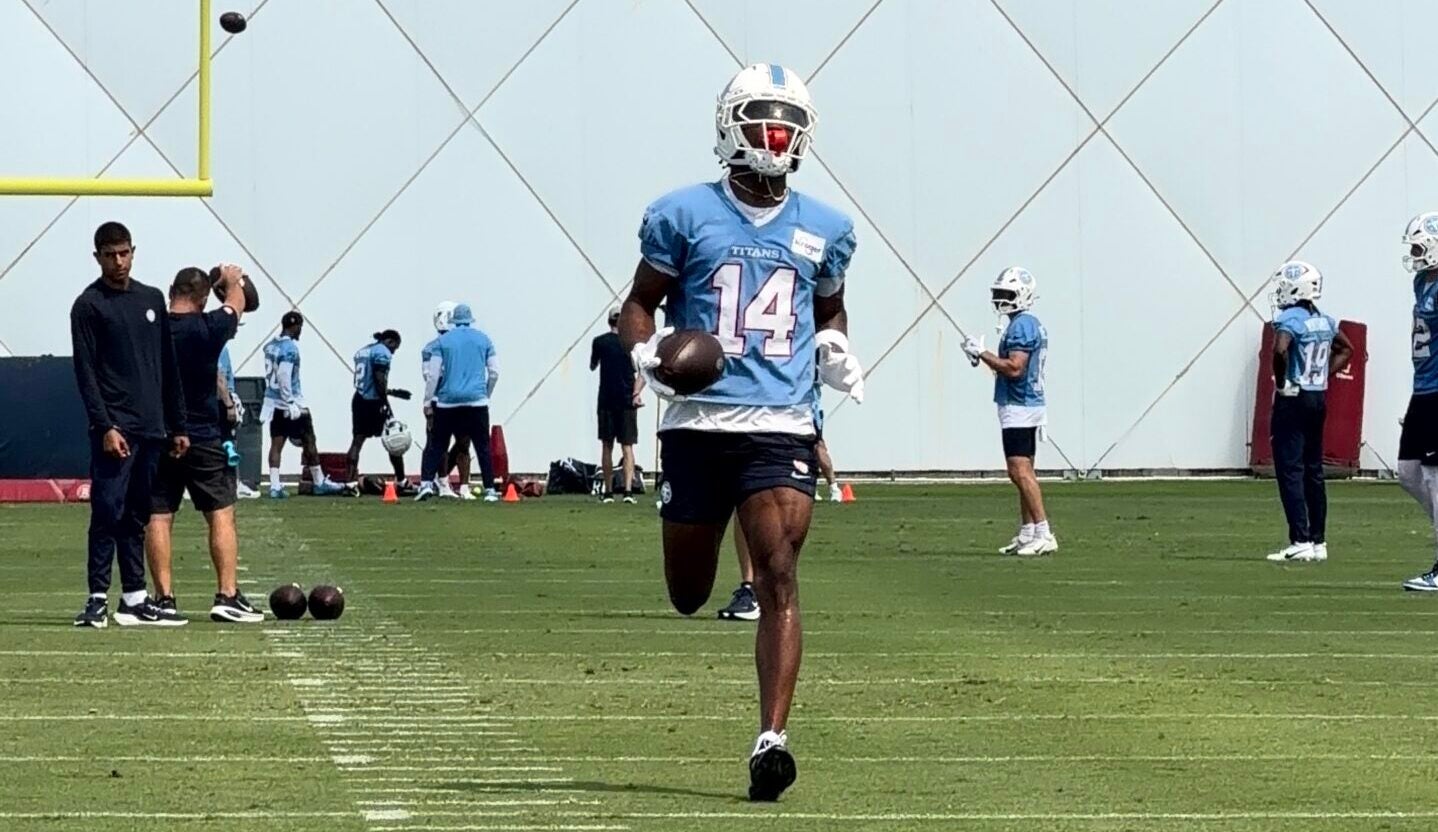
The Tennessee Titans selected Ohio State wide receiver Carnell Tate fourth overall in the 2026 NFL Draft, and everything he showed during OTAs and minicamp suggests he has a real shot at Offensive Rookie of the Year.
In his first day of Titans training camp the rookie looked like he cut his route off in the end zone, leading to a Cam Ward missed TD pass. But Tate showed his mental ability minutes later when he and Ward connected for a down field jump ball TD pass.
Behind his new jersey No. 14, there’s a story of loss, faith, resilience, and relentless maturity that shaped the receiver Nashville is about to watch every Sunday. Nashville resident Stephanie Otey, who covered Tate extensively during his time in Columbus, joined me on A to Z Sports to paint a fuller picture of who Tate is as a person and a player heading into training camp.
A dream that started on Chicago’s west side
Tate grew up on the west side of Chicago dreaming of one thing: playing wide receiver at Ohio State. Titans sixth-round pick Pat Coogan, his older high school teammate at the time, tried recruiting him to Notre Dame. Tate never wavered.
Brian Hartline (now the USF head coach) brought him in, and Tate entered a loaded receiver room featuring Emeka Egbuka, Marvin Harrison Jr., and later Jeremiah Smith. He was never the No. 1 option. He never transferred.
According to Otey, Hartline noted something about Tate from the very first weeks on campus: “accountability, coachability,” and the fact that he never had to tell Tate the same thing twice.
That detail matters now. When Titans head coach Robert Saleh and offensive staff praised Tate’s ability to pick up the playbook, Otey says she isn’t surprised.
“Carnell was always that way. So much attention to detail, and he’s going to make those adjustments immediately. That’s why coaches love him.”
The loss that changed everything
Just one month before his first college football game, Tate lost his mother in a drive-by shooting.
“She was his best friend,” Otey said. “They FaceTimed constantly. She was a young mom, and they had talked about his NFL career together for years. She never got to watch him play a game at Ohio State.”
Tate’s new No. 14 jersey number has significance to his mom as he told me after rookie minicamp that his mom’s birthday is Nov. 14, making the switch away from his college No. 17 easier.
After the unthinkable tragedy of a young high school graduate losing his mother before being on his own, Otey told me that Tate leaned into the coaching staff and into a locker room full of veterans who had turned down the NFL to chase a national championship.
Before the 2024 season, over 60 Ohio State students were baptized at a team-led revival, and Tate was among them. Egbuka, running back TreVeyon Henderson, and tight end convert Gee Scott Jr. were vocal leaders in that faith community.
Otey described it as one of the most distinctive team cultures she’s covered.
“He comes in, and to your point, yeah, you’re at such a young age,” Otey said. “That faith became a really strong impact on this whole team. But for Carnell in particular… having those veterans on the team that could have been in the NFL stay and be there with him, that’s when he started to get more reps.”
Never the “No. 1 WR”, yet always dependable
The skeptic’s case against Tate at fourth overall is simple: he was never the top receiver on his own college team. He played behind and alongside Egbuka, Marvin Harrison Jr., and then Jeremiah Smith. But Otey sees that as a feature, not a flaw. Hartline’s system demanded every receiver learn every position on the route tree. Tate did, and he produced when his number was called.
In his final season, Tate posted an 85.7% contested catch rate on 66 targets with zero drops. He wasn’t the fastest receiver in the class, and he never pretended to be.
According to Otey, the “I get open” mentality wasn’t draft-process marketing. She found the same language in her notebooks from interviews conducted well before the combine.
“That wasn’t like a marketing thing,” Otey said. “That’s something he always was about, is getting open.”
Hartline said during Tate’s freshman year that he was further ahead at that stage than Marvin Harrison Jr. had been. Otey also noted that Hartline and Daboll knew each other well, and that NFL teams understood what they were getting from an Ohio State receiver trained in that system: a player ready to contribute on Day 1.
The Cam Ward connection
Tate’s first message to Titans quarterback Cam Ward was straightforward: “I’ll be open. I’m always open.” Otey called their pairing “the perfect quarterback-receiver mindset,” rooted in no-nonsense preparation and attention to nuance.
Off the field, Tate is already diving into the Nashville community. He hosted a fan event at a local Kroger and has teased a jersey giveaway on social media.
Otey, who has lived in Nashville for four years, said watching Tate settle into the city has reinforced what she always believed about him.
“He is himself to his core, and he doesn’t need attention. He loves to let his play on the field do the talking. And it talks.”
