
Lions Jahmyr Gibbs and Falcons Bijan Robinson could pull off something the NFL has never seen by using this rarely used structure
Detroit Lions’ Jahmyr Gibbs and Falcons star Bijan Robinson have a way to solve the NFL’s strangest contract standoff. It would require a structure the league has almost never seen.

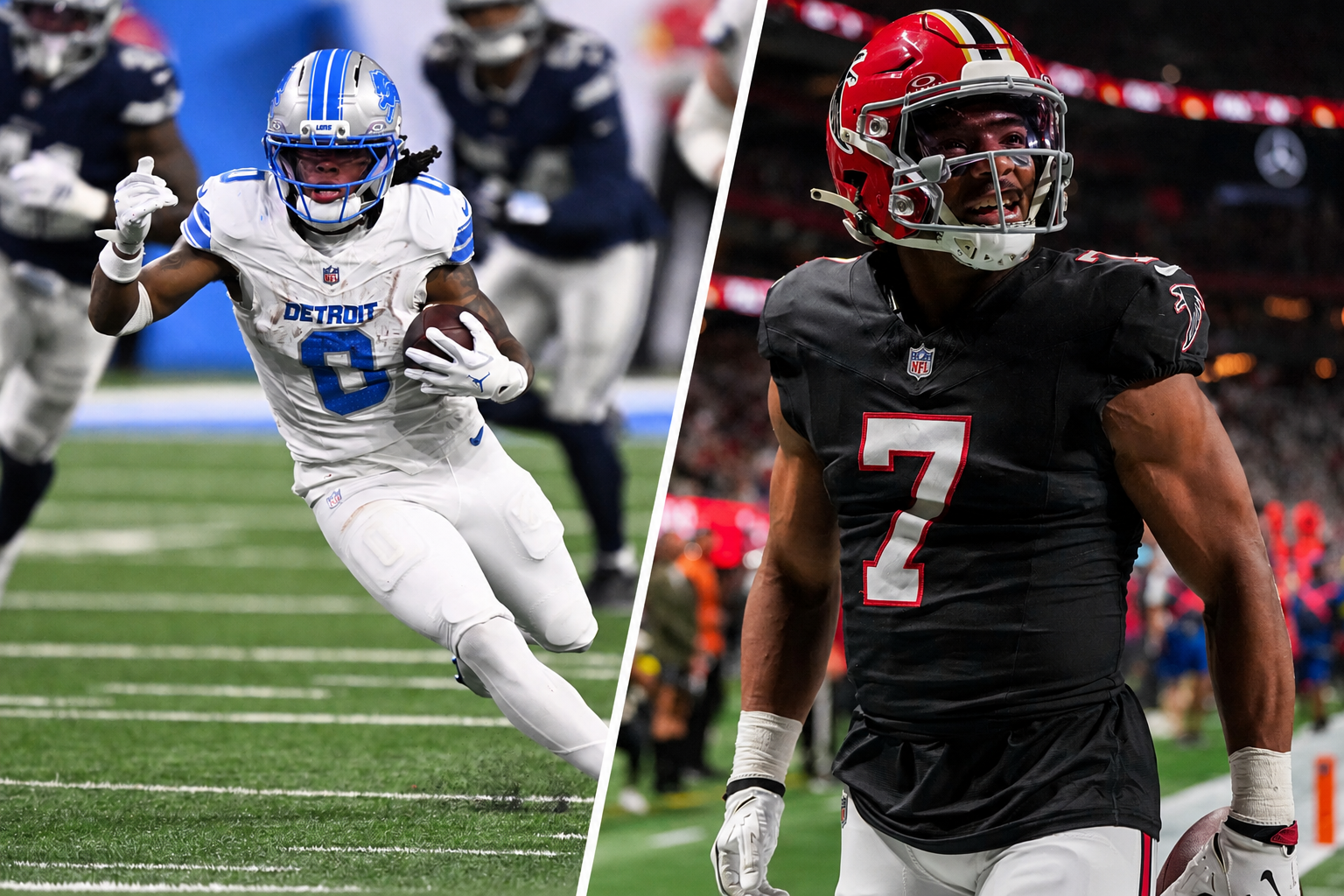
The Detroit Lions and Atlanta Falcons find themselves in a fascinating deadlock over their star running backs. After Jahmyr Gibbs missed practice on Wednesday and Thursday, the question of his next contract became even louder. Both Gibbs and Bijan Robinson need extensions, and neither team wants to blink first.
I talked about this on ESPN West Michigan radio with fellow Detroit Lions writer Jeff Risdon, and we landed on an idea: whoever signs their guy first kind of loses on the player side because the other back can then demand more. But whoever goes first wins on the team side because you’ve locked your guy up. So what if Gibbs and Robinson got together and told their respective teams, “We both want the same deal. We both want to be the highest-paid running back in NFL history in total value, average annual value, and guaranteed money”?
I decided to run that experiment and see what it actually looks like.
The current running back market
Right now, the highest total value for a running back contract is $64 million, which the Miami Dolphins are paying De’Von Achane. In terms of average per year, Saquon Barkley leads at $20.6 million with the Philadelphia Eagles. And the most total guaranteed money among all running backs belongs to rookie Jeremiyah Love with the Arizona Cardinals, which is wild because he’s a rookie. But that’s neither here nor there.
If Gibbs and Robinson want to blow past all of that, both teams have to come to the table with something massive that resets the market for the entire NFL.
The proposed deal: 4 years, $88 million
What I came up with is that both Gibbs and Robinson would sign identical 4-year deals worth $88 million, with $22 million in average annual value and $55 million guaranteed. That would put both of them into the stratosphere as the highest-paid running backs in NFL history. Keep in mind, they’re younger than all the other guys at the top of the market. It makes a ton of sense that you’d want to lock them up for a long time.
I know that sounds like a great deal of money, and believe me, it is. But here’s the thing: both teams can structure this completely differently.
How the Lions would structure it
| Year | Status | Base Salary | Bonus Proration | Roster Bonus | Cap Hit | Dead Money |
|---|---|---|---|---|---|---|
| 2026 | Rookie Year 4 | $1,145,000 | $2,494,570 | $2,038,429 | $5,677,999 | $5,677,999 |
| 2027 | 5th-Year Option | $15,000,000* | — | — | $15,000,000* | $15,000,000* |
| 2028 | Extension Yr. 1 | $1,000,000 | $4,000,000 | — | $5,000,000 | $55,000,000 |
| 2029 | Extension Yr. 2 | $6,000,000 | $7,000,000 | — | $13,000,000 | $49,000,000 |
| 2030 | Extension Yr. 3 | $18,000,000 | $7,000,000 | — | $25,000,000 | $34,000,000 |
| 2031 | Extension Yr. 4 | $29,000,000 | $7,000,000 | — | $36,000,000 | $17,000,000 |
| 2032 | Void | — | $3,000,000 | — | — | $10,000,000 |
| 2033 | Void | — | $3,000,000 | — | — | $3,000,000 |
What we know about how Detroit likes to handle its contracts is that base salary and cap hit stay low upfront while dead money goes high, paying out guaranteed money early. For Gibbs, the 2026 cap hit would sit at roughly $5.7 million, still part of his existing rookie deal. In 2027, because the Lions picked up his fifth-year option, the cap hit rises to $15 million. But the extension actually kicks in during 2028, where the cap hit drops back down to just $5 million with $55 million in dead money.
Year two of the extension brings a $13 million cap hit, still manageable. By 2030, you’re looking at a $25 million cap hit, and that’s where the Lions can say they want to restructure. When they do that, they’re essentially extending him again. He’d be just 27 years old at that point, so it’s not like they’re extending an older player. The void years in the deal give Detroit holding years to spread money around, restructure, and keep things flexible.
This next extension for Gibbs should ideally lock him up for the rest of his NFL career. He’d be in Detroit for the long haul unless they decide to trade him or something unexpected happens.
Why Atlanta has it easier
| Year | Status | Base Salary | Bonus Proration | Roster Bonus | Cap Hit | Dead Money |
|---|---|---|---|---|---|---|
| 2026 | Rookie Year 4 | $1,145,000 | $3,242,462 | $2,599,348 | $6,986,810 | $18,309,810 |
| 2027 | 5th-Year Option | $15,000,000* | — | — | $15,000,000* | $15,000,000* |
| 2028 | Extension Yr. 1 | $5,000,000 | $7,000,000 | — | $12,000,000 | $55,000,000 |
| 2029 | Extension Yr. 2 | $12,000,000 | $7,000,000 | — | $19,000,000 | $43,000,000 |
| 2030 | Extension Yr. 3 | $20,000,000 | $7,000,000 | — | $27,000,000 | $29,000,000 |
| 2031 | Extension Yr. 4 | $23,000,000 | $7,000,000 | — | $30,000,000 | $7,000,000 |
The Falcons, at least under their previous GM, didn’t use void years the way Detroit does. So their cap hits would be bigger right away: $12 million, then $19 million, then up to $27 million and $30 million. But Atlanta is in a much better cap space situation than the Lions. The Falcons currently have the 5th-most cap space in the league, so they can afford to maneuver.
They also don’t have a quarterback they’re going to be paying a ton of money to soon. They have Tua Tagovailoa and Michael Penix Jr., and maybe Penix can show he’s the guy. Atlanta just doesn’t have all the guys to pay like the Lions do. Detroit has to get more creative, which is where the void years and restructures come into play.
You could also make the case that new Falcons GM Ian Cunningham brings over some of those Howie Roseman tendencies from Philadelphia. The Eagles use more void years than any team in the league, so the Falcons could start operating similarly with Cunningham in town.
The bigger picture
No two teams have done this before, paying two players at the same position the exact same amount of money. To pull it off, you have to go way over the current market, which is how you jump from $64 million to $88 million. It’s going to make some fans gasp. But this is just the way the league is heading. Every single year you hear about a new highest-paid player at a given position. Jeremiyah Love is already getting $53 million guaranteed as a rookie. If he turns out to be the player Arizona expects, we could be looking at a $100 million running back down the line. People would look back at Gibbs and Robinson as the guys who started that trend.
Let’s see if either team actually pulls the trigger on something like this.
