
Eligibility rules could offer Notre Dame veteran a surprise 2026 return, but it wouldn’t make much sense for the Fighting Irish
The CFB eligibility rules could welcome back a Notre Dame veteran. Should HC Marcus Freeman and the Fighting Irish consider it?


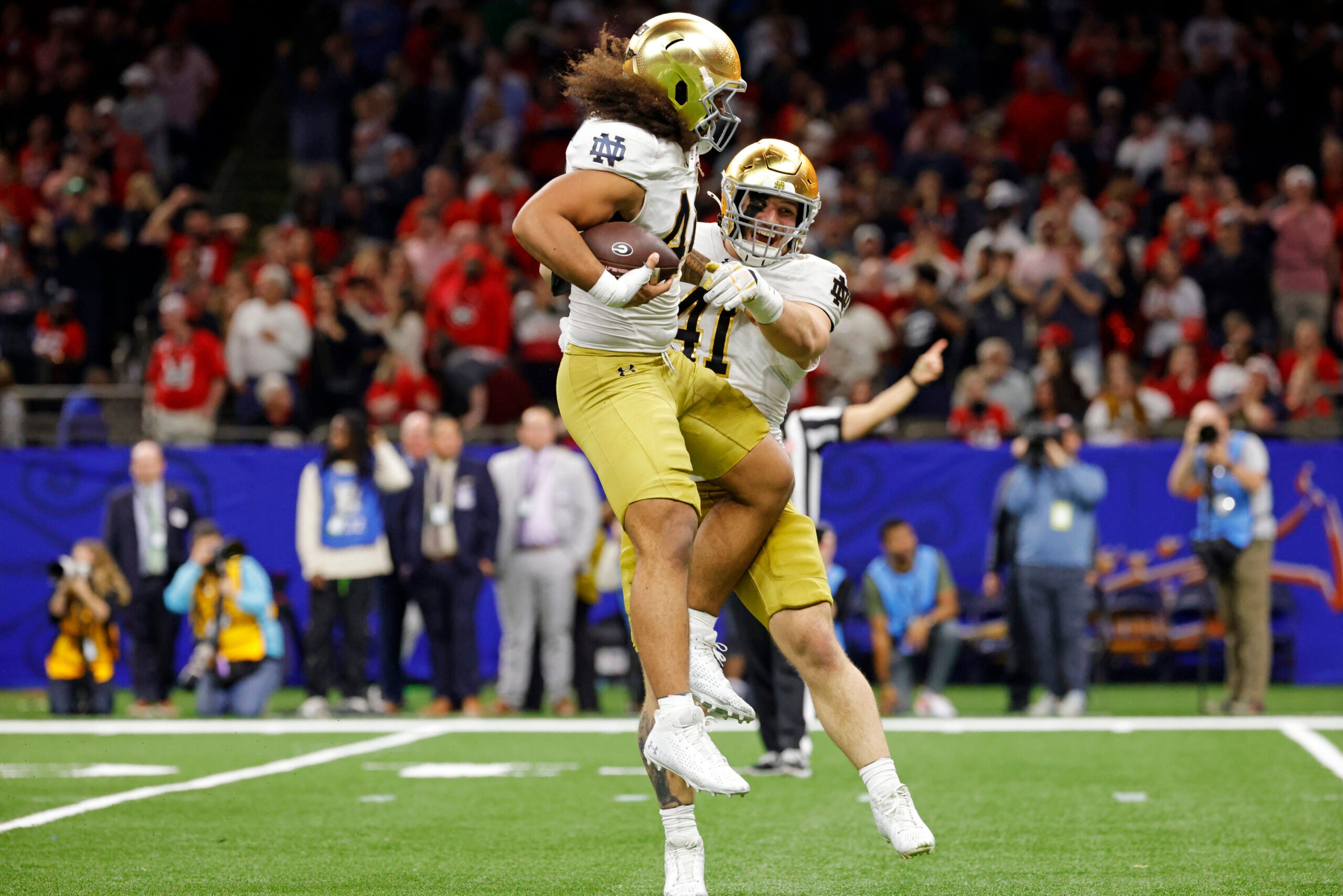
A federal court ruling on Friday injected fresh chaos into college football’s eligibility landscape. Judge Charlotte Sweeney of the U.S. District Court of Colorado granted a preliminary injunction requiring the NCAA to declare all high school Class of 2022 athletes eligible who completed their four seasons this past spring.
The ruling means every college athlete with expiring eligibility could have one more season if they choose to utilize it.
The injunction will face pushback for several reasons, and the next steps in the legal process remain unclear. But if it holds, it creates intrigue across college football for fourth-year seniors who exhausted their eligibility and are not quite at the NFL level or are borderline in camps right now.
What it means for Notre Dame football
When it comes to Notre Dame, there aren’t many players who fit this description. In fact, there is only one from last year’s team who could potentially take advantage of it: former defensive end Junior Tuihalamaka.
The 6-foot-2, 255-pound pass rusher was originally a member of the 2022 class for the Fighting Irish and signed as a linebacker. After need arose early in his career, he made the transition to an on-ball role as a defensive end.
Special teams was Tuihalamaka’s niche during his first couple of seasons, but during the 2024 season he was eventually able to secure a defensive role due to some injuries and played pretty well overall. During the 2025 season, his role diminished as the defensive end depth continued to improve.
During his four years with Notre Dame and head coach Marcus Freeman, Tuihalamaka managed to collect 61 total tackles, nine tackles for loss, four sacks, one interception, two fumble recoveries, and two pass breakups.
Whether Tuihalamaka will try to utilize an extra year if everything is verified and solidified remains to be seen.
The case against a return to South Bend
For Notre Dame defensive coordinator Chris Ash, there is some intrigue to welcoming back a veteran who played a lot of football and did right by the team for four years. But this current version of the Fighting Irish is not one where Tuihalamaka’s presence would be tremendously impactful on the field.
Some could argue that welcoming him back might actually end up doing more harm than good to the defensive end room in both the short and long term.
In a hypothetical world where Tuihalamaka would demand some reps on defense, that could potentially take away opportunities from players like redshirt junior Keon Keeley and true freshman Rodney Dunham. Heading into the 2026 college football season, Boubacar Traore is going to be a mainstay on this Notre Dame team after leading the group with 6.5 sacks a year ago. Bryce Young also returns as a starter.
Keeley and Dunham, both former five-star recruits, bring a ton of talent to the table.
Saying goodbye to a really good program player like Tuihalamaka is never easy. Notre Dame is clearly excited about the future and potential of a defensive end room that has suddenly become one of the deepest they have had in South Bend in a very long time.
There is a world where Tuihalamaka would decide to come back and serve as that veteran voice in the room without eating into reps, but that feels like an unlikely role for someone who wanted to utilize an extra year of eligibility.
Notre Dame should look forward
From Tuihalamaka’s perspective, a return to college football would certainly be worth considering. For Notre Dame, however, this feels like the right time to move toward the future. The defensive end room is in a great spot, and the Irish owe some of that to Tuilamaka for setting the floor and helping that room continue to develop and add more star power over the last couple of years.
But that page has turned. Notre Dame should roll with their young talent at defensive end and not hold too tightly to the past to preserve a floor that could potentially lessen the ceiling.
