
Running back market explosion quietly makes Packers’ decision look better by the day despite complicated layers ahead
Josh Jacobs signed for $12 million a year in 2024, and now the top of the running back market is almost twice as expensive.


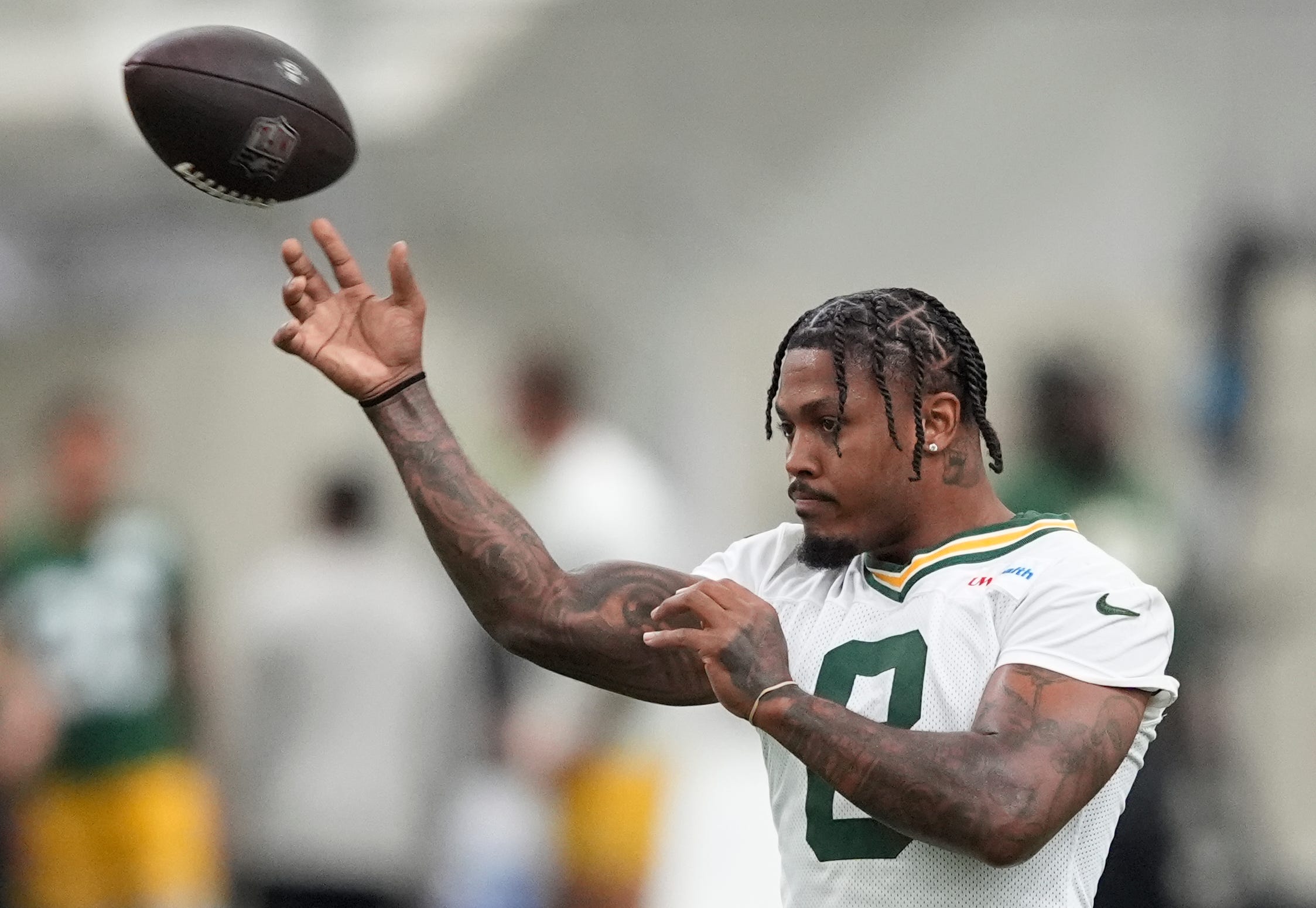
The running back market shifted dramatically this week, and the Green Bay Packers find themselves in a fascinating position because of it. Just days ago, only one running back in the NFL averaged more than $20 million per year: Philadelphia Eagles star Saquon Barkley. Now, three running backs have signed extensions worth $22 million or more annually.
Detroit Lions’ Jahmyr Gibbs became the highest-paid back in football at $22.5 million per year. Atlanta Falcons’ Bijan Robinson had gotten $22.25 million per season, and Indianapolis Colts’ Jonathan Taylor locked in $22 million yearly on a two-year contract.
For the Green Bay Packers, that sequence is interesting because the Packers signed Josh Jacobs in free agency two years ago, and that deal looks extremely affordable at this point.
Jacobs’ deal looks like a steal
The Packers signed Jacobs in free agency in 2024 on a four-year, $48 million contract. He is now slated to make $11.5 million this season and $13.5 million next year. That salary for 2026 is essentially half of what the top of the running back market now commands.
Gibbs and Robinson are young, ascending players who are probably the two most effective and efficient running backs in football right now. Taylor is a bit older but coming off a great season for the Colts. Jacobs, though, represents tremendous value for the Packers given his on-field production and his contractual cost.
He has two years and $25 million remaining on his deal. That’s nearly the price those other backs are commanding for a single season, and Jacobs will play two for Green Bay.
The Packers don’t know exactly what will happen with Jacobs off the field, though, because he was arrested earlier this offseason in connection to a domestic violence case. He was released from jail and has been able to practice throughout training camp.
Contract flexibility gives the Packers options
The other side of this situation is the contract structure itself. The Packers gave Jacobs a $12.5 million signing bonus, and that represents the entirety of his guaranteed money. There are no guarantees left on the deal. If Green Bay decided to release Jacobs next offseason, the only dead cap hit would be $3.125 million in signing bonus proration. The Packers wouldn’t owe him anything else, and they would clear $13.5 million in cap space.
That flexibility is significant, but the question becomes how the Packers would replace Jacobs if they moved on, whether that’s next year or in 2028.
Replacement options aren’t great
Green Bay drafted running back MarShawn Lloyd in the third round back in 2024 as a potential change-of-pace back, but he has played in just one NFL game because of injuries. He appears finally healthy, and that’s a consideration. If Lloyd can play better in 2026, the equation changes and the Packers might be more willing to move on from Jacobs. But that hasn’t been the case so far.
The 2027 free-agent market for running backs doesn’t look strong, either. The top names would be players like Jordan Mason, who will already be 28, and guys like D’Andre Swift, Tony Pollard, Aaron Jones, Justice Hill, James Conner, and Rachaad White. Those are older players who aren’t long-term pieces. A younger option like Tank Bigsby will be 26 but has never established himself as a starter. At that point, keeping Jacobs and letting him play out his contract would probably be the better path.
There are many questions and considerations here for the Packers. The fact that the running back market has risen after years of stagnation probably means that Green Bay, if nothing off the field precludes them from doing so, would be comfortable keeping Jacobs throughout the life of his current deal.
