
How Vikings HC Kevin O’Connell maximizes Kyler Murray’s unique profile will determine Minnesota’s success in 2026
Kevin O’Connell and Kyler Murray is the most unique pairing in the NFL, and everyone is dialed in on how it will work.

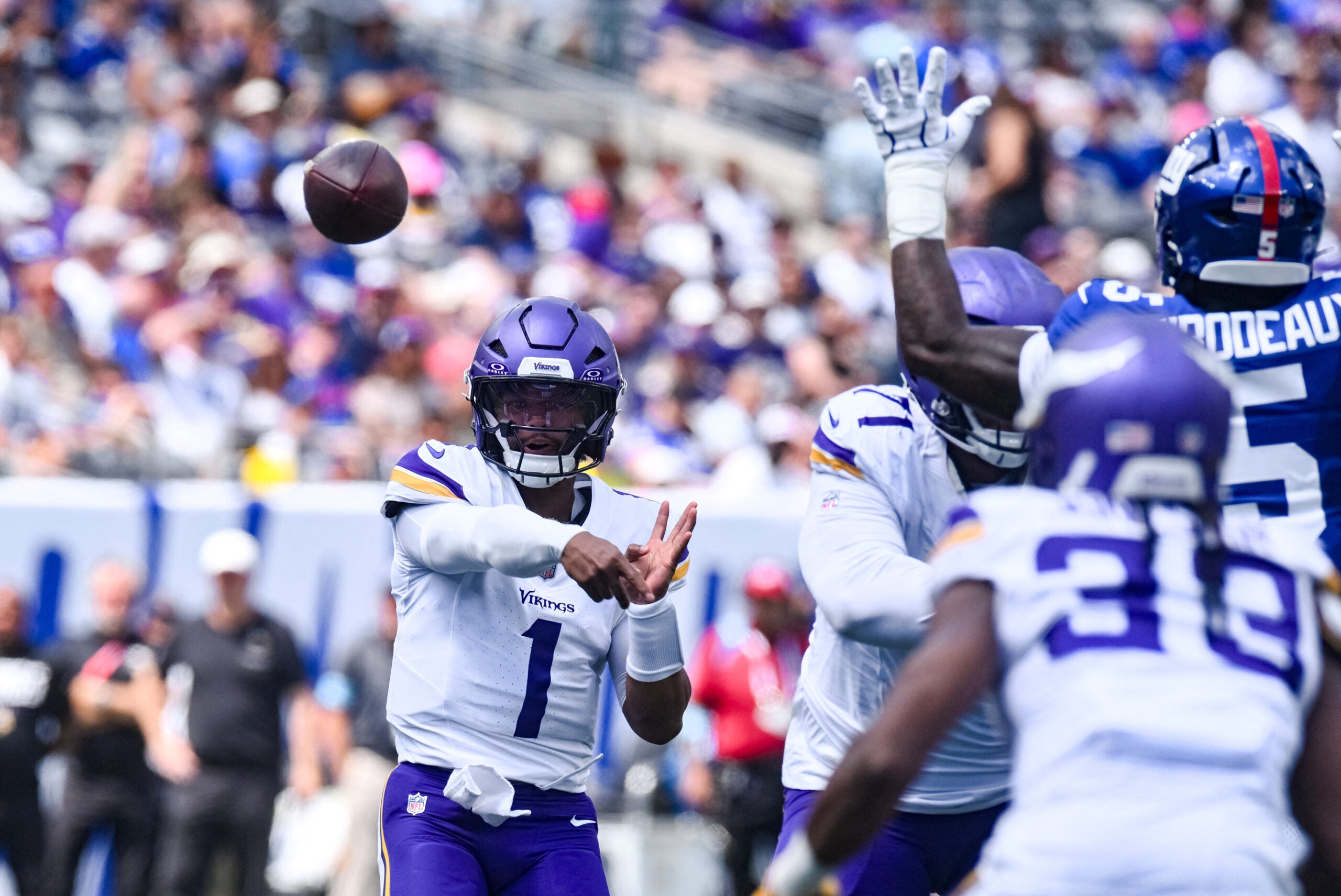
The Minnesota Vikings have never had a quarterback like Kyler Murray under center in Kevin O’Connell‘s system. He is the fastest, quickest, and shiftiest signal-caller the franchise has deployed in this offense, and those elements create layers of intrigue heading into the 2026 season. The question isn’t whether Murray can run. The question is how O’Connell will design an offense around a player whose skill set has never existed in this scheme’s lineage.
J.J. McCarthy has the ability to run but wasn’t a runner by trade. Sam Darnold and Kirk Cousins before him were pocket-first quarterbacks with limited mobility. Murray changes the equation entirely. He brings a combination of arm talent, scrambling ability, and pocket passing that forces O’Connell to adapt in ways he hasn’t needed to before. The data from Murray’s career and his 2024 season with the Arizona Cardinals paints a picture of a quarterback who could thrive in Minnesota if the scheme meets him halfway.
Murray is a passer first, scrambler by necessity
One of the most common misconceptions about Murray is that he’s a “running quarterback.” That label oversimplifies what he does. Murray scrambles because things break down around him, and he happens to be elite at making plays when they do. He doesn’t want to scramble. He wants to beat you from the pocket, but he knows he can create explosive plays the second he leaves it.
The comparison to Lamar Jackson isn’t about talent level, but rather archetype. Both quarterbacks want to throw first. Because they are both dangerous as runners, the narrative around them skews toward athleticism over arm talent. Murray’s career scramble data backs this up. He ranks 5th among quarterbacks in scrambles since 2019 with 210, has rushed for 7 touchdowns on those scrambles, and ranks 6th in scramble yardage. However, his forced missed tackle rate sits lower than expected because he plays smart. He goes out of bounds or slides to preserve his body rather than lowering his shoulder into a defender.
That self-preservation is a feature, not a bug. McCarthy suffered a concussion and high ankle sprain last season from taking hits. Murray avoids that by getting down or getting out, similar to how Jackson falls like a piece of paper in the open field rather than absorbing contact.
The data tells an encouraging story
Murray’s career numbers since 2019 among quarterbacks with at least 1,000 passing attempts show a player who sits right around average. He ranks 22nd out of 45 in EPA per play, 15th in success rate, and 15th in sack rate. The explosive pass rate, sitting at 42nd, needs some context. He spent significant time in Kliff Kingsbury’s air raid offense, where short passes function as runs. The system limited deep shots by design, suppressing his explosive metrics. With all that said, Murray isn’t the most aggressive quarterback in the NFL
His 2024 numbers under Drew Petzing in Arizona tell a more relevant story. EPA per play ticked up slightly. Success rate jumped about 3%. His turnover-worthy throw rate landed at an elite 4th out of 46 quarterbacks. The explosive pass rate remained low at 10%, but that aligns with both Petzing’s approach and the lack of talent to stretch the field.
The outside-the-pocket numbers are where things get exciting. In 2024, Murray’s EPA doubled when he left the pocket. He averaged 10.4 yards per attempt outside the pocket with a 0.16 EPA per play, both top-10 marks. Murray’s explosive play percentage doubled compared to his in-pocket numbers, and his air yards per attempt jumped from 6.7 to 8.3 when working outside the structure of the play. This is where things can get intriguing for the Vikings.
O’Connell’s adaptation is the No. 1 storyline
O’Connell comes from the coaching tree that traces back through Sean McVay and Kyle Shanahan, neither of whom has worked with a player like Murray. It will be a fascinating test case for this system. How O’Connell adjusts his scheme will define the Vikings’ 2026 season.
The passing lane problem is real. Murray is short and has been short his entire life, from high school through now. He’s always had to create his own throwing windows. One area worth watching is whether O’Connell tries to work around those elements. Could he look to how Sean Payton structured things for Drew Brees, who barely stood 6 feet tall and dealt with the same visibility issues behind offensive linemen for years?
O’Connell hasn’t historically run many bootlegs or designed rollouts. The data says Murray thrives outside the pocket, which means adding flood concepts, sprint-out actions, and wide-zone play-action boots could unlock another dimension. A play-action boot with Jordan Addison running a deep post to the opposite side of the field is a throw Murray has the arm strength to make. That’s exactly the kind of chunk play O’Connell’s offense craves.
The scramble drill chemistry with Justin Jefferson and Addison is another layer. Murray has never played with route-running savants at this level. DeAndre Hopkins and late-stage AJ Green were good players, but they aren’t doing what Jefferson and Addison can do. When Murray buys 5 or 6 seconds scrambling, those two can plant their feet, break on a dime, and find open space. If the Vikings structure their scramble drill rules well, those improvised plays could produce some of the biggest moments of the season.
The ceiling is real, even if the floor is uncertain
If Murray plays well, the Vikings face a contractual question about his future that could define the next several years of the franchise. But the on-field ceiling comes first. The Vikings were better last season on a yards-per-play and yards-per-game basis defensively, allowing only one more point than they did in 2024 while dealing with a minus-21 turnover differential from the year prior. If the offense can improve through positive regression and Murray’s addition while the defense stays in the top 10 even with some regression, Minnesota has a formula that works.
The red zone could be the biggest area of improvement. The addition of Jauan Jennings gives Murray a physical, contested-catch weapon willing to go into the post and body up defenders. T.J. Hockenson remains a factor in the red zone despite not being the same player he was a couple of years ago. Murray has historically liked throwing to tight ends, and that tendency fits what the Vikings want to do inside the 20.
The Vikings won 9 games last season with a negative EPA per dropback. If Murray can push that number toward 0.16 overall, matching what he produced outside the pocket in 2024, the leap would be massive. Whether he gets there depends on the lengths O’Connell’s goes to adapt and Murray’s ability to execute concepts he hasn’t run extensively before. The data suggests the raw materials are there.
During training camp, he was hitting deep crossers, digs, and curls over the middle of the field against Brian Flores’ defense. The projection is encouraging. Now it has to translate to games, starting with a Green Bay Packers team in Week 1 whose cornerback room leaves plenty to be desired.

