
Matt LaFleur drops a revealing hint about how the Packers’ offense plans to adapt to a difficult situation
Green Bay ranks 30th in offensive success rate and dead last in rush EPA through three weeks, and the pass-blocking unit has been the NFL’s worst.


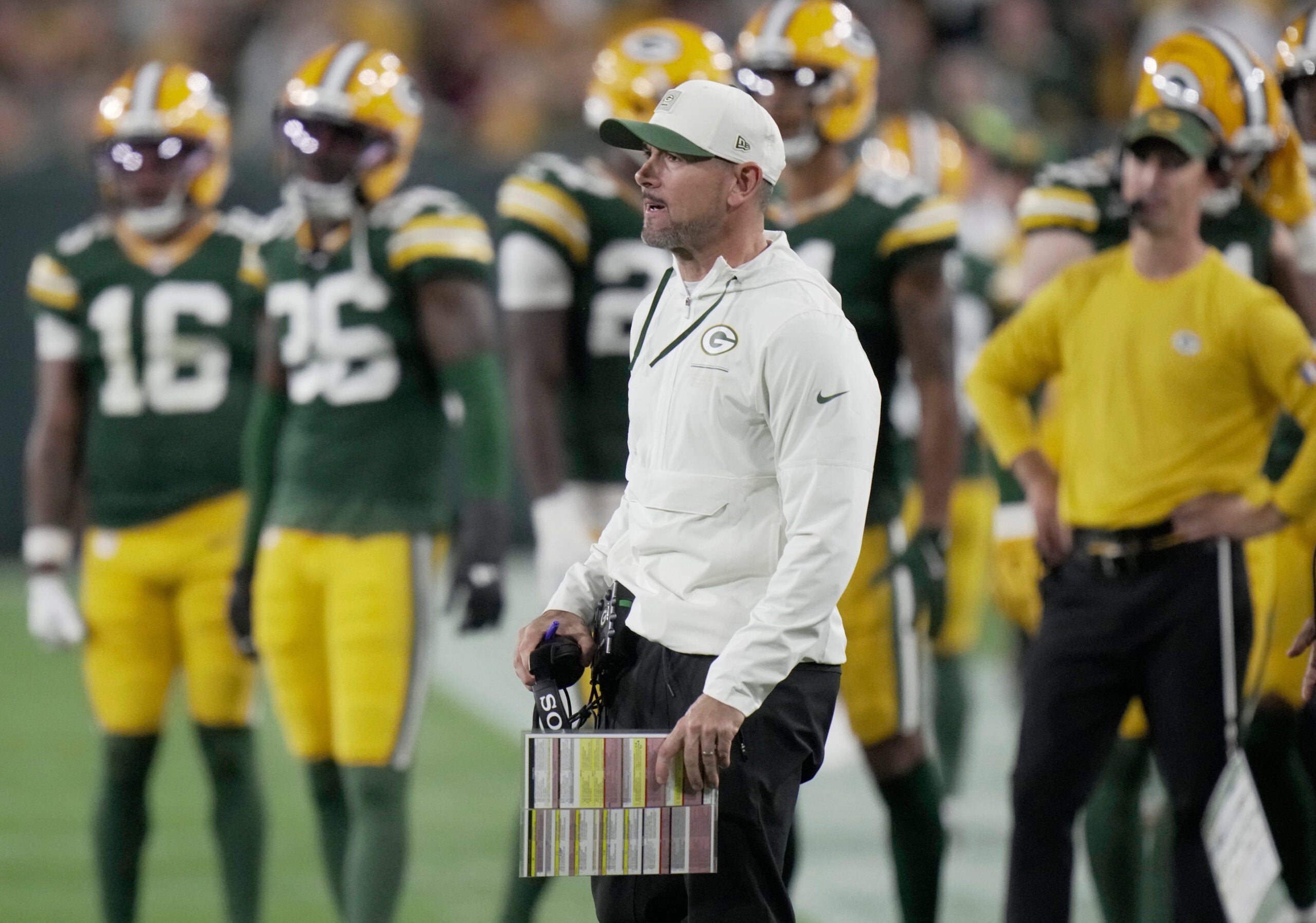
The Green Bay Packers’ offense has lacked consistency through the first three weeks of the regular season, and the root cause is obvious. Green Bay owns the worst pass block win rate in the NFL, and the ripple effects have crippled the entire offensive operation.
The Packers are 30th in offensive success rate, ahead of only the Miami Dolphins and Minnesota Vikings. They rank dead last in rush EPA. Quarterback Jordan Love sits 28th in dropback success rate among 34 qualifying quarterbacks.
The numbers paint a picture of an offense that simply cannot function the way it has over the past two or three seasons.
The explosive play solution is now a problem
Both head coach Matt LaFleur and Love have built their offensive identity around chasing explosive plays. Over the past few years, the formula worked. Attack downfield through the passing game and build consistency through the run. That approach has failed in 2026 because the offensive line cannot give Love time to explore deep areas on longer-developing plays, and the running backs have not been able to generate a productive ground game to complement it.
Love ranks 10th in air yards (9.0), showing Green Bay is still pushing the ball downfield. The results, though, have been ugly. Love is 30th among 34 quarterbacks in success rate, ahead of only Malik Willis, Baker Mayfield, Jameis Winston, and Cooper Rush. Among those same 34 quarterbacks, he is 32nd in completion percentage over expectation (-10.1), ahead of only Rush and Winston.
The Packers are not building success on early downs. Instead, they are trying to compensate with throws on third-and-long, and the offensive line does not give Love the time he needs in obvious passing situations to find receivers down the field.
LaFleur hints at a shift that’s coming
Matt LaFleur knows the offense has to adapt. When asked Monday whether Love could benefit from a quicker trigger, the head coach offered a revealing answer.
“I would say there are certain situations, yes, but then there’s a lot of times where the rush has been hitting home quick,” LaFleur explained. “So again, you gotta look at what you’re asking your guys to do and what you’re doing schematically. And you’ve got to do a better job of mixing it up, I would say, so it’s not just all these longer developing plays. Certainly we love explosives. He loves them. I love them. They typically lead to points, but we just gotta be a little bit more timely, I would say, when we’re calling them.”
That is about as clear as LaFleur gets when it comes to admitting a philosophical shift is necessary. The Packers need a more rhythmic passing game, one built around timing and quick throws rather than hunting for chunk plays on every snap.
This is not what LaFleur and Love ideally want to be. They want the explosive, aggressive attack that has defined the offense since Love became the starter. But the current personnel, particularly along the offensive line and within a struggling running game, does not support that style right now.
A quicker, more timing-based passing game would limit the damage done by poor pass protection, give Love a chance to get into rhythm on early downs, and reduce the number of third-and-long situations that have plagued Green Bay so far.
