
The myth of Marcus Freeman’s loaded inheritance: How Brian Kelly left a hollow 11-1 Notre Dame team and a self-created ceiling
Former Notre Dame head coach Brian Kelly is back in the headlines. It’s the same hollow story, and luckily for Fighting Irish fans, a different day.

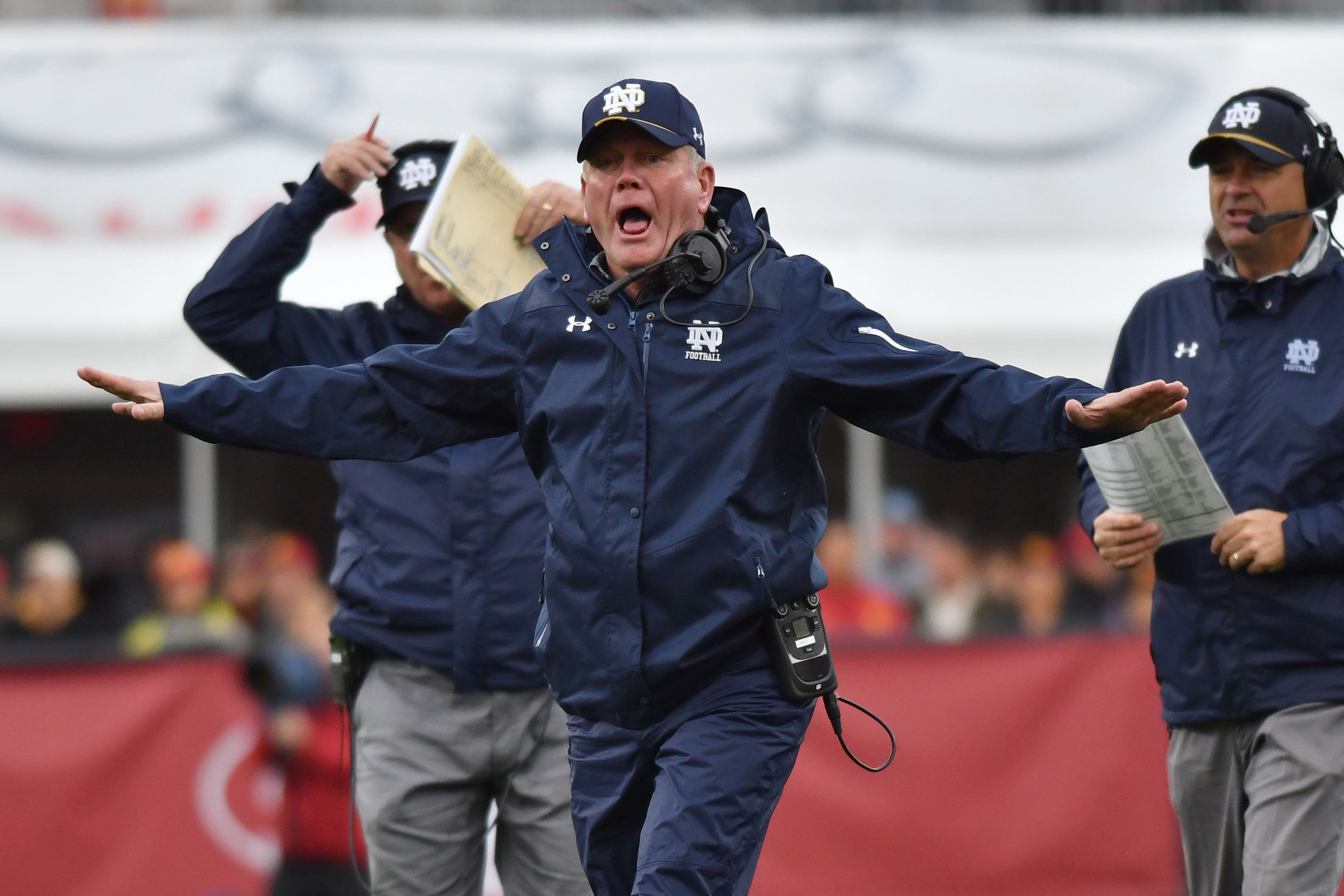
Brian Kelly is back in the headlines, and Notre Dame football fans are once again relitigating the former Fighting Irish head coach’s 12-year tenure in South Bend.
Kelly sat down with The Independent’s Pete Sampson and Matt Fortuna for a wide-ranging interview that touched on his LSU exit, his time at Notre Dame, perception of the Irish program, both then and now, head coach Marcus Freeman, and his overall coaching legacy. The conversation reignited a familiar debate about where Kelly left Notre Dame and whether Freeman inherited a program primed for success.
The answer, when you dig into the details, is far more complicated than the “he inherited an 11-1 team” crowd wants to admit.
Kelly rebuilt the floor but created the ceiling
Nobody should deny that Kelly improved Notre Dame from the Charlie Weis era. He walked into a program that lacked identity, rebuilt the offensive line pipeline, and made the Irish a team that consistently beat the opponents they were supposed to beat. Outside of the Brian VanGorder era, which Kelly refused to move past for too long, Notre Dame typically played good defensive football under Kelly.
If the conversation stopped there, it would be a fine legacy. Some would even argue a good one.
But Kelly can never let it stop there. Throughout the interview, he did what he has always done: talk about all the good he accomplished while deflecting blame for the program’s inability to break through. Even on his LSU exit, Kelly had to throw in that there were “72 different other reasons why having a .700 winning percentage and being 22-3 at home is winning”, instead of just leaving it as he needed to win more games, the big ones.
It was about wooden bleachers. It was about nutrition. It was about recruiting restrictions. And yet there was never a plan put in place to fix those things, beyond complaining about not having them. Kelly even left Notre Dame for “a place that could give him the chance to win a championship”, even though he’s backtracking on that comment now, as well.
The numbers tell the story clearly enough. Kelly held a 23-23 record against top-25 teams during his tenure. He was 3-8 against AP top-10 opponents and a staggering 1-7 against top-5 programs (the lone victory being against a Trevor Lawrence-less Clemson team). One of the greatest brands in college football history was an afterthought against elite competition, and the self-created ceiling was undeniable.
And while some will yell about Kelly being “the winningest coach in Notre Dame history,” they will never talk about him having the most losses. This longevity award apparently wipes away the fact that Kelly failed to get Notre Dame back to where it deserves to be: at the top of College Football. That final step wasn’t important enough for him.
The ‘great situation’ Freeman inherited was anything but
The narrative that Freeman walked into a loaded roster after Kelly’s departure is a farce, a lie, a massive exaggeration.
The quarterback room alone should end that argument. Freeman inherited Tyler Buchner, who ended up being a massive disappointment, and Drew Pyne, with whom Freeman managed to win eight games during his first season in 2022. If you need proof of how remarkable that was, Pyne threw four touchdown passes to five interceptions while playing for MAC-level Bowling Green this past year. Brendon Clark had transferred the offseason prior, ending up serving as a backup at Old Dominion.
The wide receiver room was equally thin. Kelly left behind a group featuring Braden Lenzy, Avery Davis, Lorenzo Styles, Tobias Merriweather, Deion Colzie, and Jayden Thomas. Thomas, Colzie, and Merriweather all transferred and barely produced elsewhere. Styles ended up playing nickelback for Ohio State. Davis and Lenzy were solid role players, but neither was anything close to an NFL-caliber pass catcher.
Comparing that group to the overall depth of talent to the 2026 group is laughable. It’s a pretty remarkable feat considering no talented wide receivers want to play in South Bend, allegedly.
The defensive side was no better.
The safety room would have been in serious trouble without Xavier Watts’s transition from wide receiver. The defensive tackle room lacked playable depth to the point where Notre Dame had to bring in Chris Smith from Harvard to log significant snaps. Defensive end depth behind Isaiah Foskey was thin, featuring players who pale in comparison to the 2026 group of Boubacar Traore, Bryce Young, Keon Keeley, and Rodney Dunham.
That 11-1 record was hollow
Kelly’s final full season produced an 11-1 record that looks far less impressive under scrutiny. The only opponent that won double-digit games was Cincinnati, which beat Notre Dame at home. The rest of the schedule included 5-7 Florida State, unranked Wisconsin, a near-upset against 7-6 Toledo at home, 4-8 USC, and 3-9 Stanford. That schedule was a joke, and no one felt good about that team at the time.
The recruiting gap is massive
Kelly’s recruiting efforts during his final years ignored critical talent pipelines. While his staff was busy “shopping down a different aisle”, Freeman’s staff has decided to shop wherever they feel like. They aren’t going to look past the high-priced items and best quality options available just because other things are cheaper and easier to grab.
Texas was not a priority. Florida was inconsistent because he couldn’t win big battles. Georgia, one of the richest recruiting hotbeds in high school football, was barely touched. Compare that to the 2027 class under Freeman, which holds commitments from several big-time players out of Florida, including safety Zayden Gamble, wide receiver Julius Jones Jr., and quarterback Champ Monds.
Notre Dame has increased its presence in Texas, dipped into Georgia, and landed five-star offensive lineman Albert Simien out of Louisiana for the 2027 class.
These are not comparable recruiting efforts. The infrastructure, the roster improvements, the retention of upperclassmen who want to be part of the program even when they know their roles are limited: that is what Freeman has built. The completeness of each class is also a testament to growth after Kelly, not completely whiffing on positions and falling short of numbers.
Somehow recruiting has gotten even easier while navigating the NIL era. Perhaps it was just about effort all along. Perhaps it was just about spending less time on the golf course, and more time on the phone and on the recruiting trail.
Appreciate Kelly for raising the floor of a program that desperately needed it. But the ceiling he created was his own doing, and his continued refusal to take real accountability for why Notre Dame could never take that final step tells you everything you need to know. He was not willing to work for it.
Hopefully now that Kelly has some much-needed downtime, he can more appropriately think back to his time in South Bend and the flaws that created so much frustration during his tenure. Perhaps he had an epiphany while he contemplated whether to go to the Travis Kelce-Taylor Swift wedding that he wasn’t invited to. Or perhaps not.
The greatness Coach Freeman inherited was the rich tradition of Notre Dame, the values of the program, and what it stands for. All those things were created long before Kelly stood on the sideline.
