
One Peyton Manning decision dramatically altered two struggling NFL franchises and a dozen Hall of Fame careers
When you think about Peyton Manning, what’s the first thing that comes to mind? For some, they think about one of the very best quarterbacks in NFL history. They will reminisce about 71,940 passing yards, 539 touchdowns, 14 Pro Bowls, and two Super Bowl championships. They will think about "The Sheriff", and his stoic nature […]

When you think about Peyton Manning, what’s the first thing that comes to mind?
For some, they think about one of the very best quarterbacks in NFL history. They will reminisce about 71,940 passing yards, 539 touchdowns, 14 Pro Bowls, and two Super Bowl championships. They will think about "The Sheriff", and his stoic nature on the football field.
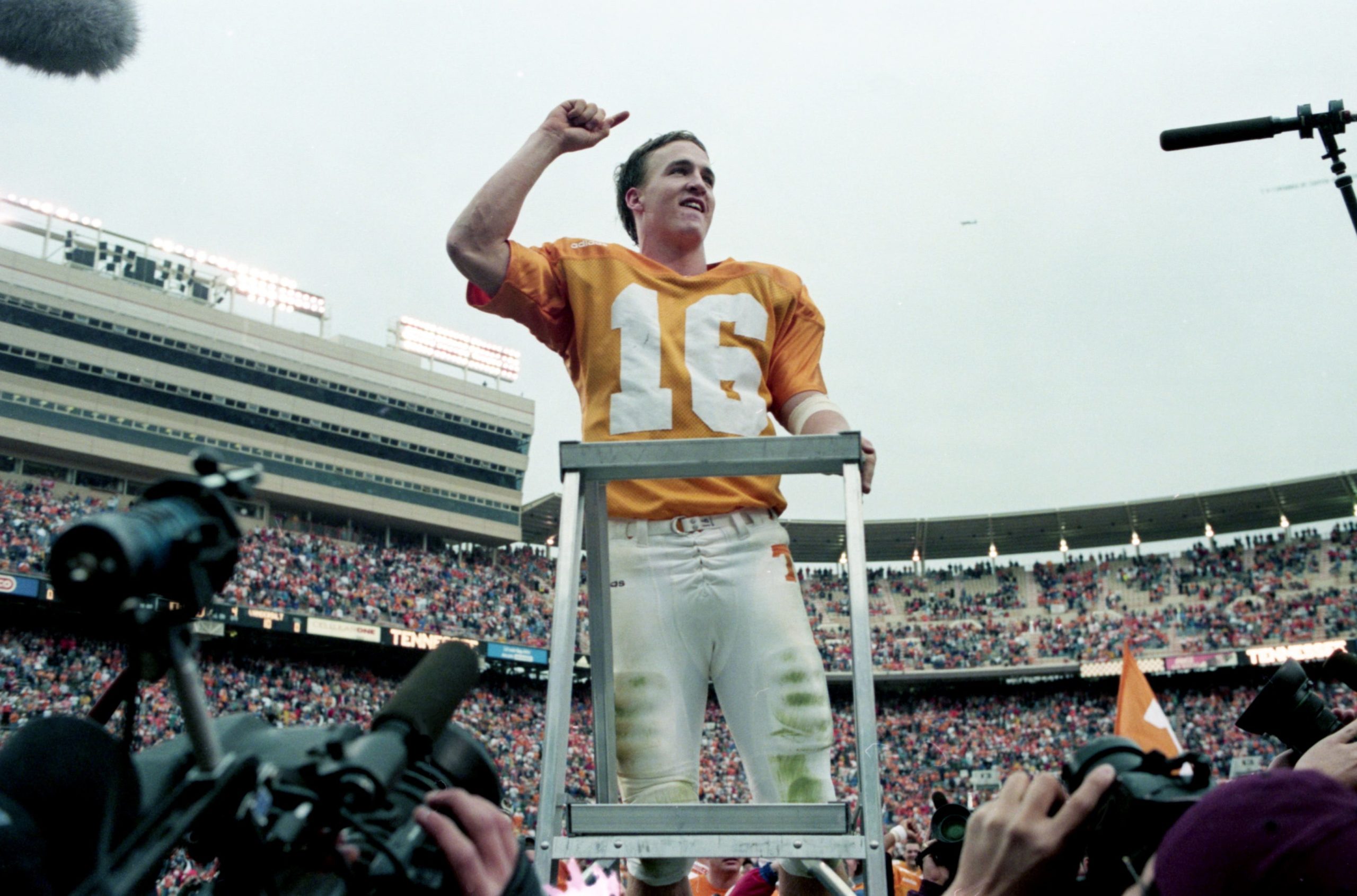
Others will remember Manning for his upbringing, and his incredible family tree. The son of a former top draft pick to the New Orleans Saints, "Archie's son" has been in the spotlight for a very, very long time along with his younger brother Eli. When Manning decided to attend the University of Tennessee, expectations were set extremely high by the media and fans around the country. As you can imagine, Manning excelled pretty early in his Volunteer career, enough to warrant consideration to declare early for the 1997 NFL Draft.
We all know the story from there. Manning opted to return to Tennessee, bypassing his NFL career for one more college football season. He would end up being selected by the Indianapolis Colts with the No. 1 overall selection in the 1998 NFL Draft, and the rest is history.
What hasn't been talked about enough is what would have happened if Manning ended up choosing to leave Knoxville a year early. Not only would it have changed the trajectory of Manning's career, but it would have drastically altered two struggling NFL franchises and about a dozen Hall of Fame careers.
The Greatest Show on Turf… but greater
The starting point for this conversation has to begin with the 1997 NFL Draft. With the first overall selection in that particular draft, the St. Louis Rams selected Hall of Fame offensive tackle Orlando Pace. The former Ohio State Buckeyes legend ended up being a tremendous selection for the Rams, but you have to think that conversation would have changed quite a bit if Manning was available.
It is possible that the Rams would still have chosen Pace, but when you take a look at the Rams quarterback room that year, it is hard to believe they would have passed on Manning. Their leading passer in 1997, which was the first season under head coach Dick Vermeil, was Tony Banks. In 16 starts that year, Banks threw for 3,254 yards and 14 touchdowns, while also throwing 13 interceptions and completing just 51.7 percent of his passes.
If Manning does go No. 1, the first natural question is, what happens to Pace? He most likely would have gotten selected with the very next selection to the Oakland Raiders, who originally selected defensive tackle Darrell Russell. With how good Pace was, he very likely would have gone on to have a Hall of Fame career. Would he still have a Super Bowl victory on his resume? Who knows, but Pace obviously isn't getting enshrined as a Ram back in 2016.
After a couple of rebuilding years under Coach Vermeil, that Rams team eventually evolved into the "Greatest Show on Turf", a high-flying offensive attack led by quarterback Kurt Warner, running back Marshall Faulk, and wide receivers Isaac Bruce and Tory Holt. While Warner was fantastic, it is insane to think how much better that offense could have been with Manning leading the show.
Following the 1999 season, and a Super Bowl victory, Coach Vermeil opted to retire for a year before returning to the Kansas City Chiefs for his final stop in the NFL. It may not have changed anything, but does Coach Vermeil rethink his retirement if he has a young Manning to continue building with? If not, does Mike Martz tenure end differently after taking over with Manning? It is interesting to think about.
Faulk ended up having a tremendous career, as did Bruce. Both have been enshrined in the Hall of Fame.
Holt, on the other hand, continues to wait to be accepted into Canton. In 11 seasons in the NFL, the former NC State great managed to haul in 920 receptions for 13,382 yards and 74 touchdowns. Those numbers are very good, especially when you consider that Holt played the majority of his career with quarterback Marc Bulger, who was a very average player. Would Holt still be waiting if he ended up playing with Manning for a substantial amount of time? Imagine what his numbers might have looked like.
It is conceivable to believe that each of Holt, Bruce, Faulk, and even running back Steven Jackson would each have a very different place in historical debates. Their numbers would have been much different, and it is very reasonable to expect that their resumes would be quite a bit stronger.
Does anyone rally around Kurt Warner?
"We are going to rally around Kurt Warner, and we are going to play good football."
Most people know the story of Kurt Warner. An undrafted free agent coming out of Northern Iowa, Warner went unsigned and had a very unique journey to becoming a Super Bowl winning and Hall of Fame signal caller. From NFL Europe to the Arena League, to bagging groceries, to eventually becoming one of the best quarterbacks in the NFL. It was a wild ride.
During that 1999 season, Warner was not originally supposed to be the starting quarterback for the Rams. He had taken over for an injured Trent Green, and the rest was history. If Manning was already on the team, there would have been no reason to "rally around Kurt Warner." There is a chance that Warner may have not even been on the roster. His career could have changed tremendously.
The Indianapolis Colts
For the Colts, their future would have gotten a lot murkier if Manning was not available during the 1998 NFL Draft. There was a heavy debate during that draft between Manning and former Washington State star Ryan Leaf. Leaf landing in Indianapolis would have ended more than likely the same it did with the San Diego Chargers, horribly. It is possible that Leaf's career ended up a bit differently, but it is more likely that the 2000s version of the Colts looks a whole lot worse.
Prior to the 2002 NFL season, the Colts welcomed former Tampa Bay Buccaneers head coach Tony Dungy. With his time with Manning in Indianapolis, Dungy would eventually create a Hall of Fame resume. Without him, that career trajectory may have been stunted. How we all look at Coach Dungy now may be quite a bit different.
That doesn't even include all of the tremendous talents that Manning played with offensively. Both wide receivers Marvin Harrison and Reggie Wayne put up tremendous numbers during their times with The Sherriff. Wayne is still waiting to hopefully get that call for enshrinement someday, while Harrison has already made it. Throw in Hall of Fame running back Edgerrin James, and Manning helped to push several players over the top.
Offensive lineman Jeff Saturday has also been in constant conversation about eventually finding himself immortalized in Canton. With all due respect to Saturday and his abilities, it is unlikely we are having that conversation without his partnership with Manning. Star pass rusher Dwight Freeney also definitely profited from playing with so many leads. Manning's impact transcends every level of a football team.
Just between those two teams, we are talking about a lot of Pro Bowlers, current, and future Hall of Famers. The amount of talented players that Manning’s decision to return to Tennessee is almost unbelievable. He completely morphed the trajectory of multiple NFL franchises in effect.
