
NFL evaluators make convincing case for the Bengals to exercise restraint with ascending starter
The Cincinnati Bengals face a decision on whether or not to extend the rookie contract of running back Chase Brown. The NFL’s evaluation of Brown suggests Cincinnati should proceed with caution.


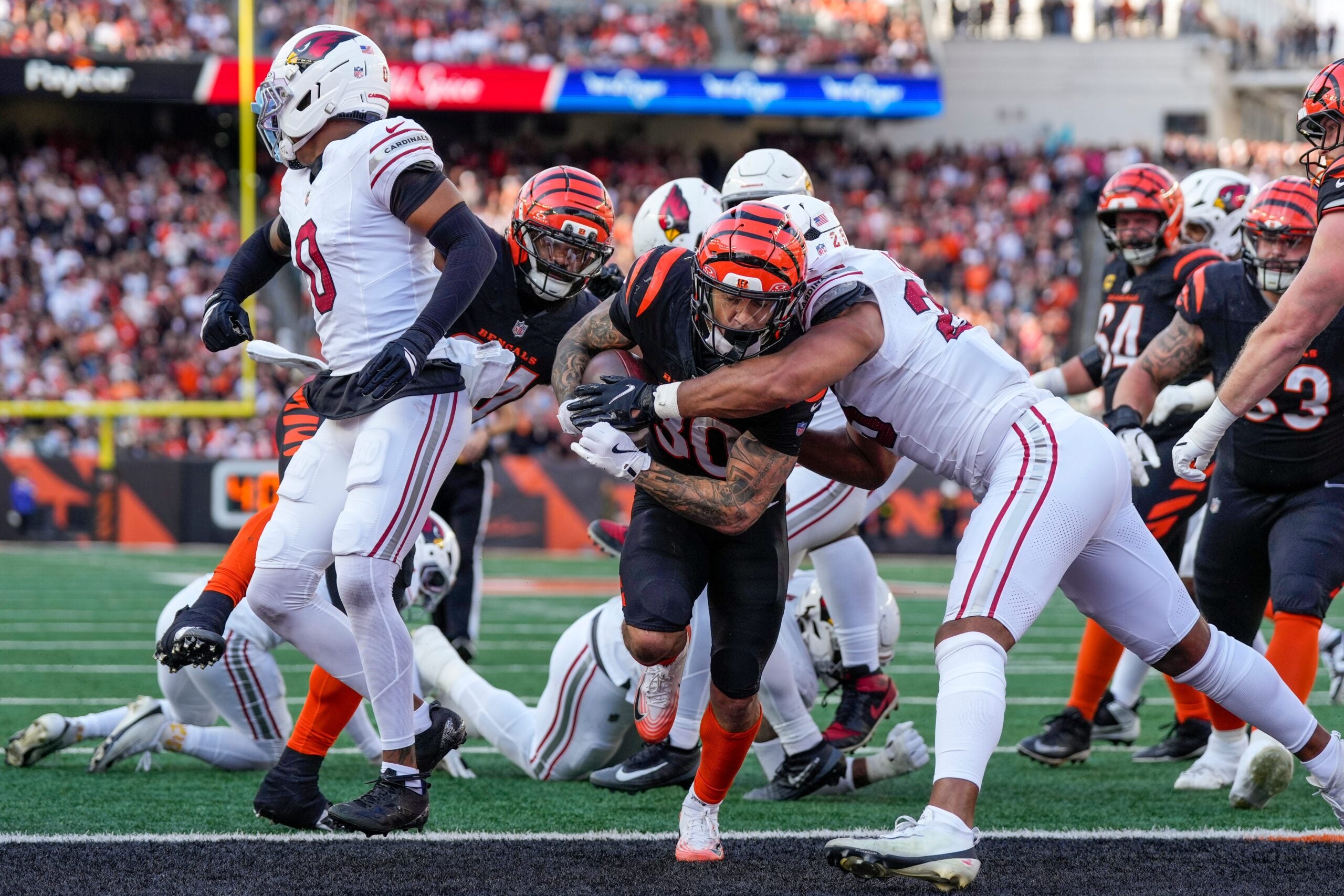
The Cincinnati Bengals face a decision on whether or not to extend the rookie contract of running back Chase Brown. The NFL’s evaluation of Brown suggests Cincinnati should proceed with caution.
Brown was left off ESPN’s top 10 running back rankings in its annual survey of over 70 executives, scouts, and coaches. Pro Football Focus ranked him 18th out of 32 starters.
Despite crossing the 1,000-yard mark for the first time in his career last season, Brown’s standing among NFL running backs is not where it needs to be for the Bengals to commit significant money to him going forward. Finding the happy medium is going to become crucial.
Chase Brown’s potential cost does not match his value
Brown fits well in the Bengals’ offense. He’s been a reliable starter for the last two seasons as Cincinnati has developed him nicely since selecting him in the fifth round of the 2023 NFL Draft.
Now that Brown enters a contract season, the issue lies in finding a reasonable number for an extension.
The RB market has recovered a bit in recent years, with seven players now making at least $14 million per year. Three of those deals were inked this offseason alone. Travis Etienne also signed for $12 million per year as a free agent back in March.
Spotrac’s market value for Brown is right in the middle between Etienne, and the $14 million threshold at $13.1 million per year. Based on how PFF metrics and NFL personnel view him, that figure feels like an overpay for Brown at this stage in his career.
Finding the right price for Brown
There’s a level below the $12-14 million range that looks perfect for the Bengals and Brown.
Dallas Cowboys RB Javonte Williams and Denver Broncos RB J.K. Dobbins both signed multi-year deals with an Average Annual Value (AAV) of $8 million. Williams, 26, is also coming off his first 1,000-yard campaign for the Cowboys. Dobbins has still yet to reach that milestone and is turning 28 later this year.
There’s a clear argument that Brown, who turned 26 in March, belongs right above the $8 million AAV mark. Somewhere between the $8-10 million range would put him outside the top-13 contracts, which better matches how he’s ranked across the league.
The smart path forward for the Bengals
If Cincinnati can get Brown on a value deal with a $10 million AAV or lower, that would match his value correctly. The Bengals are paying tens of millions every year to roster Joe Burrow, Ja’Marr Chase, and Tee Higgins. Those three are the important components of the offense, and paying a tailback too much per year on top of it would not be a wise use of resources.
There is a market for Brown, of course, just as there are alternative ways of replacing his production. That’s just how the running back position works in the NFL. Sure, there are special players like Atlanta Falcons running back Bijan Robinson, who may reset the position’s market here soon, but successful teams find effective backs in a multitude of ways. They are sometimes high draft picks. Most of them are mid-to-late round selections. Oftentimes they become affordable free agent signings.
Cincy proved it could find a capable back in Brown without investing significant resources. If Brown and the front office can’t come together on an extension prior to the regular season, letting him play out the final year of his rookie contract and exploring next year’s free agent market or draft class would give the Bengals flexibility to reinvest that money elsewhere.
