
ESPN’s harsh offseason grade for Bengals completely misses the point of the Dexter Lawrence trade
The Cincinnati Bengals did pay a hefty cost to trade for Dexter Lawrence. But is that enough to tank the Bengals’ entire offseason grade? Absolutely not.


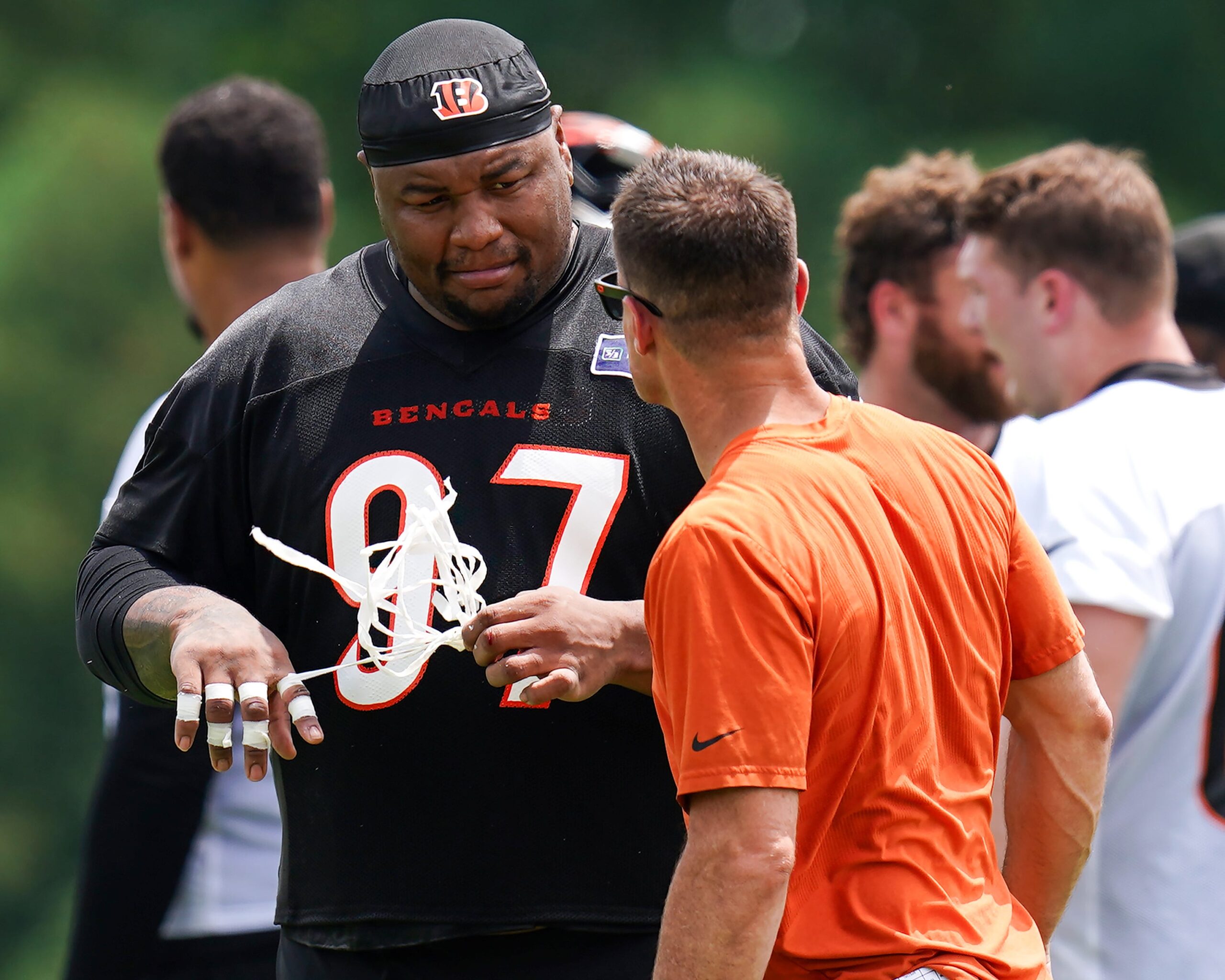
Trading for nose tackle Dexter Lawrence in exchange for the No. 10 pick in the 2026 NFL Draft was the biggest move made by the Cincinnati Bengals this offseason. ESPN’s Seth Walder agrees in his assessment of Cincinnati’s offseason, yet graded the club’s offseason a C, ranking it 27th among all 32 teams.
Walder tabbed the Lawrence trade as the move he disliked the most for the Bengals. He cited the cost of the No. 10 pick being too high for Lawrence following a relatively down year in terms of production.
The Bengals made a high-profile trade, sending the No. 10 pick to the Giants in exchange for Lawrence. The move was both uncharacteristic and unwise. Yes, Cincinnati needs to invest resources into its defense. But this was not the way to do it. Lawrence is a good player who has been elite in the past. But he is coming off a down season — just an 8.4% pass rush win rate and 0.5 sacks. There’s also a big difference between sending the No. 10 pick and, say, a late first-rounder. And that’s why this was too pricey a trade.
Seth walder
ESPN analytics
The problem with this assessment is it ignores the context of what made the trade possible, and the impact Lawrence is set to make as a member of Cincinnati’s new-look defense.
The context behind the Dexter Lawrence trade cost
The Bengals did pay a hefty cost for Lawrence. A top-10 pick is a top-10 pick at the end of the day. Before the trade materialized, Lawrence’s value appeared to sit around a late first-round pick. The Cleveland Browns and Los Angeles Chargers were reportedly in consideration as owners of picks in the early 20s. Cincinnati didn’t have a late first-rounder to offer as its next selection sat at No. 41, which was eventually used to take Cassius Howell.
Cincinnati has traditionally included pick-swaps in its trades. A swap involving the No. 10 pick and the Giants’ No. 37 pick in the second round could’ve brought the return value for Lawrence closer to that late first-round value.
We also have zero idea if that was ever something New York would’ve considered. The Bengals had to come up with first-round value, and their own first-rounder was their best bet. An alternative may not have existed.
Walder’s analysis treats the No. 10 overall pick in a vacuum, and also ignores how much the three-time Pro Bowler can elevate those around him.
Lawrence can have a DJ Reader impact for the Bengals’ defense
There’s a reason the Bengals’ first major free agent signing in franchise history was DJ Reader back in 2020. Cincinnati signed him to a four-year, $53 million deal, and it surprised a lot of people because Reader was one of the best free agents in that class. He also filled an immense need at nose tackle, and his impact on the defense when healthy was substantial.
Reader was a great player who was arguably the engine of Lou Anarumo’s defense. He commanded double teams, beat them with ease in the run game, and cleared space for linebackers Germaine Pratt and Logan Wilson behind him.
Lawrence, at his peak, even better than Reader. At 340 pounds, he can eat up space like few other noses can. The biggest difference is how effective he is rushing the passer. He has a case for being the best overall interior pass rusher in football because he doesn’t just beat individual blockers. He beats double teams at a rate that separates him from everyone else at the position. At 6-foot-4 and 340-350 pounds, he moves like a player 50 pounds lighter. He generates push in the pocket with natural power regardless of hand placement.
Lawrence’s sack production did dip last season, and while warrants some concern, he still won at a relatively high rate compared to other defensive tackles. When he’s healthy and playing close to his peak ability, everybody else on the defensive line is going to eat.
The trade should’ve only boosted the grade
I was underwhelmed by the Bengals’ offseason leading up to the Lawrence trade. Jonathan Allen, Bryan Cook, and Boye Mafe were quality additions, but the defense still needed something I didn’t think they were capable of finding. Lawrence became that missing piece.
Was I expecting Lawrence to be traded for a top-10 pick? No. If you look at him strictly as an individual coming off a down year by his standards, you could argue the price was steep. But is that enough to tank the Bengals’ entire offseason grade to a C? Absolutely not.
The Lawrence trade only elevated what the Bengals did this offseason. In a world where it didn’t happen, I struggle to imagine if their defense will be up to the task of making the improvements needed to return to postseason action.
